Skip to content

Welcome to the new

READ MORE
Not a member yet? Register now.
  • ABOUT
    • Leadership
    • Participation
    • Featured Sponsors
    • Submission Guidelines
    • Community
      • Volunteer
      • Badges
    • Contact Us
  • EXPLORE CTSNET
    • CARDIAC
    • THORACIC
    • CONGENITAL
    • Clinical Care Professionals
    • JANS
    • Events
    • Journals
  • Videos
    • Atlas of Cardiac Surgery
    • Webinars
    • Guest Interviews
    • Conference Sessions
  • Podcasts
    • The Beat With Joel Dunning
    • The Atrium
    • The Cardiac Recovery Room
    • The Lifeline
  • Profiles
    • Users Directory
    • Organizations
  • CAREERS
    • US Career Center
    • European Career Center
  • ABOUT
    • Leadership
    • Participation
    • Featured Sponsors
    • Submission Guidelines
    • Community
      • Volunteer
      • Badges
    • Contact Us
  • EXPLORE CTSNET
    • CARDIAC
    • THORACIC
    • CONGENITAL
    • Clinical Care Professionals
    • JANS
    • Events
    • Journals
  • Videos
    • Atlas of Cardiac Surgery
    • Webinars
    • Guest Interviews
    • Conference Sessions
  • Podcasts
    • The Beat With Joel Dunning
    • The Atrium
    • The Cardiac Recovery Room
    • The Lifeline
  • Profiles
    • Users Directory
    • Organizations
  • CAREERS
    • US Career Center
    • European Career Center
SUBMIT CONTENT
DONATE
JOIN

welcomes you to the new, improved website!

READ MORE
  • ABOUT
    • Leadership
    • Participation
    • Featured Sponsors
    • Submission Guidelines
    • Community
      • Volunteer
      • Badges
    • Contact Us
  • EXPLORE CTSNET
    • CARDIAC
    • THORACIC
    • CONGENITAL
    • Clinical Care Professionals
    • JANS
    • Events
    • Journals
  • Videos
    • Atlas of Cardiac Surgery
    • Webinars
    • Guest Interviews
    • Conference Sessions
  • Podcasts
    • The Beat With Joel Dunning
    • The Atrium
    • The Cardiac Recovery Room
    • The Lifeline
  • Profiles
    • Users Directory
    • Organizations
  • CAREERS
    • US Career Center
    • European Career Center
Not a member yet? Register now.
  • ABOUT
    • Leadership
    • Participation
    • Featured Sponsors
    • Submission Guidelines
    • Community
      • Volunteer
      • Badges
    • Contact Us
  • EXPLORE CTSNET
    • CARDIAC
    • THORACIC
    • CONGENITAL
    • Clinical Care Professionals
    • JANS
    • Events
    • Journals
  • Videos
    • Atlas of Cardiac Surgery
    • Webinars
    • Guest Interviews
    • Conference Sessions
  • Podcasts
    • The Beat With Joel Dunning
    • The Atrium
    • The Cardiac Recovery Room
    • The Lifeline
  • Profiles
    • Users Directory
    • Organizations
  • CAREERS
    • US Career Center
    • European Career Center
  • ABOUT
    • Leadership
    • Participation
    • Featured Sponsors
    • Submission Guidelines
    • Community
      • Volunteer
      • Badges
    • Contact Us
  • EXPLORE CTSNET
    • CARDIAC
    • THORACIC
    • CONGENITAL
    • Clinical Care Professionals
    • JANS
    • Events
    • Journals
  • Videos
    • Atlas of Cardiac Surgery
    • Webinars
    • Guest Interviews
    • Conference Sessions
  • Podcasts
    • The Beat With Joel Dunning
    • The Atrium
    • The Cardiac Recovery Room
    • The Lifeline
  • Profiles
    • Users Directory
    • Organizations
  • CAREERS
    • US Career Center
    • European Career Center
SUBMIT CONTENT
DONATE
JOIN
You are here:
  1. Esophagus

Quick Tips and Tricks for Robot-Assisted Esophagectomy: Ivor Lewis and McKeown

  • July 8, 2019

By: Anya Kalsbeek, Frans van Wagenberg, Kayla Maaraoui, Kemp Kernstine

Keywords:

  • Thoracic
  • Esophagus, Robotic & Endoscopic Cardiac

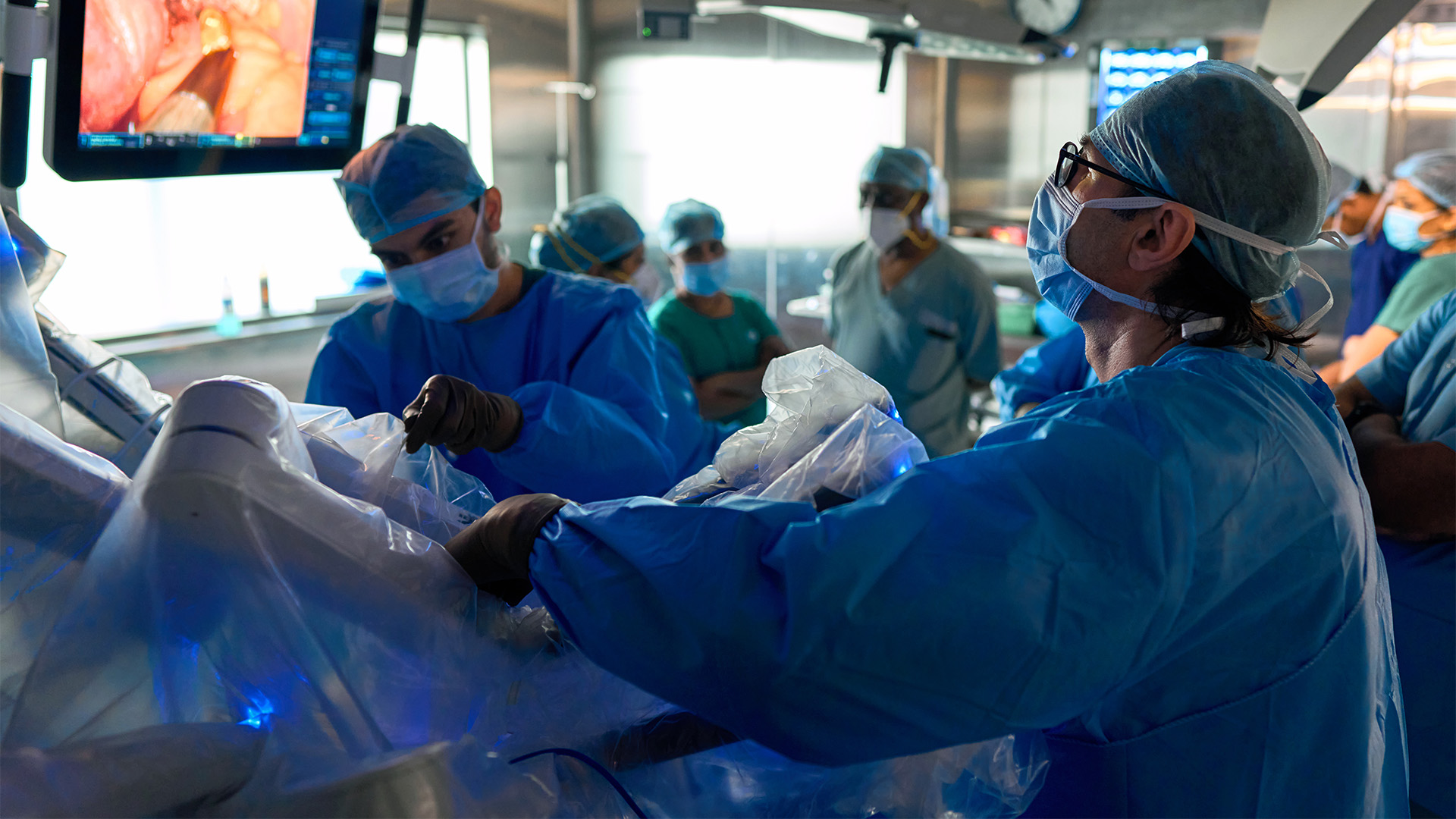
This video demonstrates the common pitfalls of robot-assisted esophagectomy and presents tips and techniques to performing the Ivor Lewis and McKeown procedures.

To begin making the conduit, it is advisable to begin at the lesser curvature and to use a 4.0 cm silk tie in order to gauge the width of the conduit—this helps to avoid creating a conduit that is either too narrow, too wide, or uneven.  Using a 45 mm staple load, rather than a 60 mm load, affords better control over the length of the conduit, and it assists with maintaining consistent width. This size staple load also allows the surgeon to stretch the conduit and maximize the number of stapler firings, which helps to achieve full conduit length in the neck.

When pulling the conduit and specimen into the chest, two figure-of-eight sutures can be used to prevent any twisting along a singular suture line; this style of suture also helps prevents tears in the tissue and provides added stability as the conduit and specimen are pulled through the diaphragm.

Rather than performing a pyloroplasty, injection of the pylorus with Botox provides similar results. Using a 20 gauge mediastinoscopy aspirating needle affixed to a 5 ml syringe, injection of 100 units of Botox mixed with 4 ml of saline is performed, using 1 ml in each quadrant. It is important to create a wheal in the muscular part of the pylorus at each point and avoid injecting any vessels.

The Kocher maneuver is avoided in this procedure, as it may cause pyloric dysfunction and may facilitate bile reflux.

Placing two marking sutures on the conduit before pulling it up into the chest can help gauge how much of the conduit has been pulled into the chest, as oftentimes it can be misleading how much has been pulled through and how much remains below the diaphragm.

After moving into the chest and dissecting the esophagus, ligation of the azygos vein is performed for two reasons:

  1. Often the anastomosis is in this area, and ligating the azygos gives the surgeon a better view.
  2. Additionally, if the azygous becomes engorged, it could cause pressure on the conduit or the anastomosis.

As the specimen is pulled up, avoid twisting of the conduit by ensuring that the staple line on the conduit is facing toward the screen. Note that this will only prevent 180 degree twisting, and not 360 degree twisting.

Once the conduit is in the chest, avoid grasping it with the Cadiere graspers or ProGrasp™ forceps as these can cause traumatic injury.

There are several ways to pull up the conduit:

  1. Using the lead point of the conduit to pull;
  2. Using a Forrester Ring Clamp or Landreneau Ring Clamp;
  3. Using 2 ProGrasps as seen in the video; or
  4. Rolling up surgicel as a buffer to prevent any traumatic tearing of the conduit.

After incising the esophagus, a Foley catheter with about 30 ml of water can be inserted to dilate the lumen of the esophagus so that it can more easily take the 29 mm anvil. The Foley can also be used to gauge what size of anvil the esophagus will take.

A 3-0 Prolene® on an SH needle is used to baseball stitch the mucosa and submucosa and provide a purse string around the anvil.  A second concentric purse string of the same suture about 5 mm away from the initial one is placed to help secure the anvil in the proximal esophagus. The authors avoid taking too much tissue with wide bites, as this can result in misfiring of the EEA.

After creating the anastomosis, wrapping it with a pedicle of omentum can promote healing and help control any kind of leakage if a leak were to occur. The authors then secure the anastomosis to the pleura to prevent any excessive movement. Finally, they use a suture to tighten the crura where the conduit emerges from the diaphragm in order to prevent any hiatal hernia from occurring. The thoracic duct is often ligated with a large stitch at this time with as well.

Add Comments Cancel reply

You must be logged in to post a comment.

Not a member yet? Register now.
YouTube 6.8K views on YouTube
1005 views
269 downloads

CITATION

van Wagenberg F, Maaraoui K, Kalsbeek A, Kernstine K. Quick Tips and Tricks for Robot-Assisted Esophagectomy: Ivor Lewis and McKeown. July 2019. doi:10.25373/ctsnet.8428886.
DOI https://doi.org/10.25373/ctsnet.8428886
TAGS
  • Esophagus - Cancer
  • Robotic Thoracic Surgery

Related Content

233 S. Wacker Drive | Suite 4400
Chicago, Illinois 60606, USA

Linkedin X-twitter Facebook-f Youtube
  • Join CTSNet
  • Donate
  • Submit Content
  • Volunteer
  • Join CTSNet
  • Donate
  • Submit Content
  • Volunteer
  • Featured Partners
  • Careers
  • Press
  • Advertise on CTSNet
  • Featured Partners
  • Careers
  • Press
  • Advertise on CTSNet
  • CTSNet Policies
  • Privacy Policy
  • Disclaimer
  • Contact CTSNet
  • CTSNet Policies
  • Privacy Policy
  • Disclaimer
  • Contact CTSNet

233 S. Wacker Drive | Suite 4400
Chicago, Illinois 60606, USA

Instagram Linkedin X-twitter Facebook-f Youtube
  • Join CTSNet
  • Donate
  • Submit Content
  • Volunteer
  • Join CTSNet
  • Donate
  • Submit Content
  • Volunteer
  • Featured Partners
  • Careers
  • Press
  • Advertise on CTSNet
  • Featured Partners
  • Careers
  • Press
  • Advertise on CTSNet
  • CTSNet Policies
  • Privacy Policy
  • Disclaimer
  • Contact CTSNet
  • CTSNet Policies
  • Privacy Policy
  • Disclaimer
  • Contact CTSNet

233 S. Wacker Drive | Suite 4400
Chicago, Illinois 60606, USA

Instagram Linkedin X-twitter Facebook-f Youtube
  • Join CTSNet
  • Donate
  • Submit Content
  • Volunteer
  • CTSNet Policies
  • Privacy Policy
  • Join CTSNet
  • Donate
  • Submit Content
  • Volunteer
  • CTSNet Policies
  • Privacy Policy
  • Featured Partners
  • Careers
  • Press
  • Advertise on CTSNet
  • Disclaimer
  • Contact CTSNet
  • Featured Partners
  • Careers
  • Press
  • Advertise on CTSNet
  • Disclaimer
  • Contact CTSNet
  • Join CTSNet
  • Donate
  • Submit Content
  • Volunteer
  • Join CTSNet
  • Donate
  • Submit Content
  • Volunteer
  • Featured Partners
  • Careers
  • Press
  • Advertise on CTSNet
  • Featured Partners
  • Careers
  • Press
  • Advertise on CTSNet
  • CTSNet Policies
  • Privacy Policy
  • Disclaimer
  • Contact CTSNet
  • CTSNet Policies
  • Privacy Policy
  • Disclaimer
  • Contact CTSNet
© 2026 CTSNet Inc. All right reserved.
Go to Top