As results of the SYNTAX trial comparing PCI and CABG surgery for treatment of de novo triple vessel and/or left main coronary artery disease are published, CABG surgery is enjoying renewed attention. However the preferred internal mammary artery (IMA) grafts are avoided for many reasons among which include: their finite length, risk of sternal infection, increased technical and time demands, perceived inadequate regional flow for a specific coronary bed or lack of belief in the evidence to date supporting the use of multiple mammary artery grafts. Many of these issues can be overcome, with use of the skeletonization harvest technique of the IMA, skeletonization produces longer conduits (1 Gurevitch) and decreases the risk of DSWI by preserving three of the 6 types of collateral blood supply of the sternum. (2 DeJesus)
However, skeletonization also has issues: the procedure is more time-consuming than the standard pedicle technique and there is fear of damage to the mammary when harvested directly without its cushion of veins, fascia and muscle.
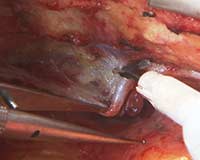
Use of the harmonic hook blade to skeletonize the internal mammary artery addresses these two factors: it is quicker than skeletonization with the cautery tip used as a dissector and much less damaging to the IMA; this video shows the technique of skeletonization of the IMA with the harmonic hook blade.
After clearing the pleura from the undersurface of the chest wall, without entering the thoracic cavity if possible, and insertion of the retractor of choice to harvest the mammary artery, the first step is to incise the fascia overlying the mammary artery with Metzenbaum scissors. This incision is made in the crevice between the medial mammary vein and the IMA itself, so that there will be no “over-hang” of tissue precluding complete view of the IMA, along its entire length during the course of the dissection.
The safest start point is the caudal end of the IMA near the level of the xiphisternum, but it may not always be visible here, hidden by muscle or fascia. The IMA is usually easily seen about 1/3 of the distance up from the caudal end and if one draws an imaginary horizontal line from where the mammary is seen, to a point at the end of the sternum, incising over this imaginary line will expose the mammary artery more than 90% of the time; inadvertent damage at this level is usually inconsequential.
Before use, the harmonic hook blade should be positioned for ideal length and orientation: to proceed from right to left as in harvest of the left mammary, the hook part faces opposite to the direction of harvest. In this procedure the blunt edge of the harmonic is used primarily, the hook side is rarely used.
The mammary artery is first bared over a small area without power to identify its borders. One can hold the mammary by the adventitia with delicate forceps, such as ringed forceps without fear of damage. Then using the harmonic hook blade on low power of 2 (of a possible 5), one “paints” the mammary artery in a sweeping motion with the non-hook side of the harmonic. The mammary artery can actually be “touched” briefly with this “painting” technique without fear of thermal damage. As long as one does not “dwell” on a part of the mammary, the tissues adherent to the mammary will part “like the red sea” and quickly expose the branches. Thermal dispersion of the harmonic is much less than that of traditional electrocautery; significant heat damage does not begin until after 3 seconds of harmonic blade contact. (3 Amaral)
When coming to a branch, it is easiest if one isolates the branch on either side, so as to expose the exact width of the branch one is dealing with. Then using the forceps prongs on either side of the branch, and simultaneously depressing the mammary so as to lengthen the branch, the blunt end of the harmonic hook is used to “sit on” the branch, at least 1 mm away from the mammary but at the same time not touching the mammary veins, until the branch turns white, or black and then breaks naturally with the gentle pressure of the blunt end of the hook. One quickly “learns” the tissues of a patient; sometimes only very gentle traction on the branch will result in tearing of the branch or an adventitial hematoma, but if one is still at the distal end of the mammary, no harm is usually done. I try to resist the temptation to go faster by using the hook to cut the branch when I feel it MUST be cooked, I am usually wrong and have to place a clip on an otherwise clip-less IMA harvest. This raises a frequently asked question: do the harmonically sealed branches ever reopen resulting in the requirement of reoperation for bleeding? The answer is: in 8 years, for 815 patients with 1363 harmonically skeletonized mammary arteries – NO. If a branch is to bleed, it will have done so before the end of the case.
Additional advantages of using the harmonic to skeletonize the mammary artery render it relatively “clip-less”. One can be absolutely sure that wherever one goes to perform a side-to-side anastomosis of a sequential graft, there will be a clip. Or clips will be near the anastomosis and get caught by the suture. Additionally, when the mammary artery dilates (relief of spasm due to manipulation) when one has clipped a branch believed to be far away from the mammary, with artery dilatation, the IMA expands to “envelop” the clip, leaving a “dimpling” on the mammary surface. With use of the harmonic, one only sees little branch stumps sticking out of a beautifully smooth IMA.
Damage to a mammary artery when skeletonized with the harmonic rarely occurs. In this author’s experience with the traditional skeletonization technique, an average of 1/20 arteries were damaged, whereas when skeletonizing with the harmonic 0.4% representing 6 of 1363 IMAs were damaged beyond the point of any use. It is the author’s surmise that these IMAs were not actually damaged by the harmonic harvest, but rather this technique allows harvesting of these excessively fragile arteries to be taken down intact: their excessive fragility coming to light, only upon initial use to perform distal anastomoses. Possibly, the “dividing” of tissues by the harmonic rather than the “dragging” of tissues by the cautery tip contributes to decreased injury.
The “smoke” one sees in this video is in fact not smoke, but steam. This steam does not carry airborne particles that can be inhaled, as with smoke from traditional electrocautery- a very important factor when surgeons of other specialties operate on cancers. (4 O’Grady)
This technique of skeletonization with a little practice becomes quicker than the cautery tip method dissection – usually taking 15-18 minutes/mammary. If one has never skeletonized before, the learning curve reaches 80% comfort level after approximately 20 mammaries, if the technique of skeletonization is already known, probably 10 dissections will afford the same level of comfort.
There can be difficult dissections with the harmonic: in particular patients with a bleeding tendency due to Plavix or heparin on board, or fragile elderly tissues, mammary harvest can be tedious and frustrating. When bleeding occurs from a branch, the harmonic cannot “coagulate” this branch without damage to the artery, necessitating the use of a clip.
Finally, when checking the mammary bed for bleeding at the end of the case, you will note the lack of “char”; in fact at times it will appear as if you were never there, the only sign is a missing mammary. Although not proven, this lack of necrotic tissue can only help toward minimization of infection.
To summarize, it is this author’s view: 1) Skeletonization of the mammary artery with the harmonic hook blade is a precise and efficient method to harvest the mammary artery. 2) Because fewer clips are needed, use of the harmonic facilitates arterial grafting and allows easier performance of sequential bypasses. And finally, skeletonization of the mammary artery with the harmonic hook blade rarely damages the artery and is the most atraumatic and refined way, to harvest this most important artery.
References
- Gurevitch J, Kramer A, Locker C, Shapira I, Paz Y, Matsa M, Mohr R. Technical aspects of double-skeletonized internal mammary artery grafting. Ann Thorac Surg 2000;69:841-846
- De Jesus R, Acland RD. Anatomic study of the collateral blood supply of the sternum. Ann Thorac Surg 1995;59:163-168
- Amal JF, Chrostek CA Abstract on Lateral Thermal Spread of Monopolar RF Energy vs Harmonic
- O’Grady KF, Easty AC. Electrosurgery Smoke: hazards and protection. J Clin Eng. 1996 Mar-Apr;21(2):149-55