Adapting Global Innovations to Local Realities: Advancing Pediatric Cardiac Surgery in Pakistan—Lessons From Austria [1]

Background
In a field where precision saves lives and innovation shapes futures, every opportunity to learn globally becomes a responsibility to act locally. As a pediatric cardiac surgeon trained in Pakistan, I have long worked in a resource-limited, high-volume environment where each intervention carries immense weight—not just for a child’s survival, but for a family’s hope.
In 2024, I had the privilege of undertaking three months of the Marc R. de Leval Fellowship in Pediatric Cardiac Surgery at the Medical University of Vienna, Austria—a center globally recognized for its surgical excellence, innovation, and structured care delivery. This immersive experience offered more than clinical exposure; it provided a lens through which I could reimagine what congenital cardiac care might look like in South Asia.
This article shares key contrasts between the European and South Asian models of care, highlights the innovative systems witnessed, and outlines a realistic vision for transforming congenital cardiac surgery in resource-constrained environments—one inspired by collaboration, adaptability, and purpose-driven change.
A Glimpse Into the Austrian Surgical System: Contrasts in Practice and Culture
The transition from the National Institute of Cardiovascular Diseases (NICVD) in Karachi—one of the busiest free-of-cost cardiac centers in the world—to the Medical University of Vienna revealed striking contrasts, not only in resources and infrastructure but also in how systems are designed to support precision, learning, and sustainable care.
Workflow and Operating Room Culture
In Vienna, every surgical step felt choreographed. The operating room culture emphasized preoperative planning, structured time-outs, meticulous documentation, and consistent adherence to protocols. There was a calm, unhurried tempo—not due to lack of urgency, but because systems were optimized to prevent chaos.
In contrast, at the National Institute of Cardiovascular Diseases (NICVD), the sheer patient volume often necessitates rapid turnover and improvisation. While the commitment to patient care is no less intense, the environment demands resilience and adaptive decision-making under pressure. The challenge lies in balancing speed with safety, often without the luxury of advanced logistics or support systems.
Technological Access and Innovation
One of the most prominent differences was access to technology. Vienna’s surgical teams utilized 3D printing for preoperative modeling in complex cases, intraoperative transesophageal echocardiography as a routine step, and hybrid operating rooms that seamlessly combined catheter-based and open surgical approaches. Simulation-based training was built into surgical education, allowing residents and fellows to refine their skills before performing on patients.
At the National Institute of Cardiovascular Diseases (NICVD), while basic surgical tools and imaging modalities are available, high-end adjuncts such as real-time modeling, intraoperative continuous imaging, and hybrid setups remain scarce. This underscores the importance of innovation not just as technology adoption, but as a mindset—finding ways to adapt global solutions into low-cost, context-specific models.
Team Dynamics and Interdisciplinary Communication
In Vienna, interdisciplinary care was deeply embedded. Daily rounds included anesthetists, intensivists, nurses, perfusionists, and surgeons, all contributing equally to the care pathway. Morbidity and mortality reviews were nonpunitive and data-driven, serving as educational tools for continuous improvement.
At the National Institute of Cardiovascular Diseases (NICVD), team cohesion exists but often operates under informal structures. Interdisciplinary meetings are less frequent, and systematic feedback loops are underdeveloped. The experience in Vienna highlighted how institutional culture—not just individual skill—influences outcomes.
Documentation, Audit, and Data Utilization
The Austrian system placed heavy emphasis on documentation, registry entry, and outcome tracking. Every case contributed to institutional and national databases—a cornerstone for quality improvement and research.
In South Asia, data collection is still evolving. Despite the high volume of complex cases, structured databases and audit frameworks are limited. There is tremendous potential to leverage this volume for academic and clinical insight if data systems are prioritized and standardized.
Innovations and Practices That Stood Out
While excellence in surgery rests on skill and decision-making, what struck me in Vienna was how innovation permeated not just the operating room, but the entire ecosystem of care. These innovations weren’t always about cutting-edge technology—often, they were about process, culture, and systems thinking.
Preoperative 3D Modeling and Simulation
For complex congenital heart defects—such as double outlet right ventricle or complex pulmonary atresia—the team regularly used 3D-printed cardiac models to plan surgical strategies. This tangible, anatomical preview allowed for safer surgeries and better intraoperative orientation, especially in borderline or rare anatomies. Moreover, simulation labs equipped with pediatric heart models enabled residents and fellows to practice surgical techniques before live patient exposure.
This technology could be a game-changer for centers such as the National Institute of Cardiovascular Diseases (NICVD). Even basic simulation models or virtual planning software could significantly enhance training and reduce intraoperative surprises.
Structured Surgical Training Pathways
Training in Vienna was structured, stepwise, and competency-driven. Clear milestones, supervised progression, and feedback mechanisms were in place. Simulation was used not only to develop dexterity, but also to assess readiness before moving to more complex tasks.
In contrast, South Asian systems often rely on an apprenticeship model with variable exposure. Creating structured curricula with simulation-based milestones could enhance surgical safety and accelerate the development of independent surgeons.
Hybrid Operating Rooms
Hybrid operating rooms where surgical and intervention cardiology teams work together in real time allowed for staged or combined procedures (e.g., device closure followed by surgical repair, or pulmonary valve replacement post-conduit stenting). This integrated approach optimized patient outcomes and reduced hospital stays.
While costly, the hybrid concept could be adapted at the National Institute of Cardiovascular Diseases (NICVD) through tighter collaboration between the catheterization lab and surgical teams, even without a shared space—creating a “hybrid workflow” if not a hybrid room.
Digital Audit and Continuous Quality Improvement (CQI)
In Vienna, every complication, delay, or unplanned reintervention was documented and analyzed. The culture encouraged asking “What can we learn?” rather than “Who is to blame?” Dashboards tracked infection rates, surgical site events, and readmissions, fostering transparency and accountability.
The National Institute of Cardiovascular Diseases (NICVD), with its enormous caseload, could benefit immensely from similar continuous quality improvement (CQI) models. Even basic electronic tracking of key outcomes—mortality, infection, and reintervention—could lay the groundwork for a national pediatric cardiac registry and enable outcome-driven improvement.
Patient- and Family-Centered Care
A subtle but profound shift was the consistent inclusion of families in the care journey—from preoperative counseling with diagrams and models to postoperative recovery education. This approach improved compliance, reduced anxiety, and built trust.
In our setting, where literacy and resources vary widely, investing time in family education—even through simple visual tools or group counseling—could bridge the information gap and empower caregivers.
Reflection: Translating Global Excellence to the Pakistani Landscape
As I return to Pakistan, I carry with me more than surgical memories—I bring a vision shaped by systems of safety, precision, and humanity. What I witnessed in Austria is not just aspirational; it’s adaptable. Many of the practices I observed can be translated into the Pakistani healthcare context with creativity, collaboration, and incremental implementation.
ECMO: Building a Culture of Postoperative Support
Assisting in extracorporeal membrane oxygenation (ECMO) management in Vienna was a turning point for me. It highlighted how critical postoperative mechanical circulatory support can be—not as a desperate last resort, but as a planned, proactive tool in managing complex congenital cases or postoperative cardiopulmonary failure.
In Pakistan, ECMO use in pediatric cardiac surgery is rare and often underutilized due to costs and lack of trained staff. However, establishing ECMO awareness programs, designating “ECMO champions” within ICU teams, and initiating small-scale support protocols for high-risk cases could pave the way for gradual integration. We must move from fear to familiarity with this life-saving modality.
Infection Control: A Culture of Conscious Detail
One of the most immediate and striking differences I noted was in infection control practices—from the consistent use of double-layer draping and routine pyodine skin preparation to the strict no-touch protocols during gowning and gloving. Surgical staff assisted each other in donning sterile attire, ensuring no breaks in barrier integrity—not out of formality, but out of mutual respect for patient safety.
At the National Institute of Cardiovascular Diseases (NICVD) and similar centers in Pakistan, we often find ourselves battling resource constraints and time pressures. However, these practices require little to no cost—only a shift in discipline and accountability. Reinforcing the importance of sterile rituals through daily reminders, team huddles, and modeling by senior staff could significantly reduce surgical site infections in pediatric patients.
Respectful OR Culture: Safety Starts with Teamwork
A small, yet telling detail: In Vienna, scrub nurses gently corrected any breaks in sterility, junior staff were encouraged to speak up, and the operating room (OR) ran on mutual respect rather than hierarchy. Helping each other with gloves or adjusting masks wasn’t seen as menial, but as part of shared responsibility.
Implementing a similar culture of professionalism and humility in Pakistani operation theaters can reduce stress, improve safety, and encourage learning. Surgical leadership must model this culture in which every member—from technician to consultant—is part of the same life-saving mission.
Embracing Minimally Invasive Techniques
I had the opportunity to observe and assist in muscle-sparing thoracotomies, particularly in selected pediatric cases where cosmetic and recovery outcomes are important. These techniques preserved chest wall musculature, reduced postoperative pain, and offered faster recovery without compromising access or safety.
While full sternotomy remains the standard in many Pakistani centers, there is a growing case for minimally invasive approaches in selected congenital pathologies. By initiating workshops, cadaveric training, and case-based learning, we can build local capacity and patient trust in such approaches—especially for atrial septal defect closures or vascular ring divisions.
A Call to Adapt, Not Just Adopt: Lessons from Austria
In Vienna, I was impressed by the emphasis on precision, safety protocols, and system-level refinements. Early extubation protocols, structured postoperative care, advanced imaging modalities, and simulation-based training all stood out as practices that could improve outcomes if adapted in Pakistan. The environment encouraged open communication among surgeons, anesthetists, perfusionists, and nurses, creating a culture where every team member’s voice was valued.
However, the European system is not without challenges. The strict protocols can limit flexibility in decision-making, and the lower case volume means fewer opportunities for rapid hands-on experience compared to developing countries. Additionally, the complexity of cases is often less pronounced due to earlier diagnoses and interventions, unlike in Pakistan, where patients frequently present late with advanced pathology.
What We Do Well in Pakistan
Returning to the National Institute of Cardiovascular Diseases (NICVD) in Karachi, I recognized the immense strengths of our local system. Despite resource limitations, NICVD handles a very high volume of pediatric and adult cardiac cases, often involving rare and complex pathologies. This high caseload allows surgeons to develop technical expertise and decision-making skills quickly—an advantage that many high-resource systems lack.
Additionally, our model of providing free-of-cost treatment ensures access to life-saving surgeries for all patients, regardless of socioeconomic status. More than 2.3 million patients are treated completely free or charge each year within the entire National Institute of Cardiovascular Diseases NICVD network. The dedication, resilience, and adaptability of local teams are strengths that must be celebrated.
Bridging Two Worlds
International training is most impactful when the best elements of both systems are combined. From Austria, I aim to bring structured data collection, quality-improvement initiatives, and team-based simulations. From Pakistan, I carry forward resourcefulness, adaptability, and the ability to handle high case volumes with efficiency.
The goal is not to replace one system with another but to blend them in a way that enhances patient care and builds sustainable surgical programs in developing countries.
Conclusion
My time in Vienna was transformative, but it also deepened my pride in what we achieve in Pakistan despite our challenges. Both systems offer unique lessons: Austria’s structured, technology-driven care and Pakistan’s high-volume, hands-on expertise complement each other. The future of pediatric cardiac surgery in our region lies in this synergy—adapting global best practices while leveraging our own strengths to achieve better outcomes for every patient.
Conflicts of Interest
The author declares no conflicts of interest.
Funding
This international fellowship was supported in part by the American Association of Thoracic Surgeons (AATS) Marc R. de Leval Fellowship Award.Shape
Acknowledgments
I am deeply grateful to Professor Dr. Daniel Zimpfer, Professor Dr. Sohail Bangash, and the team at the Medical University of Vienna for their mentorship and openness. I also thank the faculty at the National Institute of Cardiovascular Diseases (NICVD) for their continued guidance and encouragement to pursue global learning. I am thankful to the American Association of Thoracic Surgeons for their support: “A surgeon saves one life, but the AATS saves millions, training countless surgeons who go on to change lives globally.”
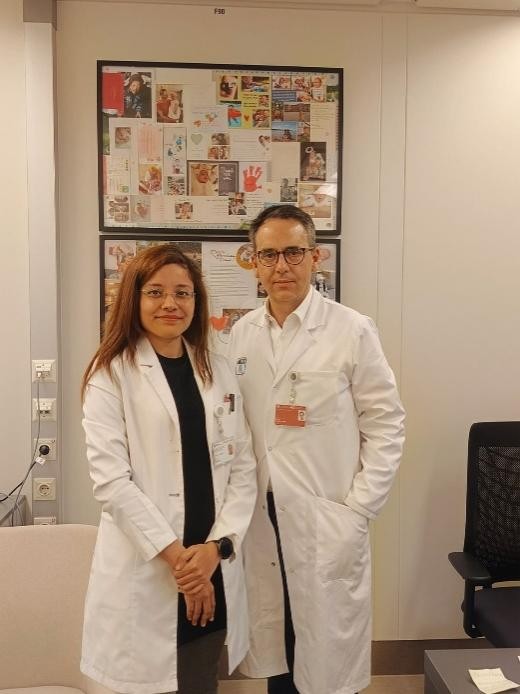
Figure 1: In this photograph, Dr. Daniel Zimpfer and I stand together in front of a wall adorned with framed images of the babies on whom he has operated. These portraits symbolize the many lives touched by his skill and compassion in pediatric cardiac surgery.
Declaration of Generative AI and AI-Assisted Technologies in the Writing Process
Statement: During preparation of this work, the author used ChatGPT by OpenAI to assist with structuring the manuscript, improving clarity, and generating initial drafts based on the author’s personal experiences and clinical insights. After using this tool, the author reviewed and edited the content as needed and takes full responsibility for the content of the publication.
References
- Bartlett, R. H., Gazzaniga, A., & Zwischenberger, J. B. (2009). Extracorporeal membrane oxygenation: A review of contemporary applications in pediatric cardiac surgery. Journal of Thoracic and Cardiovascular Surgery, 138(3), 507-514. https://doi.org/10.1016/j.jtcvs.2009.06.003 [3]
- Makaryus, A. N., & D'Alessandro, A. (2017). Extracorporeal membrane oxygenation in pediatric cardiac surgery: An overview. Pediatric Cardiology, 38(6), 1252-1261. https://doi.org/10.1007/s00246-017-1689-x [4]
- Morine, M. J., & Delosh, D. (2013). Pediatric ECMO: A lifesaving modality in pediatric cardiac surgery. Cardiothoracic Surgery Clinics of North America, 22(4), 467-474. https://doi.org/10.1016/j.cstc.2013.08.007 [5]
- Seethala, R., & Kuzmiak, M. (2017). Hybrid operating room: A new paradigm in congenital heart surgery. Journal of Cardiothoracic Surgery, 12(1), 28. https://doi.org/10.1186/s13019-017-0632-9 [6]
- O’Neill, M., & Cooper, M. (2015). The role of hybrid ORs in pediatric cardiac surgery. Journal of Pediatric Surgery, 50(6), 1005-1010. https://doi.org/10.1016/j.jpedsurg.2015.03.001 [7]
- Viskovska, M., & Stanczak, P. (2015). Infection prevention in pediatric cardiac surgery: Standard protocols and beyond. Pediatric Cardiology, 36(2), 465-472. https://doi.org/10.1007/s00246-015-1150-3 [8]
- Jørgensen, H. M., & Tidemann, M. (2012). The importance of draping and sterility in cardiac surgery: A comparative study. European Journal of Cardiothoracic Surgery, 41(4), 814-818. https://doi.org/10.1093/ejcts/ezs372 [9]
- Martin, J. A., & St. John, J. (2014). Simulation in cardiac surgery: Current applications and future potential. Annals of Cardiothoracic Surgery, 3(5), 449-456. https://doi.org/10.3978/j.issn.2225-319X.2014.10.02 [10]
- O'Neill, P., & Thomas, A. (2018). Training in pediatric cardiac surgery: The role of simulation and practice. Journal of Surgical Education, 75(5), 1180-1187. https://doi.org/10.1016/j.jsurg.2018.02.018 [11]
- Guy, T. S., & Dinsmore, J. A. (2019). Muscle-sparing thoracotomy in pediatric cardiac surgery: A minimally invasive approach to improve recovery. Journal of Thoracic and Cardiovascular Surgery, 158(1), 214-220. https://doi.org/10.1016/j.jtcvs.2019.01.061 [12]
- Brown, A. M., & Ferrer, J. A. (2017). Minimally invasive surgery in pediatric cardiac surgery: Trends and benefits. Pediatric Surgery International, 33(8), 835-841. https://doi.org/10.1007/s00383-017-4094-6 [13]
- Jacobs, J. P., & Mavroudis, C. (2015). National registries and outcome tracking in pediatric cardiac surgery: A step toward global best practices. Journal of Thoracic and Cardiovascular Surgery, 150(1), 25-30. https://doi.org/10.1016/j.jtcvs.2015.02.045 [14]
- Bricker, J. T., & Watterson, J. (2016). Outcome improvement in pediatric cardiac surgery: Building a culture of continuous quality improvement. Annals of Pediatric Surgery, 12(3), 123-129. https://doi.org/10.1016/j.apsu.2016.06.004 [15]
Disclaimer
The information and views presented on CTSNet.org represent the views of the authors and contributors of the material and not of CTSNet. Please review our full disclaimer page here. [16]