



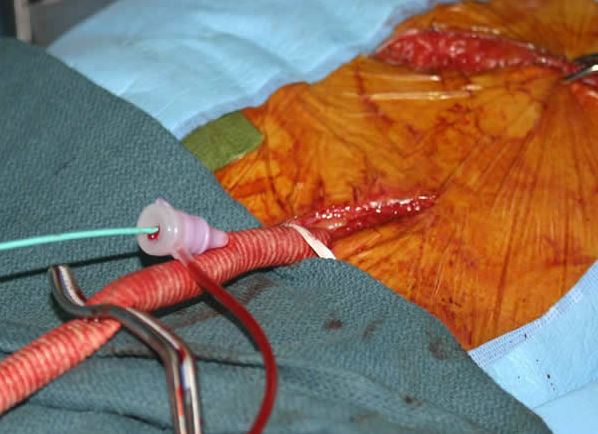

Introduction Whether diagnostic or interventional, catheters and other endovascular devices are rarely sufficiently maneuverable to be used without guidewires. The purpose of guidewires is to create a pathway in the vascular system through which the...
Introduction “Diagnostic” catheters allow the endoluminal practitioner to assess areas of the vascular system and to evaluate for a possible intervention; additionally, they assist in performing an intervention. This often...
Introduction Balloon catheters have two principal applications in peripheral endoluminal procedures. Therapeutic or angioplasty ballooning is the forceful inflation of a balloon to dilate stenotic/occlusive lesions in a vessel. This...
Patient Selection Indications for endovascular repair of the abdominal aortic aneurysm are: Patients with asymptomatic abdominal aortic aneurysm greater than 5 cm in an orthogonal projection or larger than twice...
Patient Selection Indications for endovascular repair of the thoracic aortic aneurysm (Figure 1) are: Figure 1: The three-dimension reconstruction (Medical Metrx Solutions, West Lebanon, NH) off the aortic-centerline from a...
Patient Selection Indications for endovascular repair of the thoracic aortic aneurysm (Figure 1) are: Figure 1: The three-dimension reconstruction (Medical Metrx Solutions, West Lebanon, NH) off the aortic-centerline from a...

Patient Selection Indications for endovascular repair of the iliac artery are: Stenosis or (short-segment) occlusion of iliac artery (TASC type A and B, TASC C lesions are controversial) with ipsilateral...