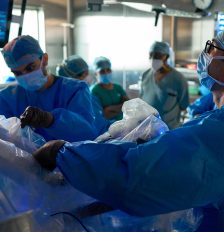
This single-center retrospective study examined 86 living-donor lobar lung transplant recipients who received 163 lobar grafts. Airway complications occurred in eight grafts (4.9 percent), all presenting as bronchial stenosis. Segmental perfusion defects on postoperative lung-perfusion scintigraphy were far more common in grafts developing airway complications than in unaffected grafts (50.0 percent vs 6.5 percent; 𝑃=.002). These defects occurred exclusively in the superior segment of lower-lobe grafts and were associated with more incomplete interlobar fissures at donor lobectomy, suggesting that disruption of small translobar vascular branches may impair bronchial healing. Overall survival did not differ significantly by airway-complication status.
For CTSNet’s transplant audience, this report identifies a potentially modifiable surgical mechanism for airway complications in the specialized setting of living-donor lobar transplantation. It supports careful preoperative vascular assessment and meticulous fissure division in donor lobectomy, while suggesting that postoperative perfusion scintigraphy may help identify grafts at elevated risk for airway stenosis.