Operative Steps
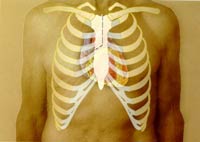
| The patient is anesthetized in the supine position and intubated with a single lumen endotracheal tube. Defibrillator patches are placed on the patient’s back and anterior left chest wall. A transesophageal echo Doppler probe is placed to assess the pathoanatomy of the aortic valve disease and assist in removing air from the heart at the completion of the procedure. An 8-10 centimeter incision is made beginning half-way between the sternal notch and the angle of Louie. The incision is carried down to the sternum using cautery. The sternum is opened from the sternal notch to the third or fourth interspace and extended into that interspace on the right. |
![[Illustration: Figure 1]](https://dev.cts.freelock.com/wp-content/uploads/2026/04/cosav1_01.jpg) |
![[Illustration: Figure 2]](https://dev.cts.freelock.com/wp-content/uploads/2026/04/cosav2_01.jpg) |
To help reduce the potential for air emboli, a cannula is sewn to the wound edge and the field flooded with CO2 at liters per minute. This displaces oxygen and nitrogen and any bubbles of CO2 are rapidly absorbed. |
![[Illustration: Figure 3]](https://dev.cts.freelock.com/wp-content/uploads/2026/04/cosav3_01.jpg) |
To reduce the size of the venous cannulae, vacuum-assisted venous drainage is employed. Forty to fifty millimeters of mercury negative pressure is placed on the venous reservoir. This greatly improves venous drainage and enables adequate flow via a single 28 Fr cannula placed in the right atrial appendage. Vacuum-assisted venous drainage has the additional advantage of providing a drier surgical field and reducing the surgical priming volume of the cardiopulmonary bypass machine by eliminating the need to prime the venous lines. The aorta is cannulated for arterial return at the pericardial reflection and venous drainage obtained by cannulae placed in the right atrial appendage. The retrograde cardioplegia cannula is placed in the right atrium and directed into the coronary sinus. |
![[Illustration: Figure 4]](https://dev.cts.freelock.com/wp-content/uploads/2026/04/cosav4_01.jpg) |
The aorta is cross-clamped and an oblique incision is made which is extended into the noncoronary sinus. |
| Sutures are placed at the top of each commissure and suspended from the drapes under tension. This serves to elevate the valve, retract the aorta, and gives normal physiologic orientation to the aortic root. Cardioplegia can be directly injected into the coronary ostia. |
![[Illustration: Figure 5]](https://dev.cts.freelock.com/wp-content/uploads/2026/04/cosav5_01.jpg) |
| The valve to be replaced is excised. Sutures are placed through the annulus and subsequently through the aortic prosthesis and tied. |
![[Illustration: Figure 6]](https://dev.cts.freelock.com/wp-content/uploads/2026/04/cosav6_01.jpg) |
![[Illustration: Figure 7]](https://dev.cts.freelock.com/wp-content/uploads/2026/04/cosav7_01.jpg) |
Tension is maintained on the sutures in the valve prosthesis until closure of the aorta has been started. This aids in exposure of the most difficult to reach portion of the incision in the non-coronary sinus. Sutures in the valve are then cut and the aorta closed with a single layer of 4-0 Prolene. Prior to completion of the closure, the lungs are inflated driving air out of the left ventricle and aorta. Completeness of air removal in monitored with echocardiography. A small cupula is created in the ascending aorta to trap air as it exits the left ventricle. De-airing has been greatly facilitated by flooding the field with CO2. |
![[Illustration: Figure 8]](https://dev.cts.freelock.com/wp-content/uploads/2026/04/cosav8_01.jpg) |
At the completion of the procedure the patient is decannulated. The atrial and two ventricular wires are placed and the sternum closed with monofilament wire. The wound is closed in layers. |
![[Illustration: Figure 9]](https://dev.cts.freelock.com/wp-content/uploads/2026/04/cosav9_01.jpg) |
In order to adequately drain the mediastinum and right pleura, a right angle chest tube is placed that lies on top of the diaphragm and a straight tube inserted directly into the pericardial sac. |
Preference Card
![[Illustration: Cosgrove clamp]](https://dev.cts.freelock.com/wp-content/uploads/2026/04/cosclamp_01.jpg) Cosgrove Flex Clamp
Cosgrove Flex Clamp
(V. Mueller, Allegiance Healthcare Corporation, 1435 Lake Cook Road Dearfield, IL 60015) This clamp is flexible and can be easily moved out of the way.
Tips & Pitfalls
- This approach represents a progression thoughts based on different incisions used. Having used a parasternal and transverse sternotomy incision, this seems to be the most useful with the best healing.
- Small flexible cannulae should be used to minimize obstruction of the operative field.
- If the venous cannulae are attached to the cardiotomy suction set at (-80mmHg) smaller cannulae can be used with better venous drainage and prevention of an airlock in case of air aspiration.
References
- Chitwood Jr WR, Elbery JR, Chapman WHH et al, Video-assisted minimally invasive mitral valve surgery: The “Micro-Mitral” operation. J Thorac Cardiovasc Surg 1997;113:413-4.
- Benetti FJ, Rizzard JL, Pire L and Polanco A, Mitral Replacement under video assistance through a minithoracotomy. Ann Thorac Surg 1997;63:1150-2.
- Carpentier A, Loulmet D, Carpentier A et al, First open heart operation (Mitral valvuloplasy) under videosurgery through a minithoracotomy. C.R. Academie of Sciences, Paris 1996;319-219-23.
- Chiwood Jr WR, Elberry JR, Chapman WHH et al. Video-assisted Minimally invasive mitral valve surgery. The “Micro-Mitral” operation J. Thorac Cardiovasc Surg 1997;113:413-4.
- Cosgrove DM and Sabik JF, Minimally invasive approach for aortic valve operations. Ann Thorac Surg 1996;62:596-7.
- Cosgrove DM, Sabik JF and Navia J. Minimally invasive valve surgery. Ann Thorac Surg 1997 [in press].
- Gundry SR, Shattuck OH, Rassouk AJ, del Rio MJ, et al. Cardiac operations in adults and children via ministernotomy facile minimally invasive aortic, valve replacement. Ann Thorac 1997 [in press].
- Lin PJ, Chang CH, Chu JJ, Liu HP, et al, Video-assisted mitral valve operations. Ann Thorac Surg 1996;61:1781-7.
- Minale C, Reifschneider HJ, Schmitz E and Uckmann FP, Single access for minimally aortic valve replacement. Ann Thorac Surg 1997;64:120-3.
- Navia JL and Cosgrove DM, Minimally invasive mitral valve operations. Ann Thorac Surg 1996;62:1542-4.
- Schwartz DS, Ribakove GH, Grossi EA, Stevens JH, et al, Minimally invasive cardiopulmonary bypass with cardioplegic arrest: A closed chest technique with equivalent myocardial protection. J Thorac Cardiovasc Surg 1996;111:556-66.



![[Illustration: Figure 1]](https://www.ctsnet.org/sites/default/files/graphics/experts/Adult/d_cosgrove_mininvasive/cosav1.jpg)
![[Illustration: Figure 2]](https://www.ctsnet.org/sites/default/files/graphics/experts/Adult/d_cosgrove_mininvasive/cosav2.jpg)
![[Illustration: Figure 3]](https://www.ctsnet.org/sites/default/files/graphics/experts/Adult/d_cosgrove_mininvasive/cosav3.jpg)
![[Illustration: Figure 4]](https://www.ctsnet.org/sites/default/files/graphics/experts/Adult/d_cosgrove_mininvasive/cosav4.jpg)
![[Illustration: Figure 5]](https://www.ctsnet.org/sites/default/files/graphics/experts/Adult/d_cosgrove_mininvasive/cosav5.jpg)
![[Illustration: Figure 6]](https://www.ctsnet.org/sites/default/files/graphics/experts/Adult/d_cosgrove_mininvasive/cosav6.jpg)
![[Illustration: Figure 7]](https://www.ctsnet.org/sites/default/files/graphics/experts/Adult/d_cosgrove_mininvasive/cosav7.jpg)
![[Illustration: Figure 8]](https://www.ctsnet.org/sites/default/files/graphics/experts/Adult/d_cosgrove_mininvasive/cosav8.jpg)
![[Illustration: Figure 9]](https://www.ctsnet.org/sites/default/files/graphics/experts/Adult/d_cosgrove_mininvasive/cosav9.jpg)
![[Illustration: Cosgrove clamp]](https://www.ctsnet.org/sites/default/files/graphics/experts/Adult/d_cosgrove_mininvasive/cosclamp.jpg) Cosgrove Flex Clamp
Cosgrove Flex Clamp