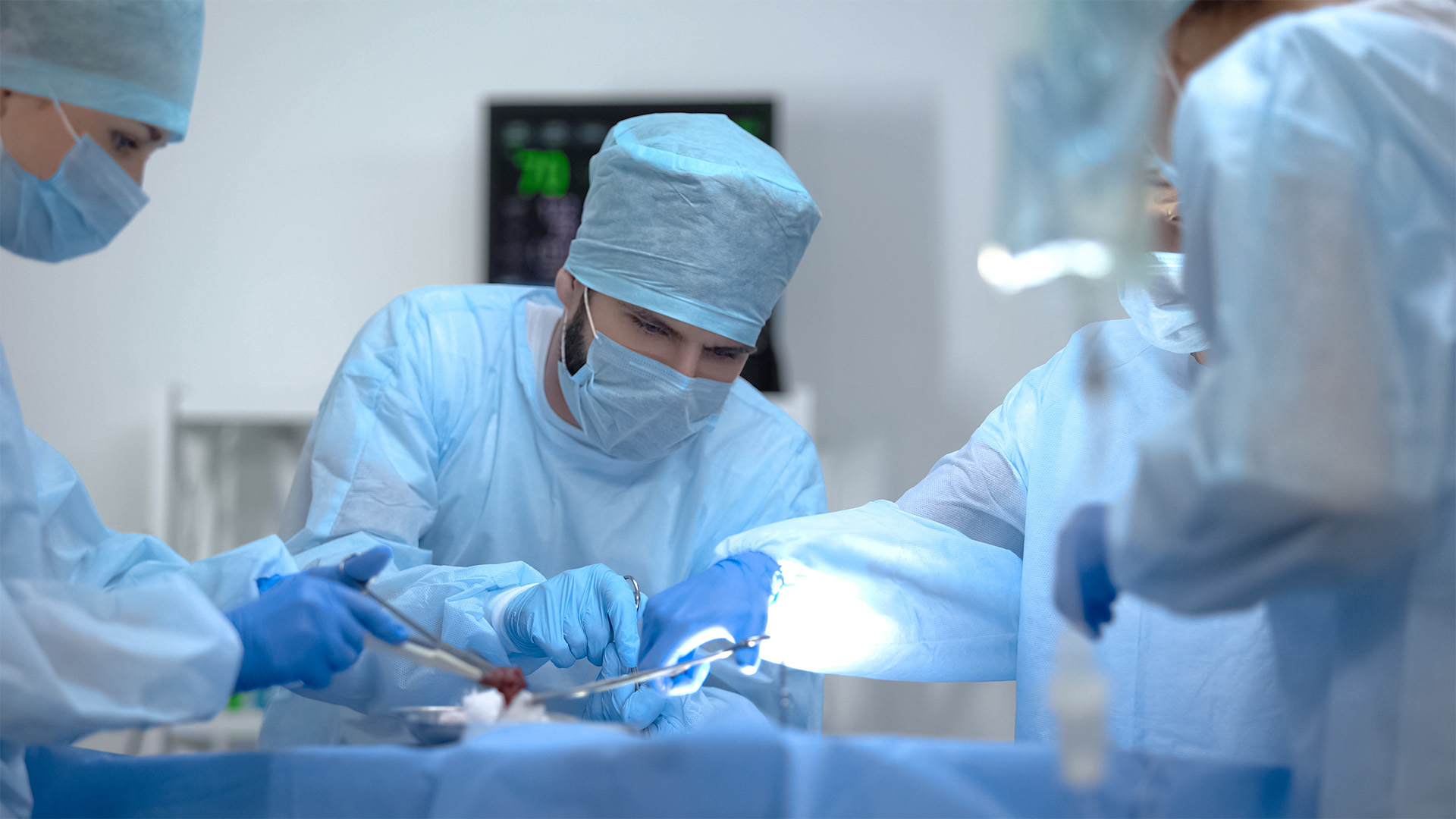
This video demonstrates hemi-commando reconstruction for destructive infective endocarditis of a prior transcatheter aortic valve replacement (TAVR) caused by Coxiella burnetii. Preoperative transesophageal echocardiography (TEE) revealed posterior aortic root thickening, a broad diastolic paravalvular jet, vegetations, and a systolic jet into the left atrium, indicating an aorto-left-atrial fistula.
Key Operative Steps
After standard cannulation, cross-clamp, and antegrade cardioplegia, all infected prosthetic and necrotic native tissue were excised This included the aorto-mitral curtain and anterior mitral leaflet, while the posterior leaflet, annulus, and subvalvular apparatus were preserved, allowing hemi-commando rather than full commando reconstruction.
Key operative steps included tailored bovine pericardial patch reconstruction of the intervalvular fibrous body and anterior leaflet, left ventricular outflow tract preparation with interrupted polypropylene sutures, cryopreserved aortic root homograft implantation, and coronary button mobilization and reimplantation. Careful attention was paid to prevent tension and kinking.
Deairing and verification of coronary flow were demonstrated. Adjunctive strategies included infected pacemaker lead extraction, prophylactic intra-aortic balloon pump for low ejection fraction, meticulous hemostasis, and criteria for delayed sternal closure in inflamed fields.
Key Learnings
Postoperative TTE confirmed a well-seated homograft, a competent aortic valve, and no residual paravalvular leak. Educational points include echocardiographic predictors of periannular extension, anatomic thresholds for hemi-commando vs full commando reconstruction, patch-sizing and anchoring techniques, homograft selection in infected fields, practical strategies to reduce ischemic time and bleeding, and postoperative imaging surveillance and antibiotic-duration protocols to minimize recurrence risk.
Disclosure
Derek Brinster is a consultant for Artivion, Cook Medical, Terumo Medical, Inc., and Gore.
References
-
- Elgharably H, Hakim AH, Unai S, et al. The incorporated aortomitral homograft for double-valve endocarditis: the “Hemi-Commando” procedure. Early and mid-term outcomes. European Journal of Cardio-Thoracic Surgery. 2018;53(5):1055–1061.
- Marin-Cuartas M, De La Cuesta M, Davierwala PM, et al. Mid-term outcomes following the Hemi-Commando procedure for complex infective endocarditis involving the aortomitral junction. European Journal of Cardio-Thoracic Surgery. 2023;64(1):ezad195.
- Forteza-Gil A, Sandoval E, Martínez-López D, et al. Mid-term outcomes of intervalvular fibrosa body reconstruction with Commando variants for active infective endocarditis. European Journal of Cardio-Thoracic Surgery. 2025;67(3):ezaf047.
- Jiang X, Liu J, Khan F, et al. Aortic and mitral valve surgery for infective endocarditis with reconstruction of the intervalvular fibrous body: an analysis of clinical outcomes. Journal of Thoracic Disease. 2020;12(4):1427–1436.
- Galeone A, Mastrobuoni S, Vobornik M, et al. Aortic homografts for native and prosthetic aortic valve and root endocarditis: results from the European Registry of Cryopreserved Aortic Homografts (EURECAH). The Journal of Thoracic and Cardiovascular Surgery. 2026; in press.
- Sabik JF, Lytle BW, Blackstone EH, et al. Aortic root replacement with cryopreserved allograft for prosthetic valve endocarditis. The Annals of Thoracic Surgery. 2002;74(3):650–659.
- Harding D, Cahill TJ, Redwood SR, Prendergast BD. Infective endocarditis complicating transcatheter aortic valve implantation. Heart. 2020;106(7):493–498.
- Aoun J, Kharsa C, Desai P, et al. Infective endocarditis of transcatheter aortic valve replacement and transcatheter edge-to-edge repair devices. JACC: Advances. 2026;5(7).
- Maor Y, Sternik L, Orlov B, et al. Coxiella burnetii endocarditis and aortic vascular graft infection: an underrecognized disease. The Annals of Thoracic Surgery. 2016;101(1):e1–e6.
- Fernández-Guerrero ML, Muelas JM, Aguado JM, et al. Q fever endocarditis on porcine bioprosthetic valves: clinicopathologic features and microbiologic findings in three patients treated with doxycycline, cotrimoxazole, and valve replacement. Annals of Internal Medicine. 1988;108(2):209–213.
Disclaimer
The information and views presented on CTSNet.org represent the views of the authors and contributors of the material and not of CTSNet. Please review our full disclaimer page here.
 11 views on Vimeo