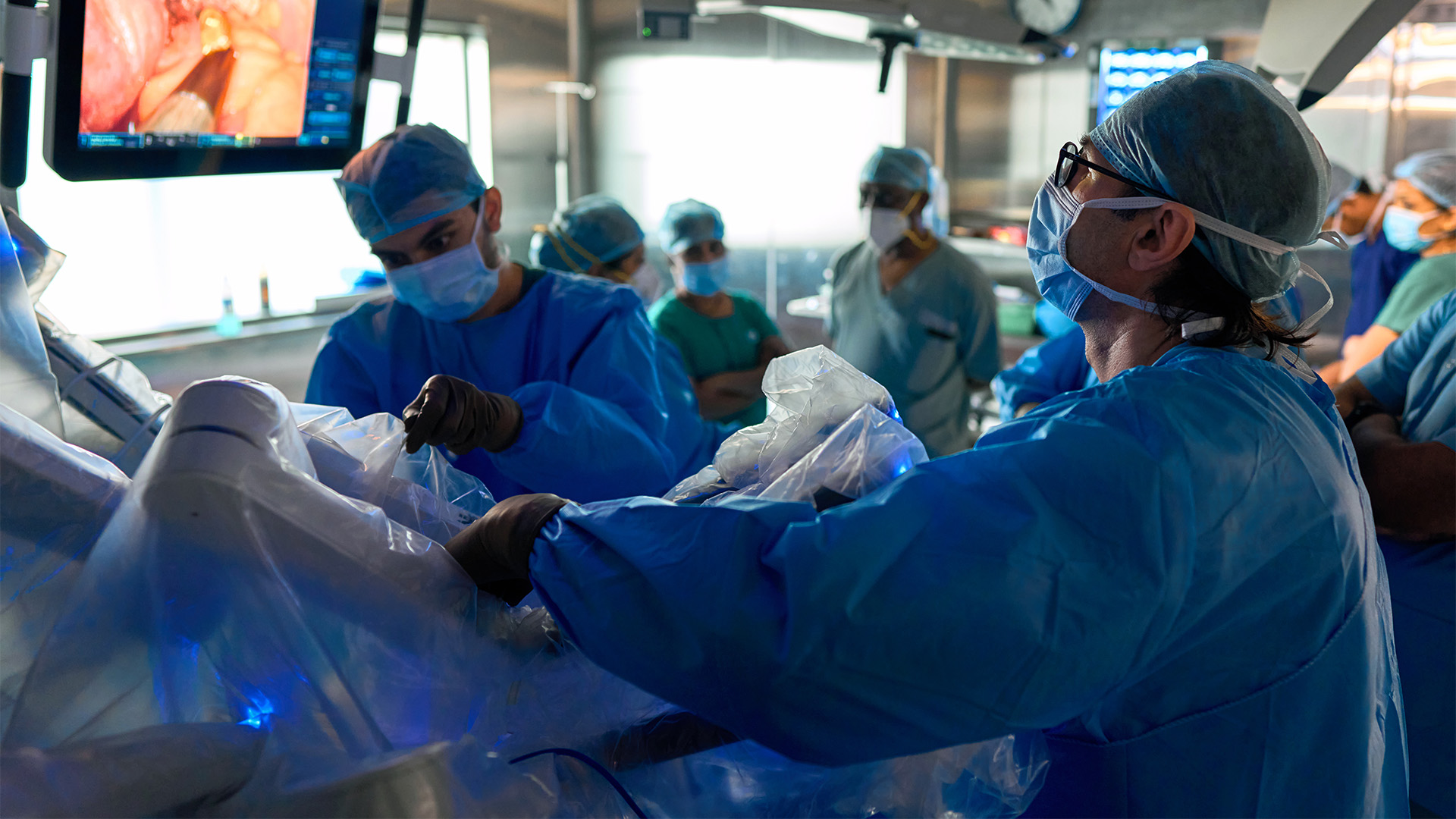
This video demonstrates a robotic-assisted resection of the left fifth rib for oligometastatic melanoma involving the chest wall.
An 83-year-old man with a history of cutaneous melanoma presented with progressive left posterior chest wall pain that required escalating analgesia. Preoperative computed tomography (CT) demonstrated two areas of lytic disease involving the left fifth rib, with interval progression of the lateral lesion. Fluorodeoxyglucose (FDG) positron emission (PET) imaging showed intense hypermetabolic uptake confined to the left fifth rib, with no additional sites of metastasis. Given the isolated nature of the lesion, preserved functional status, and significant symptom burden, surgical resection was pursued for oncologic control and palliation. A robotic approach was selected to minimize the morbidity associated with a thoracotomy.
The patient was positioned in the lateral decubitus position, and four 8 mm robotic ports were placed along the eighth intercostal space, with a posterior assistant port. Dissection began with the mobilization of the intercostal musculature while maintaining a plane directly on the rib to minimize bleeding. The rib was progressively skeletonized, and the intercostal neurovascular bundle was identified, dissected, clipped, and divided to ensure early vascular control.
Dissection was continued posteriorly toward the paravertebral region, where the robotic platform facilitated precise work in a confined space. The sympathetic chain was identified and divided, and an appropriate oncologic margin was maintained. The rib was then disarticulated via a small posterior incision using a periosteal elevator, with care taken to remain on the bone to avoid bleeding. The specimen was removed intact, and hemostasis was ensured prior to chest tube placement and closure.
Robotic rib resection provides enhanced visualization and instrument control, particularly in the posterior thoracic cavity. However, early vascular control and maintenance of the correct dissection plane are critical to avoid bleeding and preserve visualization. In selected patients, this approach enables precise chest wall resection while avoiding the morbidity of thoracotomy.
This video submission is from the 2026 CTSNet Instructional Video Competition. Stay tuned to CTSNet.org and the CTSNet YouTube channel in the coming weeks to watch all entries from the competition, including the winning videos.
References
- Reyes M, Alaparthi S, Roedl JB, Moreta MC, Evans NR, Grenda T, Okusanya OT. Robotic First Rib Resection in Thoracic Outlet Syndrome: A Systematic Review of Current Literature. J Clin Med. 2023 Oct 23;12(20):6689. doi: 10.3390/jcm12206689. PMID: 37892829; PMCID: PMC10607688.
- Hazama H, Nakamura K, Koido K, Oshima T, Ohata K. Long-Term Survival After Radical Resection of Rectal Cancer With Synchronous Solitary Rib Metastasis: A Case Report. Cureus. 2025 Sep 10;17(9):e92025. doi: 10.7759/cureus.92025. PMID: 41080388; PMCID: PMC12514421.
- Egyud MRL, Burt BM. Robotic First Rib Resection and Robotic Chest Wall Resection. Thorac Surg Clin. 2023 Feb;33(1):71-79. doi: 10.1016/j.thorsurg.2022.08.003. PMID: 36372535.
- Burt BM, Palivela N, Goodman MB, et al. Safety of robotic first rib resection for thoracic outlet syndrome. J Thorac Cardiovasc Surg. 2021;162(4):1297-1305.e1. doi:10.1016/j.jtcvs.2020.08.107
- Zehnder A, Lutz P, Kocher GJ, et al. Completely thoracoscopic 3-port robotic first rib resection for thoracic outlet syndrome. Ann Thorac Surg. 2022;114(4):1238-1244. doi:10.1016/j.athoracsur.2021.08.053
- Yang C, Wang W, Jiang F, et al. Robotic-assisted costectomy using a Gigli saw for fibrous dysplasia. J Cardiothorac Surg. 2025;20(1):95. doi:10.1186/s13019-025-03340-x
Disclaimer
The information and views presented on CTSNet.org represent the views of the authors and contributors of the material and not of CTSNet. Please review our full disclaimer page here.
 233 views on Vimeo