


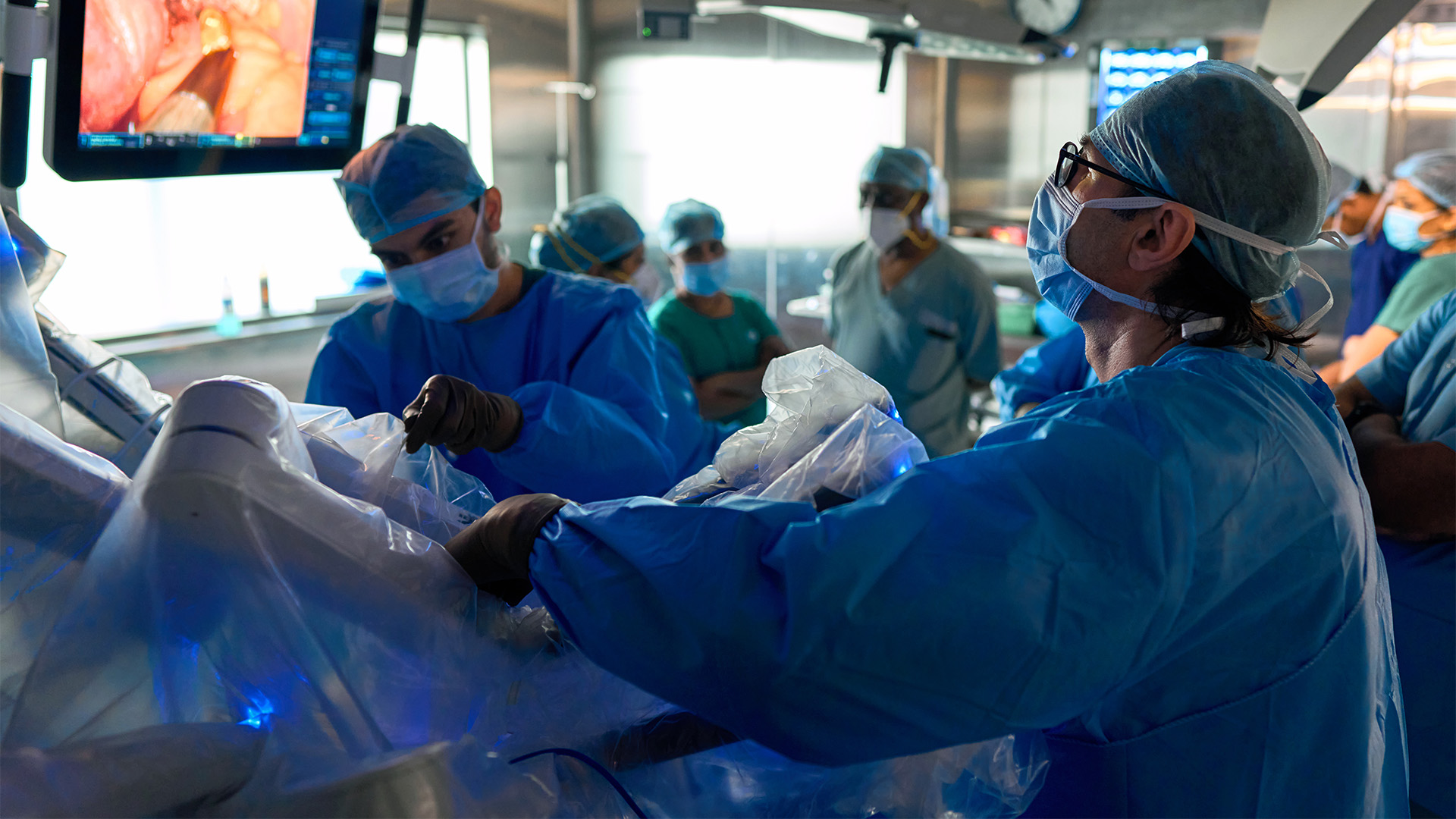
Raja Flores, Professor and Chairman of the Mount Sinai School of Medicine Department of Thoracic Surgery, discusses the use of pleurectomy and decortication in the treatment of mesothelioma.
This presentation was originally given at the 27th Annual Meeting of the General Thoracic Surgical Club. This content is published with the permission of GTSC.
 4.5K views on YouTube











12 Comments
A very sensible summary of the current status of mesothelioma surgery. Well done Raja Flores
An excellent presentation. As a thoracic surgeon in South Australia, where the incidence of mesothelioma is one of the highest in the world, I have been involved withe several hundred such patients. How can you justify the morbidity, and high incidence of post-thoracotomy intercostal neuralgia that invariably follows a thoracotomy in patients who are terminal? Should we not be aiming to palliate these patents effectively? With a mean survival of 12-16 months in the vast majority of patients, shouldn’t we be avoiding a thoracotomy and focussing on minimally invasive treatment of their symptomatic effusions? Radical, highly morbid procedures (without adequate evidence) in a disease in which a cure is rare defies the principle of palliation. Very few surgeons in Australia perform this procedure (in the Public system) though some do so in the Private sector.
We all have our biases based upon our own personal experiences. Then there is data. To quote mean or median survival without stratification by stage or histology is not appropriate since stage 1 lung cancer is treated very differently than stage 4 lung cancer yet the median survival of all patients lumped together is poor. So we should not lump all mesothelioma patients together in a single mean or median survival. The argument you make has greater weight in arguing against extrapleural pneumonectomy since its morbidity and mortality is almost triple pleurectomy decortication according to the STS database. In my opinion the morbidity and mortality of pleurectomy decortication is worth the potential upside of getting rid of tumor and opening up the lung to improve the patients breathing. Something that neither chemotherapy nor radiation can accomplish in this disease. The only other alternative is to do nothing or talc alone. Post-thoractomy pain syndrome is a risk with any surgery including VATS and should rarely prevent a procedure with potential oncological benefit. A combination of tumor biology, surgical treatment, patient performance status may all contribute to long term survival. Just how much each contributes is unknown. If pleurectomy decortication may be part of the formula for long term survival in some patients should they be denied the opportunity for surgery with little downside?
So what you are saying is that, despite there being no convincing evidence of real benefit we should subject a person with an extremely short life expectancy (irrespective of stage) to an operation which will require a 3-4 month recovery period and a significant likelihood of chronic pain until their demise. I hardly consider that “little downside”. This is also the evidence-based opinion of most oncology groups dealing with mesothelioma. Hence, the low take-up of these procedures despite years of promotion by several surgically focused groups.
Large series from the US, Europe , and Asia have demonstrated a number of long term survivors after surgical resection. The real question is whether this group of patients would have lived such a long time without surgery. There is no good way to answer that question. Another important point is the pain. Post-thoracotomy pain syndrome can occur after any thoracotomy, even decortication for empyema. The scenario that you describe sounds more like pain from recurrent tumor after attempt at surgical removal since those patients die very quickly. We need to continue to investigate how to identify this group of high risk patients and thereby avoid surgery. Regardless, there is heated controversy concerning surgical resection across the globe. My own very biased opinion dictates that if I evaluate an early stage, epithelioid mesothelioma they are getting surgery. Period. You have every right to disagree.
A non-evidence based, “very biased” approach in which patients will be “getting surgery. Period” is very interesting. The consent process must be also be interesting. As a Cardiothoracic surgeon in Australia I would find it very difficult convincing my referring respiratory physicians and oncologists, let alone the patient, that I should embark on such a procedure based on personal bias alone. There are also the medico-legal implications of such an approach which must be taken into consideration in Australia.
Your conviction in such a gray area is quite impressive. How would you treat a healthy asymptomatic 45 year-old woman who walks into your office with her husband and 10-year-old daughter with a stage 1 epithelioid mesothelioma of the left chest? Please leave out your previously expressed legal concerns and focus on the individual person. Please provide data to support your stance and treatment recomendations.
I would start by directing the patient to the European Guidelines for the treatment of malignant mesothelioma.
http://www.sciencedirect.com/science/article/pii/S2090123211000312
This outlines the various treatment modalities and specifies the level of evidence upon which the decision to use each of these modalities is based. I would then inform the patient of the mean survival of patients with the various subtypes of malignant mesothelioma emphasising that, at this stage, a cure is extremely unlikely with any treatment modality. I would put to her the various treatment options including no treatment, palliative treatment, chemoptherapy alone, chemoradiotherapy, and tri-modality therapy (including EPP and PD). I would refer her back to the guidelines and inform her that there is not enough evidence to recommend radical surgery outside a recognized trial. Currently there is insufficient evidence to support radical surgery over chemotherapy alone (Rice D. “Surgical therapy of mesothelioma. Recent results.”Cancer Res. 2011; 189:97-125, Tsao S et al,”Outcome of patients with malignant pleural mesothelioma referred for tri-modality therapy in Western Australia. J Thorac Oncol. 2009;4: 1110-6). If the patient were asymptomatic (and pain free) and of good performance status I would inform her that any treatment that involved a thoracotomy would carry a significant risk of leaving her with chronic pain (Wildgaard K , Ravn J, Kehlet H. Chronic post-thoracotomy pain: a critical review of mechanisms and strategies for prevention. Eur J Cardiothorac Surg. 2009;36(1): 170-80) significantly reducing her quality of life.
Such a patient would be discussed at a multidisciplinary meeting involving thoracic physicians, medical and radiation oncologists, palliative care physicians and surgeons. The team would look at the case, weigh up the evidence for all treatment modalities, and come up with an evidence-based consensus opinion. This would then be communicated to the referring physician and presented to the patient. The patient would then, with all the information at hand, come to a decision as to which (if any) treatment they would accept.
If the patient wanted to consider radical surgery they would be referred to centre which offered such treatment.
Most patients in my home state and in Australia in general opt for symptomatic treatment of their effusions (in the form of a VAT talc pleurodesis) with or without chemotherapy.
The Wildgaard et al. study you quote is a literature review of many older retrospective studies from 2000-2008 which lacked focus on a specific pain end-point and lumped any kind of pain all together. The majority experienced only mild pain requiring no medication, and only 3–16% experienced moderate to severe pain. In the more recent prospective study from the Mayo clinic Kinney et al. focus on a primary question. The objective of this study was to assess whether pain 3 months post-thoracotomy negatively impacts quality of life. Pain reported at 3 months is generally mild, shows improvement over time, and does not usually require opioid analgesics. Patients who experienced post-thoracotomy pain at 3 months were not at risk for significantly decreased social, emotional, or mental health functioning compared with patients who did not experience post-thoracotomy pain at 3 months.
Median survival for stage 1 mesothelioma is approximately 3-4 years from the largest mesotheloma studies that were quoted in the above lecture and available in the current literature. In my practice I have patients who are 8-10 years post surgery living pain free productive lives. Therefore, I advise patients based on the best available data combined with my own personal experience. If I had mesothelioma I would gladly trade the possibility of pain for a shot at long-term survival.
Thank you for an excellent discussion. Our team will also continue to advise patients based on the best available data.
Another factor to consider is that the mesothelioma observed in Austrailia may be a bit different compared to the mesothelioma we see in the US. My understanding is that the majority of patients in Australia develop mesothelioma secondary to Crocidolite asbestos exposure. It has been hypothesized that Crocidolite induces a more virulent type of mesothelioma than those secondary to Chrysotile and other forms of asbestos exposure. Thank you for sharing your perspective on this difficult to treat disease.
That is true. The majority of patients present relatively late and with advanced disease.
Again, thank you for a very insightful exchange.
Best regards,
Craig Jurisevic