In this CTSNet series, Dr. Mario Castillo-Sang presents innovative, totally endoscopic cardiac procedures for a variety of conditions. Stay tuned for more series videos in the coming weeks.
The authors present a case of totally endoscopic redo inferior vena cava (IVC) patch enlargement. The patient was a 44-year-old male who, four years prior, had presented with a cerebrovascular ischemic event secondary to a caval atrial septal defect (ASD). The patient had undergone an endoscopic ASD patch closure. This time, he presented with increasing fatigue without lower extremity edema. The echocardiogram showed flow acceleration at the level of the IVC with a high gradient across it. An attempt was made at balloon dilation without significant improvement in the gradients or symptoms.
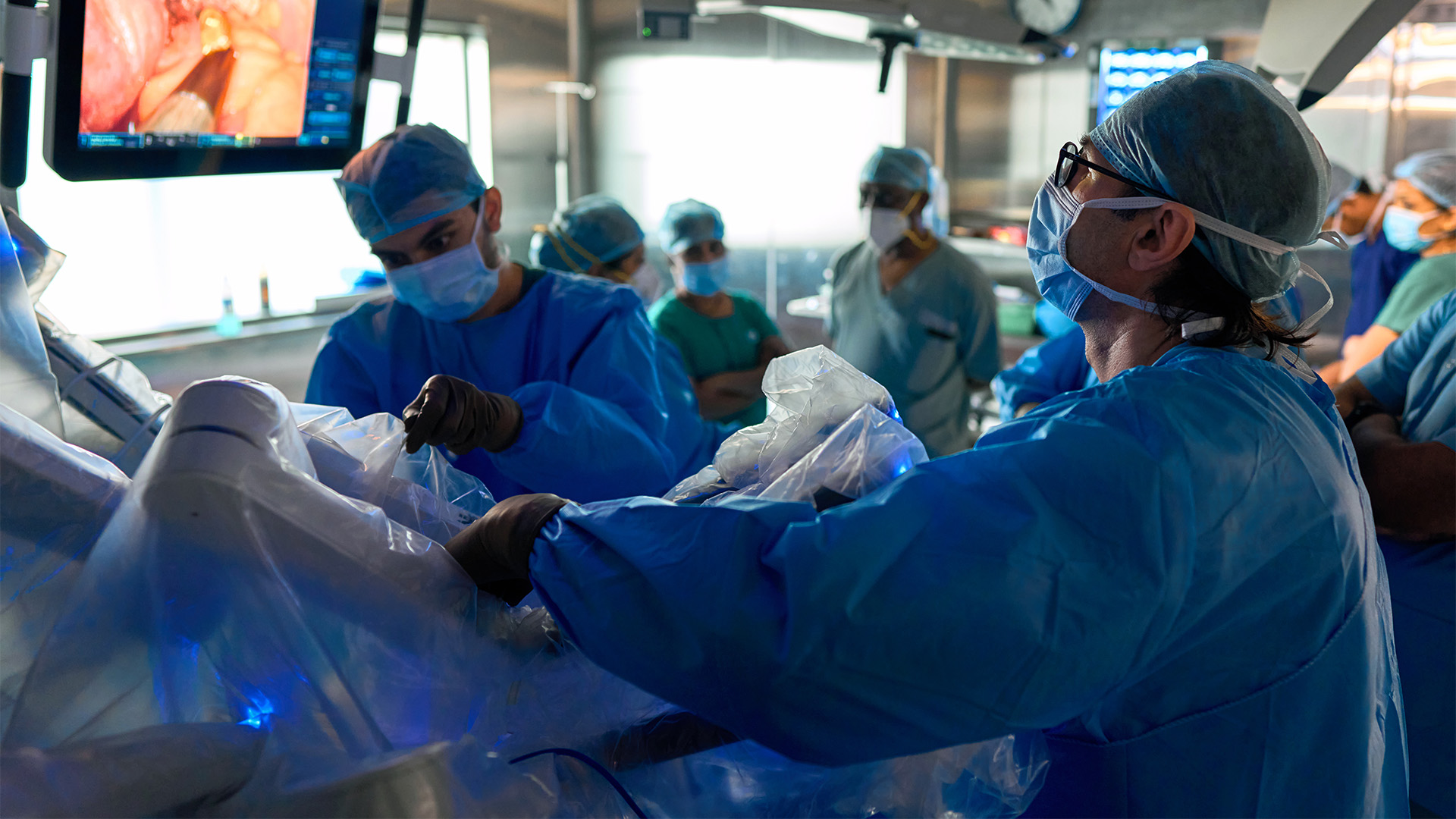
The patient was offered a redo totally endoscopic approach through the right fourth intercostal space with a 3 cm working port and a 10 mm trocar third intercostal space endoscope. A double-lumen endotracheal tube was used to facilitate lyses of adhesions, and bicaval femoral and jugular cannulation was performed with a femoral arterial cannula. Once the adhesions were taken down, the surgeons were able to appreciate the IVC stenosis externally. The IVC size was just slightly larger than 1 cm. The authors discovered an area marked with arrows in the video that corresponded to a napkin ring-like stenosis around the IVC. They hypothesized that the caval tapes from his prior operation could have been involved in this injury.
Using a beating heart technique, the right atrium was opened, and the stenosis clearly appreciated. The diameter of the IVC was about 1 cm. The prior ASD patch was close to the IVC orifice, but the surgeons noticed that the entire IVC circumference was involved in the stenosis.
They extended the incision of the right atrium down to the IVC orifice, and with the help of a Foley balloon and vacuum-assisted venous drainage up to 30 mm Hg, they obtained a good view of the stenosis.
A double patch technique was used to enlarge the IVC medially and laterally. Using a 4-0 RB needle, the surgeons employed a running locking polypropylene suture for the medial patch, avoiding a purse-string effect. Invaginating the patch into the defect can sometimes be helpful when suturing these patches endoscopically.
A valve sizer can be used to evaluate the magnitude of the enlargement. In this case, the surgeons doubled the size of the IVC with the first patch. The second patch was sutured using the same technique of a locking running suture, and this patch was also used to close the right atriotomy.
Postoperative echocardiogram documented a significant enlargement of the IVC with a considerable reduction in the flow acceleration.
Discussion
IVC stenosis has been described after orthotopic bicaval heart transplantation, but it is a rare complication following nontransplant cardiac surgery. IVC obstruction and IVC flow diversion to left atrium have been described in the closure of caval-type ASDs when the Eustachian valve is mistaken for the lower edge of the ASD and included in the suture line. When closing ASDs near the IVC orifice, the suture line could potentially narrow the IVC orifice. In this case, the stenosis was more circumferential, and the authors suspect a caval tape compression injury. Prompt diagnosis is crucial to minimize the morbidity from congestive end-organ damage, which can be significant.
Traditionally, the treatment has involved open surgical procedure or, more recently, an endovascular approach with stenting or balloon dilation. The authors present a unique approach using a totally endoscopic platform with IVC patch angioplasty to minimize the morbidity of a redo open procedure and avoid potential issues associated with endovascular therapies, such as restenosis and stent migration.
References
- Kauling RM., Pelosi C, Cuypers J., van den Bosch A., Hirsch A., Carvalho J.G., Bowen D.J.,Kardys I.,Bogers AJ.,Helbing W.A.,Ross-Hesselink J.W.: Long term outcome after surgical ASD-closure at young age: longitudinal follow up to 50 years after surgery. Int J. cardiol. 2024;397:131616
- Hardman G, Zacharias J. Minimal Access Atrial Septal (ASD) closure. J Cardiovasc Dev Dis. 2023 May 10;10(5):206
- Vivek S, Wasowicz M, Brister S, Jacek K, Meinieri M. Postoperative Transesophageal Echocardiography Diagnosis of Inferior Vena CavaObstruction After Mitral Valve Replacement. Anesthesia &Analgesia.2011113:1343-134
- Soares T, Dias P, Sampaio S, Teixeira J, Intracardiac endograft stent of inferior vena cava stenosis after cardiac surgery. J Vasc Surg Cases Inn Tech. 2022;8:67-9
- Ross JK, Johnson DC. Complications following closure of atrial septal defects of the inferior vena caval type. Thorax 1972; 27: 754-758.
Disclaimer
The information and views presented on CTSNet.org represent the views of the authors and contributors of the material and not of CTSNet. Please review our full disclaimer page here.
 275 views on Vimeo
 416 views