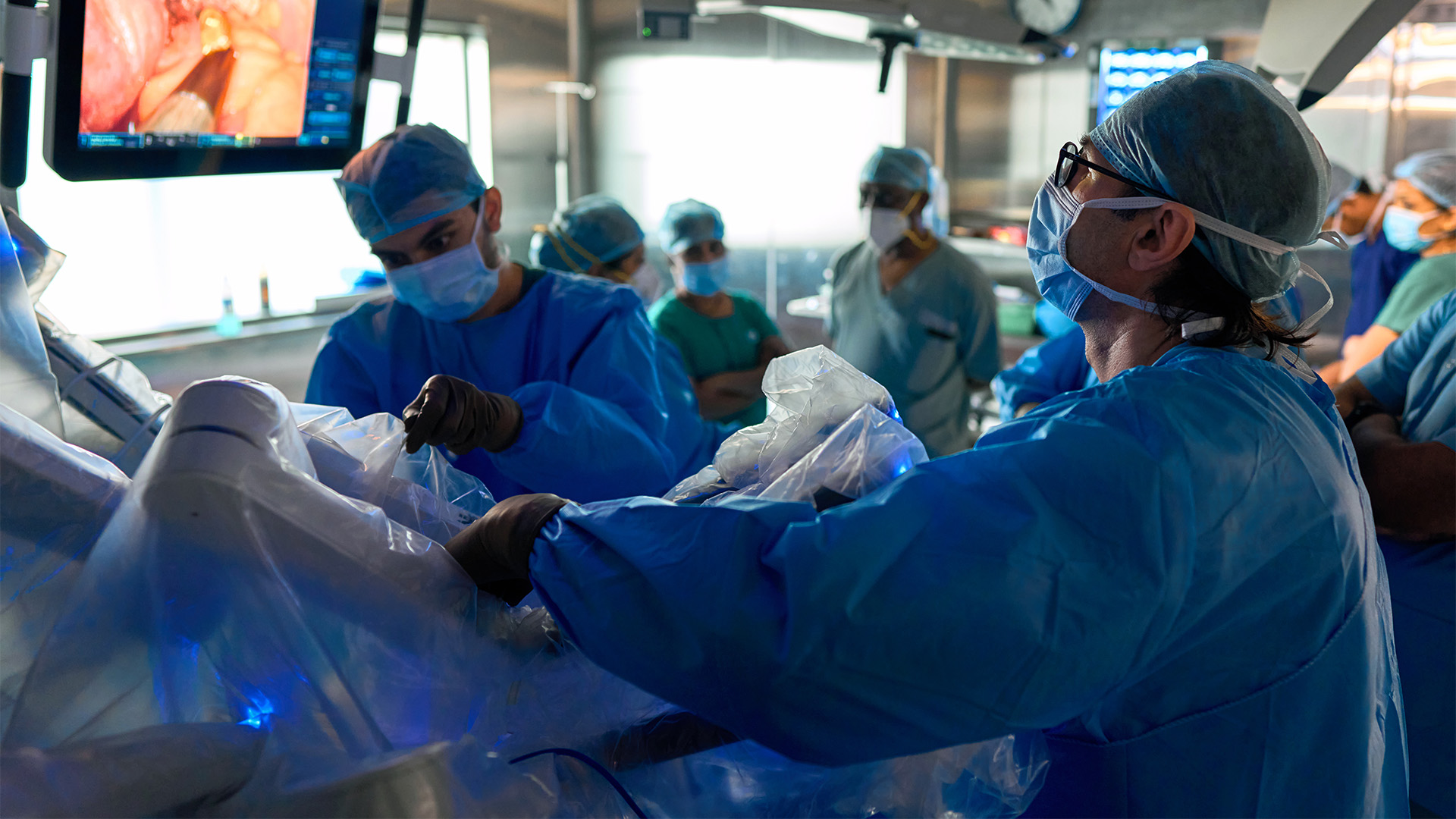
In this CTSNet series, Dr. Mario Castillo-Sang presents innovative, totally endoscopic cardiac procedures for a variety of conditions. Stay tuned for more series videos in the coming weeks.
The authors present the case of a 59-year-old female patient with a history of three embolic strokes during four years, with the last two occurring while on oral anticoagulation with a novel oral anticoagulant (NOAC). The patient’s only neurologic deficit was partial loss of vision in one eye. Her workup included a cardiac MRI and transesophageal echocardiogram (TEE), which confirmed the presence of a moderately large left ventricular apical mass that was considered to be a thrombus. She tested negative for all hypercoagulable conditions.
The patient was offered an endoscopic approach to for left ventricular thrombectomy.
The endoscopic approach involved a 2.5 cm working incision in the fourth intercostal space, which was expanded with an extra-small soft tissue retractor and without a rib spreader. The camera port was a 10 mm trocar in the third intercostal space. A 5 mm incision was placed in the fourth anterior intercostal space for the atrial lift retractor. Femoral bypass was established via cutdown with direct arterial and venous cannulation. The heart was arrested using antegrade del Nido solution, and the left atrium was exposed using the HV retractor. A nitinol ribbon retractor was used to spread the mitral valve atraumatically. The thrombus overlying the left ventricular apex was immediately visible. Using a powerful waste sucker, the clot was removed, and some of it was sent for pathological evaluation. The area was mechanically debrided until the underlying cardiac tissue was exposed. The underlying tissue appeared as a white scar of varying thickness in different areas, with several trabeculae crisscrossing the apex with thrombus accumulation under them. These trabeculae were completely resected until the entire apex was smooth. The ventricle was irrigated, and the mitral valve was statically tested. The left atrium was closed, and the heart was reanimated.
The patient was weaned off cardiopulmonary bypass without problems, was extubated in the operating room, and was discharged three days later. She was started on warfarin, and at the six-month follow-up, she was doing well, with echocardiogram demonstrating the absence of thrombus.
Endocardial fibroelastosis is a difficult diagnosis to make. Patients often present with symptoms of heart failure despite having a normal left ventricular ejection fraction (LVEF) or may have experienced thrombus formation leading to embolic events (1, 2). The surgical management of these cases involves thrombectomy and resection of the endocardial fibroelastosis as much as possible. Considering the anatomy and location of the fibroelastosis, the surgeon must weigh the risks of ventricular injury when resecting the fibroelastosis. For this reason, the authors chose to perform a limited resection to avoid the risk of mitral valve damage or ventricular perforation.
References
- Xu X, Friehs I, Zhong Hu T, Melnychenko I, Tampe B, Alnour F, Iascone M, Kalluri R, Zeisberg M, Del Nido PJ, Zeisberg EM. Endocardial fibroelastosis is caused by aberrant endothelial to mesenchymal transition. Circulation research. 2015 Feb 27;116(5):857-66.
- Chan JL, Rosing DR, Klion AD, Horvath KA. Surgical management of adult endocardial fibroelastosis. The Journal of thoracic and cardiovascular surgery. 2017 May 23;154(5):e81.
Disclaimer
The information and views presented on CTSNet.org represent the views of the authors and contributors of the material and not of CTSNet. Please review our full disclaimer page here.
 251 views on Vimeo
 385 views