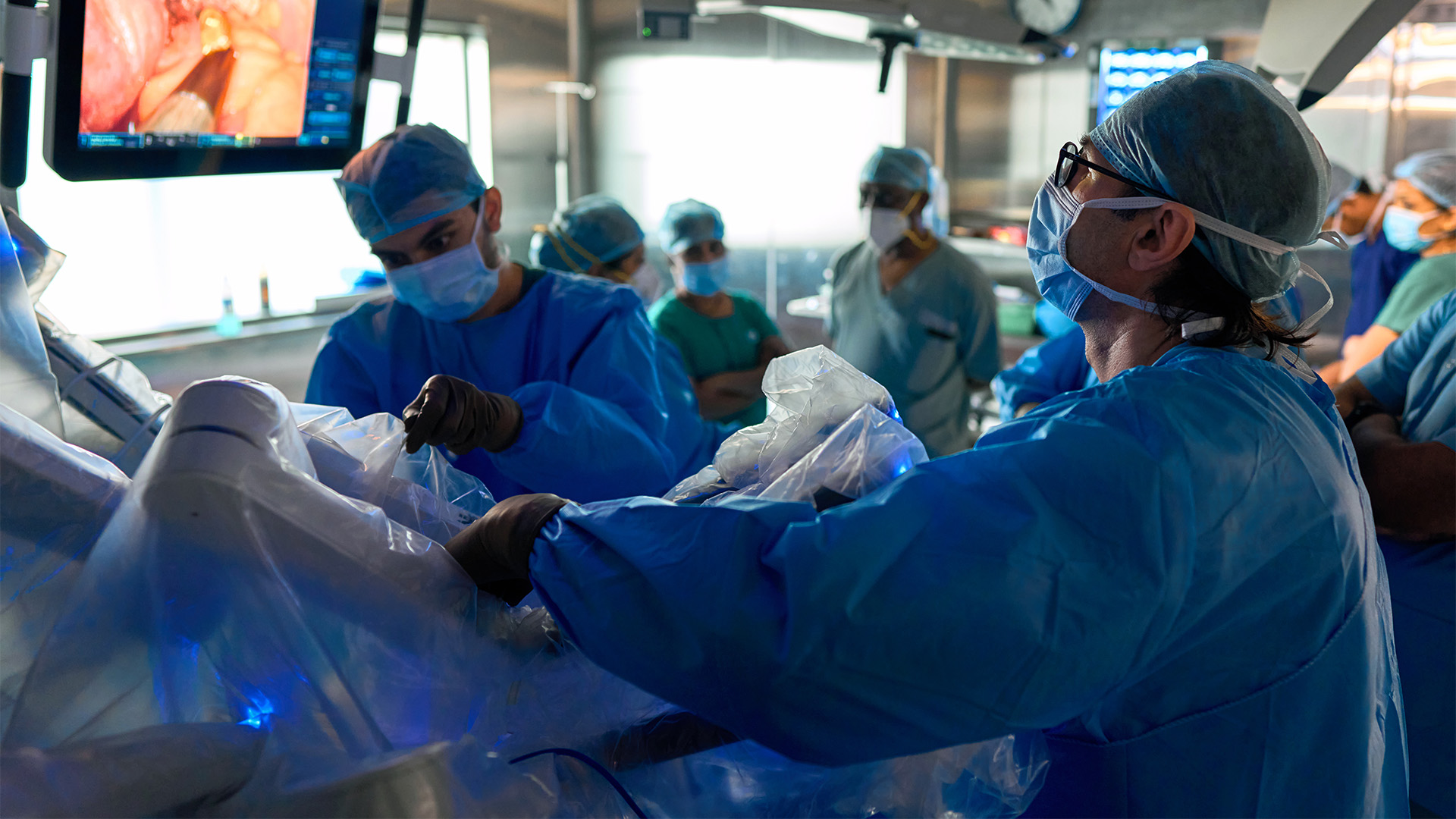
In this CTSNet series, Dr. Mario Castillo-Sang presents innovative, totally endoscopic cardiac procedures for a variety of conditions. Stay tuned for more series videos in the coming weeks.
The authors present a case of totally endoscopic repair for atrial functional mitral regurgitation, including left atrial ablation and left atrial appendage clip placement.
The patient was a 59-year-old female with severe mitral regurgitation of an atrial functional nature, slightly depressed left ventricular ejection fraction, dilated left atrium, and slightly dilated left ventricle. The typical centrally directed jet of functional atrial mitral regurgitation was observed. Transesophageal echocardiogram and 3D reconstruction were performed to estimate the location and severity of the jet. Oftentimes, small indentations or clefts that are contributing mechanisms to the mitral regurgitation are identified.
The authors utilized a totally endoscopic approach with single-lung ventilation, which began with a 2-3 cm working incision in the right fourth intercostal space using a soft tissue retractor. Femoral cannulation is used in most cases; however, in instances of significant Ilio-femoral peripheral arterial disease, the axillary artery is employed as the arterial inflow. Once cardiopulmonary bypass was established, the lungs were brought down, the oblique sinus was opened, the aorta was separated from the pulmonary artery to allow for cross-clamp placement. Antegrade del Nido cardioplegia and moderate hypothermia to 32 degrees Celsius were utilized. A flexible aortic cross-clamp was placed through the main working incision.
The surgeons retracted the cardioplegia needle using a silk suture on the left pericardial edge. This stitch helped move the root vent out of the camera’s field of view. Once the heart was arrested and the aorta was flaccid, the aorta was lifted anteriorly to expose the transverse sinus and the left atrial appendage. A stitch was placed on the tip of the appendage. It is very important to visualize the root, the base of the appendage, and, if possible, the circumflex artery. The base of the appendage was measured, and an AtriClip Flex V was upsized by one. The atrial clip was advanced into the sinus, and the base of the appendage was clipped. The authors found that clipping the appendage was a time saver compared to other techniques.
Access to the left atrium was achieved through the Sondergaard’s groove. By placing a retraction stitch on the right atrium and passing it through the anterior chest wall at the level of the fourth intercostal space laterally to the right internal thoracic artery, the right atrium was pulled upward, exposing the groove. This area was opened sharply. It was evident how thin and dilated the left atrium had become.
It was important to fashion this incision in a way that made closure easier, directing it mostly toward the dome rather than too close to the veins because getting too close to the veins may lead to the need for patching and other maneuvers. The surgeons applied an atrial lift retractor, which features a deployable wing that optimizes the valve exposure.
For the left atrial ablation portion, the authors packed a Ray-Tec sponge behind the left atrium through the oblique sinus, which elevated the left atrium and pushed it away from the posterior pericardium. The transesophageal echocardiography (TEE) probe, of course, was pulled back into the cervical esophagus, and the cryoprobe was used to create the inferior (floor) lesion, which also covered halfway through the left pulmonary veins. The end of the lesion was marked, and the authors moved to the roof of the left atrium to fashion a superior connecting lesion, thus completing a box lesion over the pulmonary veins. The surgeons added epicardial coronary sinus and endocardial mitral isthmus lesions using the cryoprobe, ensuring that these lesions overlapped to prevent any left atrial flutter at this level.
Once this was completed, the surgeons deployed the wing of the retractor, which provided excellent exposure of the entirety of the valve. The wing also held the cardiotomy sucker out of the way, creating a clean space to work through. Static testing was performed with del Nido cardioplegia using a laparoscopic suction irrigator, which showed an absence of prolapse or flail segments, as expected. Consequently, the author applied the annuloplasty sutures circumferentially, utilizing a complete ring that was semi-rigid and more flexible than traditional semi-rigid nitinol core rings.
For the placement of sutures in the P1 area of the annulus, where the circumflex artery is located, it is important to avoid deep bites that may injure the artery, as it is closer than one might think. The scope was a very useful tool, allowing for a change in vantage point to allow better visualization and ensure more precise suture placement.
This video was sped up to 200 times normal speed for the sake of time. The annuloplasty sutures took approximately 15 to 18 minutes to place. The sutures were passed through the ring outside the chest cavity, and the ring was parachuted down to the mitral valve under direct vision of the scope. Oftentimes, the surgeons need to remove the holder from the ring to facilitate passing it through the small working incision. The surgeons avoided using an intercostal retractor to minimize postoperative pain. Titanium fasteners were employed to secure the ring in place. The valve repair was tested with ink to evaluate the coaptation zone. Once satisfied with the results, the wing of the retractor was closed, leaving it partially in place to facilitate the initial closure of the left atrium. Once the retractor was removed, the closure and deairing of the atrium were completed in a standard fashion, and a titanium faster was used to tie the running suture. A ventricular pacing wire was applied to the diaphragmatic surface of the right ventricle
The aortic cross-clamp was removed, and the patient was weaned off bypass. The repair was accessed with TEE, after which the surgeons typically return to the bypass to remove the aortic vent using a titanium faster. Sometimes this can be done with a period of apnea and rapid pacing to lower the blood pressure. The results from the echocardiogram showed no residual mitral regurgitation, with ventricular contractility similar to preoperative levels, a low gradient, and normal sinus rhythm.
Discussion
Atrial functional mitral regurgitation needs to be differentiated from functional ventricular mitral regurgitation because the former can be effectively treated with annuloplasty with a low recurrence rate (1, 2). This entity is usually associated with atrial fibrillation, and ablation should be part of the surgical procedure. The endoscopic approach allows surgeons to treat these patients with lower morbidity, a shorter length of stay, and a faster return to work (3).
References
- Zoghbi W, Levine RA, Flachskampf F, Grayburn P, Gilliam L, Leipsic J, Thomas J, Kwong RY, Vandervoot Pieter, Chandrasekhar. Atrial Functional Mitral Regurgitation. J Am Coll Cardiology Img. 2022;15:1870-1882.
- Wagner CM et al. Surgical strategy and outcomes for atrial functional mitral regurgitation: all functional mitral regurgitation is not the same! J Thorac Cardiovasc Surg 2024; 167(2):647-655
- Castillo-Sang M, Nguyen Tom C. A Simplified Approach Step-by Step with Pearls and Pitfalls for Minimally Invasive Mitral Valve Surgery ( non-redo). Operative Tech in Thoracic and Cardiovascular Surgery 2022; 27 (2), 161-174.
Disclaimer
The information and views presented on CTSNet.org represent the views of the authors and contributors of the material and not of CTSNet. Please review our full disclaimer page here.
 339 views on Vimeo
 638 views