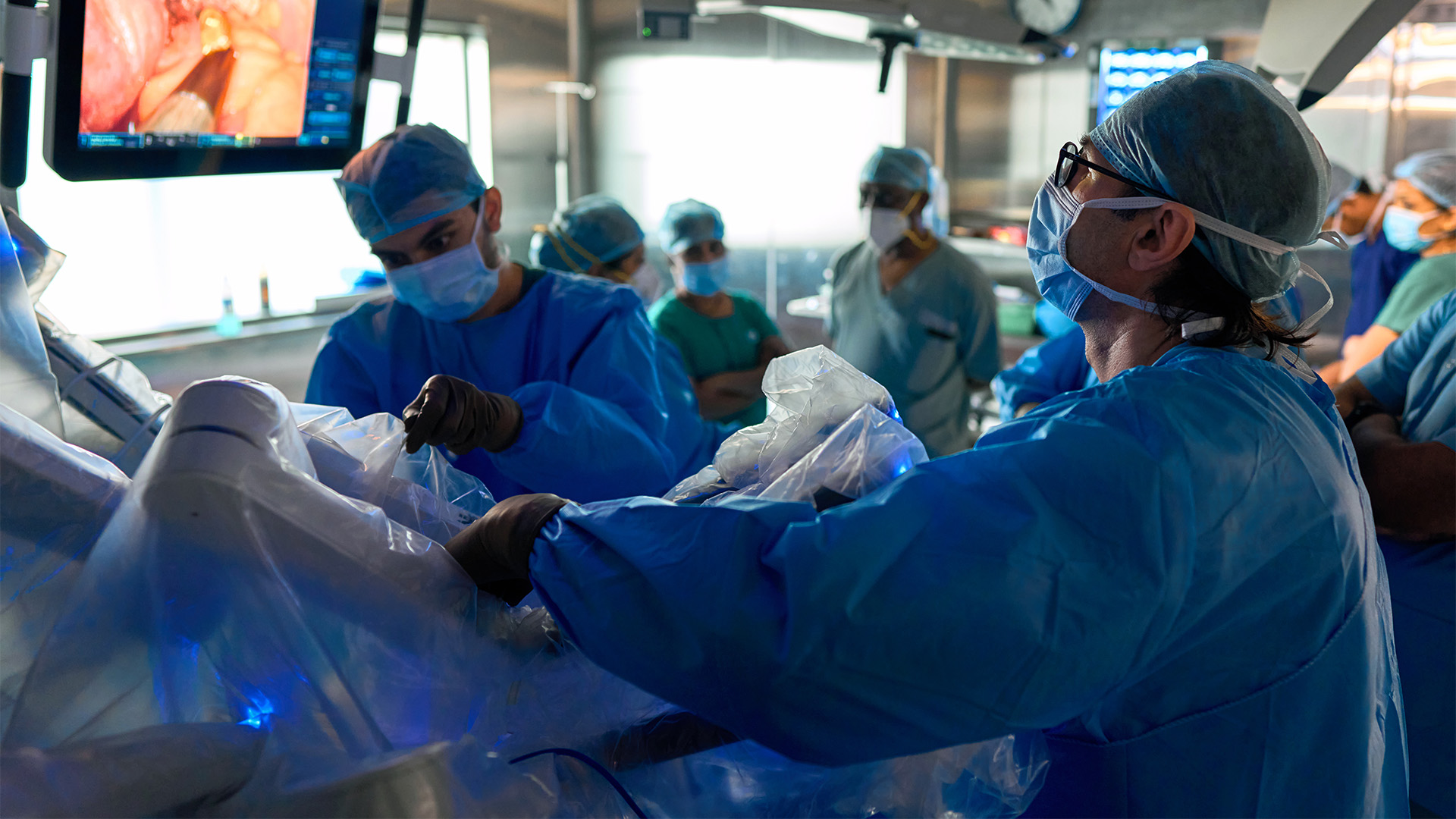
This video demonstrates the surgical repair of a ruptured right coronary artery aneurysm.
A 62-year-old man with hypertension presented with an acute onset of chest pain and was hemodynamically stable. His ischemic work-up was negative, but a computed tomography angiography (CTA) showed a right coronary artery aneurysm with hemopericardium. Coronary angiography showed a sufficient posterior descending artery target for bypass, as well as a dilated left anterior descending artery with stenosis.
Intraoperative transesophageal echocardiography (TEE) showed the right coronary aneurysm and its mass effect on the right heart, as well as the pericardial effusion.
A median sternotomy was performed, and cardiopulmonary bypass was established via the femoral vessels prior to opening the pericardium. The hemopericardium was evacuated. A thrombus was noted posterior to the right coronary artery aneurysm.
Due to the large caliber of the coronary arteries, as well as the undetermined severity of the left anterior descending artery (LAD) stenosis, two-vessel coronary artery bypass grafting was performed using saphenous vein grafts with pump assistance. The LAD was stabilized, and the distal anastomosis of the vein graft was performed, followed by the proximal anastomosis using a partial aortic clamp. This surgical approach was chosen because of the relative ease of sowing the large coronary artery distal anastomoses, the lack of ascending aortic plaque, and the potential difficulty of delivering cardioplegia through the ruptured aneurysm and the stenotic LAD. Due to the location of the aneurysm, the establishment of retrograde cardioplegia may have also proven to be challenging. The posterior descending artery was then bypassed in a similar fashion. The distal anastomoses were performed before the proximal anastomoses, as it appeared that this approach would allow for more accurate measurement of the graft lengths around the coronary artery aneurysm. Creating the bypass grafts first allowed for a reliable route for the delivery of antegrade cardioplegia. The bulldogs and partial aortic clamp were removed prior to tying down the proximal suture to allow for deairing.
An antegrade cardioplegia needle was placed, the aorta was cross-clamped, and the heart was arrested. The right coronary artery aneurysm was then opened. The incision was carried proximally to where the aneurysm tapered. This was done with knowledge of the preoperative coronary angiogram, which had shown that there were no right coronary artery branches in this area. There was a linear tear in the artery posteriorly, which was presumed to be the site of rupture. The incision in the aneurysm was then carried distally, revealing a large amount of thrombus. The thrombus was evacuated, and the aneurysm sac was irrigated thoroughly to remove any stray debris and to visualize any branch vessels feeding the aneurysm sac. The incision was then carried to the site of the distal taper, which was then oversewn with a double layer of 4-0 Prolene. The site of the proximal taper of the aneurysm was oversewn in a similar fashion.
The cross-clamp was removed, and hemostasis was achieved, first by cauterizing the edges of the aneurysm. The aneurysm sac was then inspected for bleeding branch vessels, which were then oversewn. The site of the posterior tear in the aneurysm was also oversewn, as this appeared to be a difficult area to sufficiently cauterize.
TEE showed good biventricular function. The patient recovered well postoperatively and was discharged home on postoperative day eight.
References
- Taguchi H, Obase K, Eishi J, Nakaji S, Miura T, Eishi K. Surgery for posterior wall rupture of a left main trunk coronary artery aneurysm. JTCVS Techniques, Volume 16, 96-98.
Disclaimer
The information and views presented on CTSNet.org represent the views of the authors and contributors of the material and not of CTSNet. Please review our full disclaimer page here.
 482 views on Vimeo
 706 views