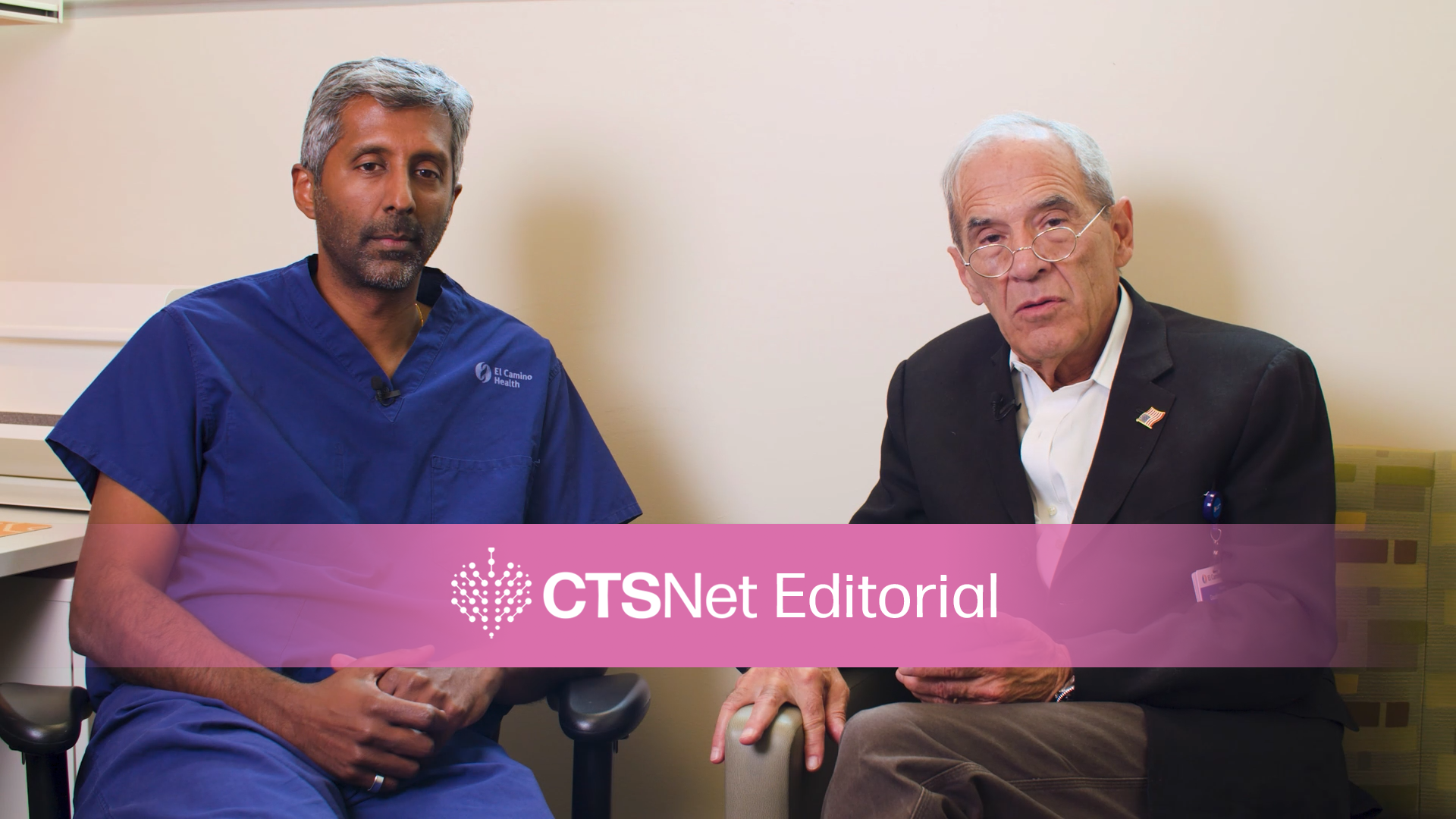
This video submission is from the 2025 CTSNet Innovation Video Competition. Watch all entries from the competition, including the winning videos.
A 27-year-old female presented with intermittent breathlessness and recurrent syncope. Transthoracic echocardiography revealed a mobile right-sided mass, initially raising suspicion of a tumor or thrombus. Transesophageal echocardiography clarified that the mass was vascular in origin. Coronary angiography revealed a giant right coronary artery (RCA) aneurysm, with the posterior descending artery (PDA) originating proximally and the posterolateral ventricular branch (PLVB) distally, along with normal left-sided system. Computed tomography (CT) coronary angiography confirmed the compression effect on the right chambers of the heart.
Conventional surgical strategies such as aneurysm exclusion with bypass or complete resection were considered; however, an innovative approach was chosen: partial aneurysm excision with interpositional grafting using a reversed saphenous vein to preserve native coronary continuity.
Following median sternotomy and initiation of cardiopulmonary bypass, the aneurysmal right coronary artery (RCA) segment was exposed and controlled, and aneurysmotomy revealed organized thrombus, which was evacuated. Both proximal and distal ends of the RCA were identified, mobilized, and trimmed to healthy segments, with flow confirmed using coronary probes. A reversed saphenous vein graft, harvested from the left lower limb, was tailored and anastomosed end-to-end to the proximal and distal RCA stumps using 8-0 polypropylene.
The aneurysmal sac was then partially excised, preserving surrounding structures, and the residual cavity was obliterated using a double-breasting technique with continuous 4-0 polypropylene sutures to ensure a reinforced, hemostatic closure and eliminate dead space.
After aortic cross-clamp release, the heart regained sinus rhythm spontaneously with good contractility, and the patient was weaned off bypass without inotropic support. Postoperative recovery was uneventful. The patient was extubated on the day of surgery, mobilized on postoperative day one, and discharged in stable condition on postoperative day six. A postoperative CT coronary angiogram confirmed complete exclusion of aneurysm with no residual sac and a widely patent interpositional graft.
This innovative surgical strategy highlights a safe, effective, and anatomy-preserving technique in the management of giant coronary aneurysms. Partial aneurysm excision combined with interpositional grafting maintains physiological vessel continuity, reduces the risks of rupture or thromboembolism, and ensures durable revascularization. This technique also retains future access for catheter-based or hybrid reinterventions and is particularly beneficial in young patients with suitable anatomy, offering a promising alternative to traditional exclusion strategies.
References
- Li D, Wu Q, Sun L, Song Y, Wang W, Pan S, et al. Surgical treatment of giant coronary artery aneurysm. J Thorac Cardiovasc Surg. 2005;130(3):817–21.
- Kuroda Y, Uchida T, Hamasaki A, Yamashita A, Mizumoto M, Akabane K, et al. Surgical treatment for a super-giant right coronary artery aneurysm induced by Kawasaki disease. Braz J Cardiovasc Surg. 2021;36(4):433–5.
- Greiten LE, Laan D, Joyce LD, Greason KL, Daly RC, Schaff HV, et al. Management of coronary artery aneurysms at the time of surgical revascularization. J Surg Res. 2020;253:288–93.
- Kawsara A, Nuñez-Gil IJ, Alqahtani F, Moreland J, Rihal CS, Alkhouli M. Management of coronary artery aneurysms. JACC Cardiovasc Interv. 2018;11(13):1211–23.
- Nuñez-Gil IJ, Cerrato E, Bollati M, Nombela-Franco L, Terol B, Alfonso-Rodríguez E, et al. Coronary artery aneurysms: insights from the international coronary artery aneurysm registry (CAAR). Int J Cardiol. 2020;299:49–55.
Disclaimer
The information and views presented on CTSNet.org represent the views of the authors and contributors of the material and not of CTSNet. Please review our full disclaimer page here.
 271 views on Vimeo