Content from the Journal of the American Neurological Surgeons.
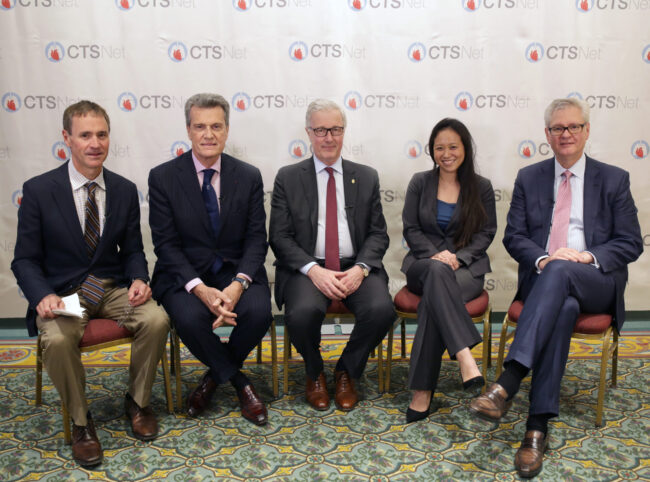
Filmed at the 2019 STS Annual Meeting in San Diego, California, Jill Ley of California Pacific Medical Center in San Francisco moderates a discussion on the ERAS multidisciplinary team. She is joined by Michael Grant of Johns Hopkins University in Baltimore, Maryland, USA, Jon Parmet of Society Hill Anesthesia Consultants in Cherry Hill, New Jersey,…
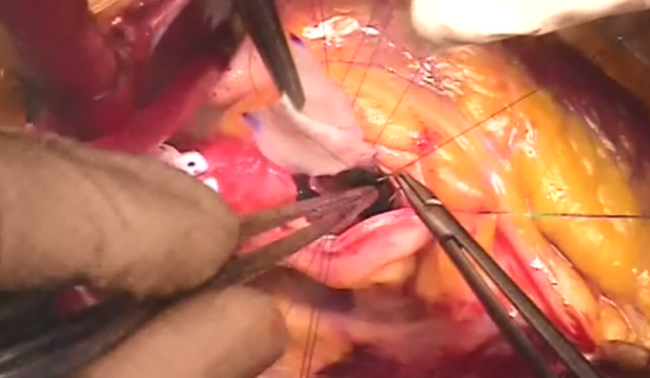
The patient was a 4.0 kg boy born at 40+2 weeks via uncomplicated spontaneous vaginal delivery. It is unknown whether an APGAR test and pulse ox screen test were administered at birth. The hospital course was uncomplicated, and the patient was subsequently discharged home. The patient was seen twice at the pediatrician for poor weight…
Objectives The authors present a video of transventricular apical myectomy in a patient with nonobstructive hypertrophic cardiomyopathy. Methods A 20-year-old woman with a diagnosis of apical hypertrophic cardiomyopathy (HCM) presented to the authors’ clinic with syncope, palpitations, and New York Heart Association class IV dyspnea. Two years prior to presentation, she had a cardiac arrest,…
A 17-year-old woman was admitted to the authors’ hospital with left chest pain, cough, and dyspnea. Computed tomography (CT) scan showed a giant bulla of the left upper lobe. Lobectomy was performed with video-assisted thoracic surgery (VATS). After the operation, the patient was stable, and chest CT showed good expansion of the left lower lobe.…
James Tatoulis of the Royal Melbourne Hospital in Australia discusses the use of the radial artery, including tips and tricks for vein harvesting, and how to deploy it in coronary surgery. This presentation was originally given during the SCTS Ionescu University program at the 2019 Annual Meeting of the Society for Cardiothoracic Surgery in Great…
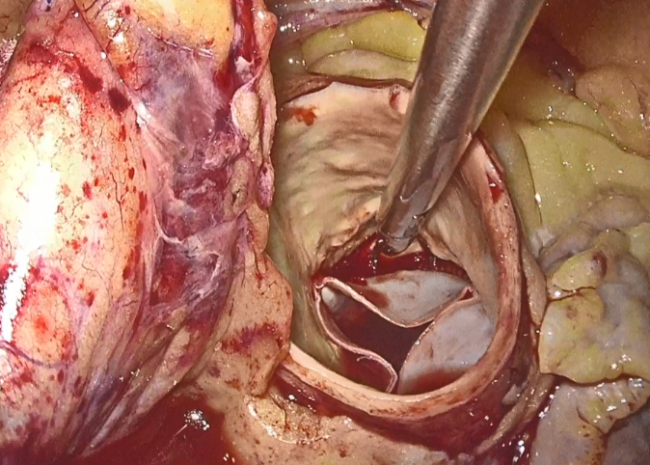
Aortic valve reconstruction with glutaraldehyde-treated autologous pericardium has been demonstrated by Ozaki and colleagues to have good midterm results with less transvalvular gradient, less than mild aortic regurgitation, and 96.2% freedom from reoperation. The Ozaki technique uses an original template for each cusp designed by Ozaki, and the leaflets are trimmed according to the template…
The authors present a video showing their technique of totally endoscopic aortic valve replacement with a bovine pericardial valve (Trifecta GT, Abbott), performed for an 81-year-old patient with severe aortic stenosis and moderate aortic regurgitation. The patient was heavily symptomatic in class III and had a EuroSCORE II of 2.36. The patient was positioned supine…
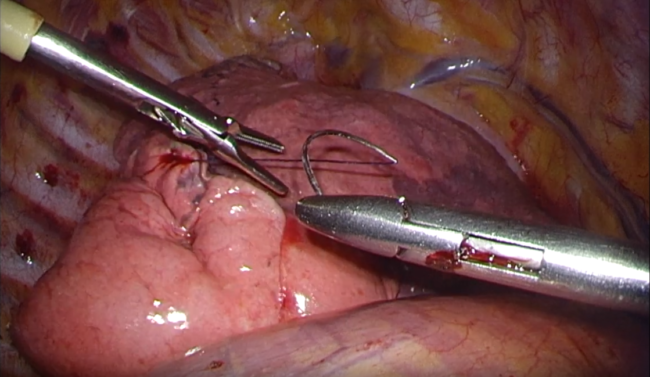
SummaryThoracoscopic suturing can be performed in different clinical scenarios, from pulmonary iatrogenic injuries to bronchoplastic resections, avoiding the necessity of conversion to open surgery. In this video, some of the prevailing indications for suturing are shown using a full thoracoscopic technique (1). DescriptionThis video shows some of the most common indications for thoracoscopic suturing. A…
Filmed at the 2019 AATS Annual Meeting in Toronto, Canada, Marc Moon of Washington University in St Louis, Missouri, moderates a discussion on wellness in cardiothoracic surgery. He is joined by Gilles Dreyfus of the Cardiovascular and Thoracic Centre of Monaco, Alec Patterson of Washington University, Stephanie Chang of Washington University, and David Jones of Memorial…
Sir Magdi Yacoub of the Imperial College London in the UK and Patrick Serruys of the Thoraxcenter Erasmus University in Rotterdam, Netherlands, discuss the use of tissue-engineered valves versus endogenous tissue restoration. This debate was presented at the Heart Valve Society (HVS) Annual Meeting 2019 in Sitges, Spain, and is presented here with permission from HVS. For…
Current American Heart Association/American College of Cardiology guidelines state that mitral valve repair for asymptomatic patients with preserved left ventricular function is reasonable when the likelihood of a successful and durable repair is greater than 95%, with an expected mortality rate of less than 1% when performed at a Heart Valve Center of Excellence (1).…
Zenker’s or pharyngoesophageal diverticulum is the most common diverticulum of the esophagus. It is herniation of the esophageal mucosa and submucosa through a weak point in the muscle layers of the hypopharynx. The most common herniation site, known as Killian’s triangle, is bordered by the inferior constrictor muscle or thyropharyngeus superiorly, and by the cricopharyngeus…
Sridhar Rathinam of Glenfield Hospital in Leicester, United Kingdom, discusses surgical approaches for pulmonary neuroendocrine tumors. He focuses on the role of the surgeon in caring for patients with neuroendocrine tumors, reviewing tumor staging, endobronchial interventions, and techniques for resection. This presentation was originally given during the SCTS Ionescu University program at the 2019 Annual…
Enhanced Recovery After Surgery (ERAS) is a perioperative protocol that places the patient at the center of all medical decisions. It is designed to reduce stress for the patient, alleviate the amount of pain they experience, and crucially, speed up the recovery and mobilization process, where removing invasive lines and drains as soon as possible…
The transapical artificial chord implantation technique using the NeoChord DS1000™ (NeoChord, Inc., St. Louis Park, MN, USA) system allows re-establishment of normal leaflet motion under real-time two-dimensional (2D) and three-dimensional (3D) transesophageal echocardiography guidance. With this technique, chord implantation and adjustment of their length is achievable without the use of cardiopulmonary bypass and without sternotomy.…
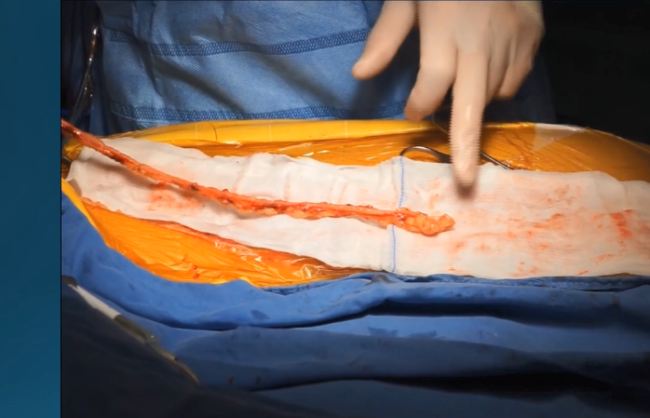
This video was recorded in the operating room of the cardiovascular surgery department of Shanghai 10th People’s Hospital in China. In this video, the authors present a modified no-touch technique of the saphenous vein harvesting and also the use of this kind of pedicle vein graft in an off-pump coronary artery bypass (CABG) procedure. The…