Content from the Journal of the American Neurological Surgeons.
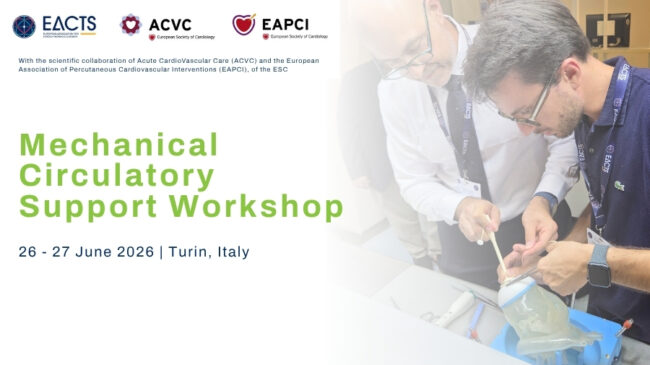
Join Us in Turin in June for This Interactive MCS Workshop! Providing didactic teaching, hands on dry lab operative experience, and practical demonstrations, this MCS Workshop welcomes everyone involved in heart failure care. Surgeons, anesthesiologists, perfusionists, acute care specialists, interventional cardiologists and heart failure nurses—all who participate in the management of critically ill patients…
Advanced-stage lung cancer patients who have undergone lung resection, adjuvant chemotherapy, and immunotherapy are often immunocompromised and prone to pleural space infections. A pleural window is usually not accepted by patients because of poor quality of life. Thoracoplasty with latissimus dorsi myoplasty, on the other hand, continues to play a vital role in selected patients,…
Background Transcatheter aortic valve replacement (TAVR) is now widely used for the management of aortic stenosis. As indications expand to include younger and lower-risk patients, surgical explantation of failed TAVR prostheses is being encountered more frequently. TAVR explantation is technically demanding due to the extensive endothelialization of the device and its integration with the aortic…
The patient was a healthy 88-year-old male who had been in atrial fibrillation (AF) for 20 years, who presented with a large left atrium. He had undergone ascending aortic replacement, aortic valve replacement, mitral valve repair (MVr), and tricuspid valve repair in the past, during which the repair of the tricuspid valve was performed through…
This video demonstrates the surgical management of a 36-year-old non-smoking female who was diagnosed with a typical carcinoid tumor involving the left lower lobe bronchus. The diagnosis was established through endobronchial ultrasound-guided transbronchial needle aspiration (EBUS-TBNA), and further evaluation with computed tomography (CT) and PET-DOTANOC imaging revealed a 25 mm centrally located hilar lesion without…
Change is hard, so for those who are looking for guidance on where to find specific features or further explanation about the redesigned CTSNet, you’ve come to the right place! This guide provides a comprehensive overview of the new CTSNet.org experience, including explanations of new features, along with videos and screenshots to help you navigate…
This video demonstrates the use of chrondotomies in the Nuss procedure to allow the sternum to lift more safely in the most severe pectus excavatum cases. The authors found that in very severe cases, and in older patients with asymmetry, simply lifting the sternum with bars is not sufficient. The cartilages can fracture in undesirable…
The patient was a 2-month-old, 4.5 kg infant with heart failure symptoms and severe pulmonary hypertension who was diagnosed with multiple apical ventricular septal defects (VSDs). He was placed on home oxygen and Sildenafil in an attempt to lower his pulmonary artery pressure. After a thorough evaluation, cardiac catheterization showed improvement in his pulmonary vascular…
Pectus excavatum is a common chest wall deformity that can cause significant symptoms. The minimally invasive Nuss procedure is a widely used surgical technique to correct this condition by placing a curved metal bar (Nuss bar) behind the sternum, repositioning it into a more normal anatomical shape. In this video, the authors present the case of…
At the Society for Cardiothoracic Surgery in Great Britain and Ireland Annual Meeting, Dr. Emile Bacha, Chair of the Department of Surgery and Surgeon-in-Chief at Columbia University Medical Center and Morgan Stanley Children’s Hospital NewYork-Presbyterian, NY, USA, delivered an outstanding presentation titled “Surgical Management of Aortic Valve Disease in Young Patients.” He explored essential aspects…
At the 2026 Society for Cardiothoracic Surgery in Great Britain and Ireland Annual Meeting, leading surgeons presented on various cardiac topics, including the Ross procedure, aortic infections, and the branch-first technique. Dr. Emile Bacha, Chair of the Department of Surgery and Surgeon-in-Chief at Columbia University Medical Center and Morgan Stanley Children’s Hospital NewYork-Presbyterian, NY, USA,…
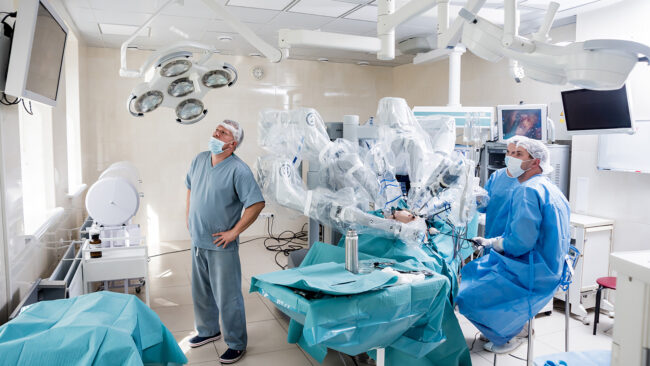
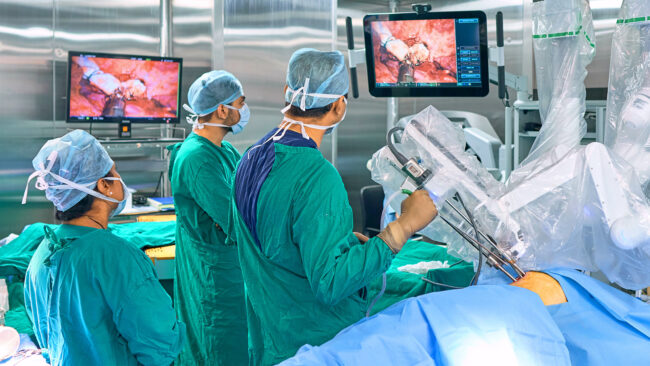
The patient was a 77-year-old man who presented with progressive shortness of breath. Coronary angiography demonstrated significant proximal left anterior descending artery stenosis, proximal left circumflex artery stenosis, and posterior descending artery stenosis. Given the extent of disease, robotic assisted minimally invasive coronary artery revascularization was planned. The procedure was performed entirely without cardiopulmonary bypass.…
This video demonstrates a case of Tetralogy of Fallot (TOF), and after clearing the right ventricular outflow tract (RVOT) and closing the ventricular septal defect (VSD) from the right atrium, the focus shifted to the RVOT from the pulmonary artery aspect. An initial incision was made over the pulmonary artery, and the pulmonary valve was…
Introduction The authors present a right-sided robotic resection of an enlarging anterior mediastinal mass, emphasizing the operative strategy, anatomic landmarks, and key decision points. Clinical Presentation and Workup A 54-year-old man with several years of intermittent, non-specific chest pressure underwent coronary calcium scoring computed tomography (CT) in November 2023, which incidentally identified an anterior mediastinal…
Position of the Patient The patient was positioned supine on the bed with a footrest. This secures the patient well, especially when a steep reverse Trendelenburg position is required. A steep reverse Trendelenburg position was used to allow the abdominal contents to fall away from the diaphragm. The patient was positioned flush to the right…
The patient was a 20-year-old female referred to the heart center for the evaluation of rheumatic heart disease and severe mitral regurgitation. She reported dyspnea on moderate exertion New York Heart Association (NYHA) Class III, as well as palpitations and reduced exercise tolerance, which progressively worsened over a period of three years. Her rheumatic history…