Content from the Journal of the American Neurological Surgeons.
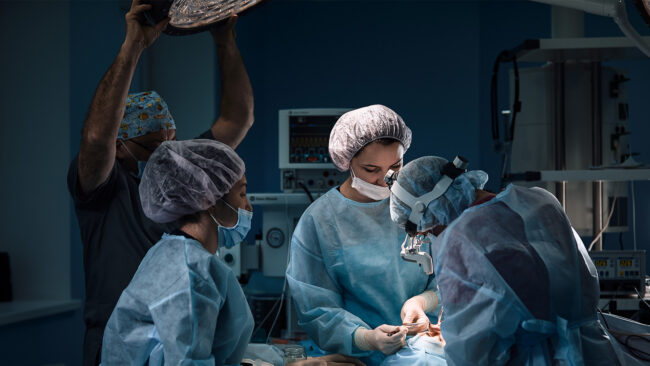
Anomalous left coronary artery from the pulmonary artery (ALCAPA) is a rare but critical congenital anomaly that typically presents in infancy with myocardial ischemia and left ventricular dysfunction. Early surgical correction is essential and aims to establish a dual coronary system. In this video, the authors demonstrate the repair through direct aortic implantation (1, 2,…
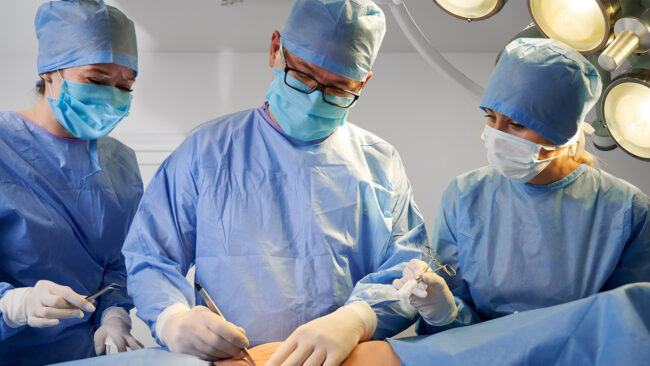
This video demonstrates the feasibility and step-by-step technique of performing a Bentall procedure through a right axillary minithoracotomy in an adult patient with aortic root aneurysm and aortic valve disease. Cardiopulmonary bypass was established via femoral cannulation, and a 5–6 cm right axillary incision was used to access the ascending aorta and root with soft-tissue…
A variety of mechanical circulatory support strategies are available to treat cardiogenic shock with left ventricular failure. Current theory suggests that direct left ventricular unloading should be superior to other strategies. However, these theoretical frameworks have flaws, and clinical data do not consistently support this concept. The authors discuss these issues and propose a middle…
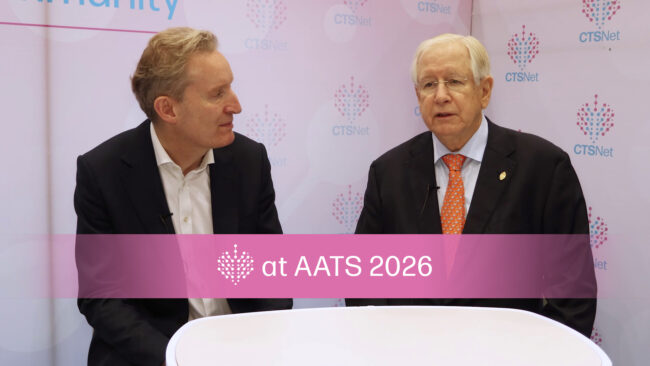
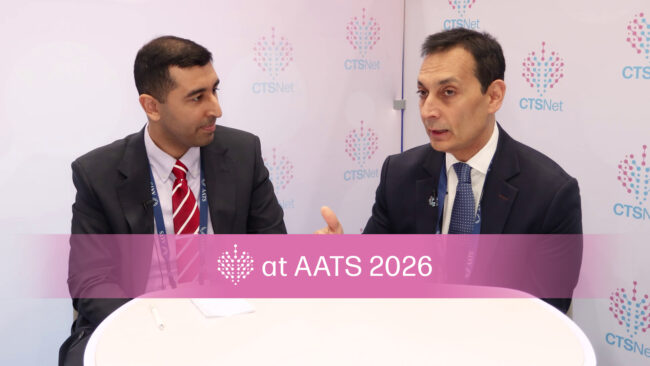
At the 2026 American Association for Thoracic Surgery (AATS) Annual Meeting, CTSNet Editor-in-Chief, Joel Dunning, a cardiothoracic surgeon at James Cook University Hospital in Middlesbrough, UK, engaged in a discussion with Dr. Joseph Coselli, Executive Vice-Chair of the Michael E. DeBakey Department of Surgery, the Cullen Foundation Endowed Chair, and a Professor in the Division of Cardiothoracic Surgery at Baylor College of Medicine,…
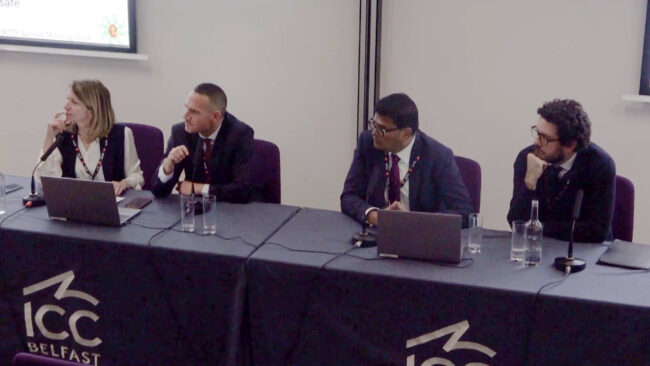
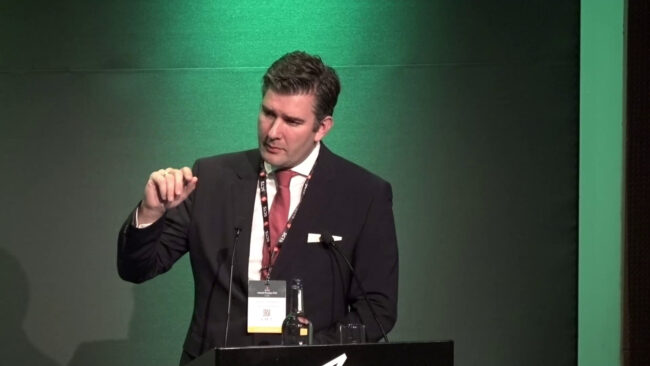
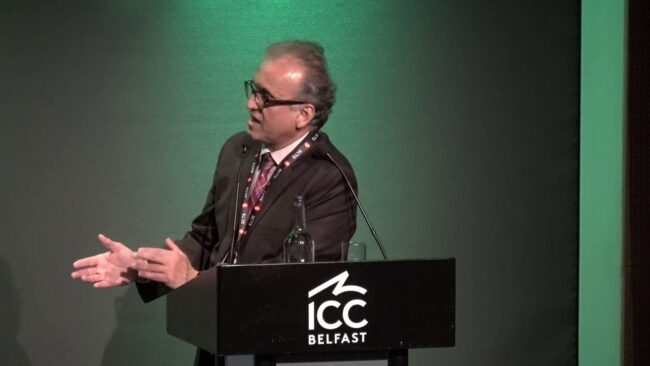
At the Society for Cardiothoracic Surgery in Great Britain and Ireland Annual Meeting, leading surgeons presented on minimally invasive cardiac surgery. Dr. Ranjit Deshpande, a consultant cardiothoracic surgeon at King’s College Hospital and Cleveland Clinic, London, UK, delivered a presentation titled “Multi Valve Surgery Through Minimal Access Approach: Who, When, and How?” He discussed mitral…
This video discusses the three pillars of precision medicine in cardiogenic shock and the latest research. First, machine learning phenotyping can identify distinct and biologically meaningful subgroups within the heterogeneous shock population. Second, causal-inference machine learning reveals real treatment-effect heterogeneity across temporary mechanical circulatory support (tMCS) devices, allowing surgeons to predict benefits at the level…
This segment provides an overview of the American Society for Artificial Internal Organs (ASAIO), including its mission, membership benefits, leadership structure, and role in advancing the science and technology of artificial organs, organ support systems, and related therapies. Attendees will also receive an introduction to the ASAIO Annual Conference, highlighting scientific sessions, networking opportunities, industry…
A 56-year-old woman with no significant past medical history presented with progressive dyspnea on exertion and intermittent back pain. Computed tomography (CT) of the chest demonstrated a markedly dilated main pulmonary artery measuring 7 x 6 cm, consistent with a giant pulmonary artery aneurysm. Transesophageal echocardiography confirmed severe aneurysmal dilation of the pulmonary artery, severe…
A 28-year-old female initially presented in 2022 with a persistent cough. Computed tomography (CT) imaging demonstrated features consistent with pulmonary sarcoidosis, which was subsequently confirmed by bronchoscopic biopsy. She was evaluated for lung transplantation and subsequently listed under the super-urgent category. Her past medical history was unremarkable. As part of the preoperative assessment, CT imaging…
Surgical repair of anomalous left coronary artery from the right pulmonary artery is indicated once diagnosed, especially in infants presenting with severe ventricular dysfunction, with or without mitral regurgitation or myocardial ischemia. Case Presentation A 4-month-old male infant (6.3 kg) presented with heart failure symptoms. Preoperative transthoracic echocardiography showed: Hyperechoic mitral papillary muscle Dilated left…
The authors present a case of reoperative settings using a minimally invasive approach in an 11-year-old girl with a complex congenital heart defect. The procedure consisted of pulmonary valve replacement via a left anterior minithoracotomy in the second intercostal space, indicated for severe pulmonary valve insufficiency. The patient was born with a complex congenital heart…
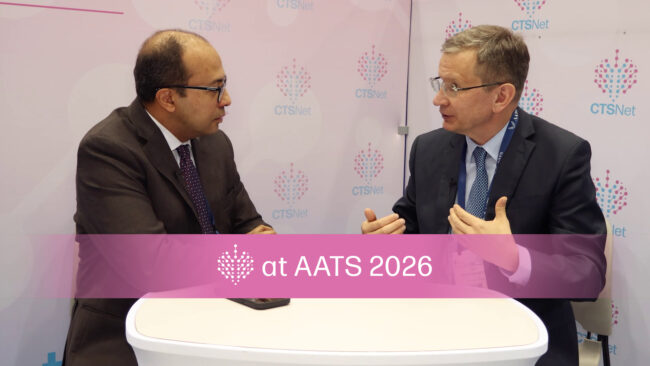
At the 2026 American Association for Thoracic Surgery (AATS) Annual Meeting, CTSNet JANS Editor Dr. Mujtaba Mubashir, a cardiothoracic fellow at Beth Israel Deaconess Medical Center, Boston, MA, USA, engaged in a thought-provoking discussion with Dr. Faiz Bhora, Professor of Surgery at the Hackensack Meridian School of Medicine and Regional Chair of Surgery and Chief…
At the 2026 American Association for Thoracic Surgery (AATS) Annual Meeting, CTSNet Senior Editor—Congenital, Dr. Sameh Said, Chief of the Division of Pediatric and Adult Congenital Cardiac Surgery at Maria Fareri Children’s Hospital in Valhalla, NY, USA, spoke with Dr. Igor Konstantinov, a consultant cardiothoracic surgeon at The Royal Children’s Hospital, Melbourne, Australia, about truncal…
At the Society for Cardiothoracic Surgery in Great Britain and Ireland Annual Meeting, Dr. Laurens Ceulemans, a thoracic and transplant surgeon and Associate Professor of Surgery at UZ/KU Leuven, Belgium, delivered a presentation titled “Lung Transplant: Daytime Surgery.” He discussed the impact of ischemic time and temperature on lung presentation, presented on a pilot study that utilized 10 degrees Celsius to intentionally delay transplantation, as well as a…
At the Society for Cardiothoracic Surgery in Great Britain and Ireland Annual Meeting, leading surgeons presented on mesenchymal stem cells and transplants. Dr. Laurens Ceulemans, a thoracic and transplant surgeon and Associate Professor of Surgery at UZ/KU Leuven, Belgium, delivered a presentation titled “Lung Transplant: Daytime Surgery.” He discussed the impact of ischemic time and temperature on lung presentation, presented on a pilot study that utilized 10 degrees Celsius to intentionally delay transplantation, as well as a prospective randomized…
A 60-year-old man with hypertension and hyperlipidemia was diagnosed with multivessel coronary artery disease and underwent cardiac catheterization, which revealed significant stenoses in the left main, circumflex, ramus, and right coronary arteries. During the procedure, he developed hypotension and chest pain, requiring intra-aortic balloon pump support and urgent referral for coronary artery bypass grafting. Coronary angiography, performed using standard catheters (JR4, JL4),…