Content from the Journal of the American Neurological Surgeons.
The patient was a nine-month-old, 8.8 kg infant who was born with anomalous origin of the right pulmonary artery (RPA) from the ascending aorta. She underwent an initial median sternotomy with translocation of the RPA to the main pulmonary artery and anterior translocation of the RPA. The patient developed stenosis of the RPA and underwent…
This video presents the management of a complex and infrequently encountered scenario. A sixty-nine-year-old patient had a large pulmonary artery aneurysm extending from the main pulmonary artery (PA) up to the bifurcation with further extension into the left PA and relative sparing of the right. The patient had a history of a heart murmur and…
Recently, a subxiphoid approach has become popular in thoracic surgery because it provides more freedom of movement, as there is no limitation by the ribs, and it avoids trauma to the intercostal nerves, thereby creating less postoperative pain. Although subxiphoid video-assisted bilateral anatomic resections have been successfully performed, to the authors’ knowledge, robotic-assisted thoracoscopic bilateral…
Colombia is a mountainous country in South America with a population of 52 million people. It is the fifth largest country in South America and, according to the World Health Organization, has the best healthcare in Latin America. Despite this, there is no official lung transplant program for surgical residents in Colombia, and only three…
The atrial myxoma is the most frequent cardiac tumor, located in the left atrium in 75 percent of the time (1). The most dangerous presentation is the papillary, which indicates is the surgical removal with the aim to avoid embolic complications (2-5). The minimally invasive approach (MICS) has shown to be a feasible technique. The…
In March 2023, the Society for Cardiothoracic Surgery in Great Britain and Ireland brought together surgeons from around the world to discuss topics in CT surgery. These recordings cover the two sessions focused on coronary surgery. Use the time stamps on each video to direct yourself to each surgeon’s discussion. Coronary Session 1: Technical Tips…
This video presents a case of a typical carcinoid tumor located in the distal part of bronchus intermedius. The patient is a fifty-six-year-old woman who is a nonsmoker. Her comorbidities included bronchial asthma, obesity, type 2 diabetes, and arterial hypertension. After a few weeks of wheezing and coughing, a chest CT scan was performed and…
Thoracic duct ligation is a proven, established procedure for chylothorax management refractory to medical management. However, intraoperative localization of the thoracic duct course or leakage is difficult, and there is a lack of consensus on the best intraoperative modality to visualize a thoracic duct. This video proposes that ICG can be used as the modality…
Do you have unanswered questions or underlying concerns regarding the discussion that took place during the ASAIO Journal and CTSNet webinar, “Extracorporeal Cardiopulmonary Resuscitation (ECPR): Building the Team for Success”? We’ve got you covered! For a total of 15 questions asked by the live audience, please refer to the below questions and answers that came…
The patient is an eighteen-year-old who underwent previous sternotomy for closure of a perimembranous ventricular septal defect and resection of subaortic membrane and presented with progressive aortic root dilation. He had strong family history of aortic dissection; therefore, surgery was recommended. Preoperative studies showed no residual intracardiac shunt and competent aortic valve with good biventricular…
The ASAIO Journal joined CTSNet in broadcasting a webinar on the developing cardiac care topic, “Extracorporeal Cardiopulmonary Resuscitation (ECPR): Building the Team for Success.” Helmed by ASAIO editor in chief Mark S. Slaughter (University of Louisville), the webinar explored this CPR method with the expert perspectives of panelists Jeffrey E. Keenan (Duke University Medical Center),…
In March 2023, the Society for Cardiothoracic Surgery in Great Britain and Ireland brought together surgeons from around the world to discuss topics in CT surgery. These recordings cover the two sessions focused on aortic surgery. Use the time stamps on each video to direct yourself to each surgeon’s discussion. Aortic Session 1: How to…
Following resistance to targeted treatment, oligoprogression can occur whereby a previously controlled site or sites of metastases progress after the majority of other sites of disease stabilize on systemic therapy. Interestingly, this patient developed MET amplification as the mechanisms of TKI resistance after being on alectinib therapy for more than two years. Limited data exist…
The patient is a two-and-a-half-year-old child with d-TGA/VSD/PS who underwent aortic translocation. The patient’s anatomy was typical of d-transposition with VSD and PS. Both coronaries were favorable in that they were off of the epicardium. To begin the procedure, the patient was positioned supine on the operating room table. A median sternotomy was performed, along…
The Patient A seventy-eight-year old man, a former smoker, was hospitalized for a six centimeter ground-glass opacity (GGO) with a central solid component arising from the upper lobe of the right lung and involving the lower lobe. His comorbidities included a pacemaker device for paroxysmal arrhythmia and a 4.9 centimeter subrenal aortic aneurysm. Clinicians had…
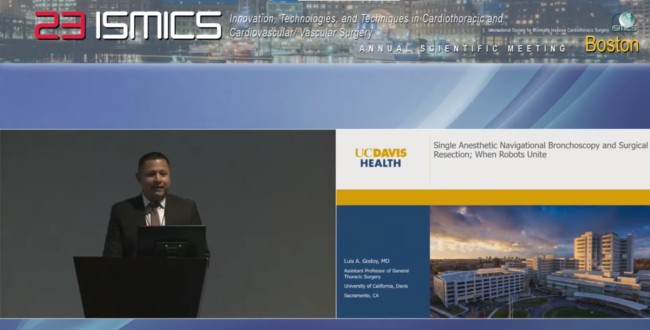
The 2023 ISMICS Annual Meeting saw cardiothoracic surgery professionals from around the world gather for three days of sessions with global experts. Two of these expert sessions were recorded. First, watch Luis A. Godoy, Assistant Professor of General Thoracic Surgery at University of California, Davis, give his talk, “Single Anesthetic Navigational Bronchoscopy and Surgical Resection:…