Content from the Journal of the American Neurological Surgeons.
The patient is a 16-year-old male who was a restrained passenger in a car that collided with a guardrail at high speed. He was initially admitted to the referring hospital with no respiratory symptoms and with oxygen saturations over 90%. The patient is a 16-year-old male who was a restrained passenger in a car that…
A 62-year-old Ukrainian man presented with facial swelling, chest wall varices, and a large mediastinal mass. He underwent core biopsy that demonstrated a mixed thymoma. Nine years previously, the patient had undergone an anterior thoracotomy and excisional biopsy of a mediastinal mass demonstrating necrotic tissue and no definitive diagnosis was made. A 62-year-old Ukrainian man…
This video was filmed from the perspective of a medical student investigating a career in cardiothoracic surgery. With each video chapter, he aims to provide information that answers many of the questions students and residents have about the field of CT surgery. Candid interviews and action reels of surgeons-at-work are used to illustrate many of…
Patient Selection Sarot first described the technique of extrapleural pneumonectomy (EPP) for the treatment of tuberculous empyema in 1949 [1]. During the last 30 years, EPP has been performed almost exclusively for malignant pleural mesothelioma (MPM). Early series reported high perioperative morbidity and mortality [2]. However, with improvements in patient selection, intraoperative management, and postoperative…
To Melba, the Willman family, friends, colleagues and admirers of Val Willman: I wish to share, with deep appreciation and regret, some recollections about Val Willman, a physician and surgeon who walked prayerfully with his God in a joyful journey of great achievement. Joy, said C.S. Lewis, is the serious business of Heaven, and Val…
Patient Presentation A 44 year old female presented with a complaint of increasing swelling in her head and upper chest over the last year. She reported increasing shortness of breath and a drowning sensation when in the supine position. Her face becomes red and tight with minimal exertion. The past medical history is significant for…
PREOP CHECKLIST Name Hx. # Ward Attending OR Room Procedure Dentition Carotid UE BP: Right UE BP: Left Pedal Pulses Veins …
Even the most talented musical virtuoso would not play a piece in public without practicing. Yet we ask residents to perform the operative equivalent of a virtuoso performance only after essentially a brief glance at the sheet music. With the persistent push to shorten work hours and training, one would think that this results in…
This video shows a left lower lobe sleeve resection (reimplantation of the left upper lobe bronchus into the left mainstem bronchus) for a carcinoid tumor in the left lower lobe bronchus. The diagnosis was established pre-operatively by bronchoscopy and fine needle aspiration (FNA) of the lesion. Surgical pathology confirmed this to be a typical carcinoid…
“If given the option when choosing a cardiothoracic residency, should one choose a two-year program or a three-year program?” A month or so back I was e-challenged by my new friend Stephen McKellar, a resident in a three-year CT residency to take the pro two-year program side in this e-debate. I want to start by saying…
Cardiothoracic surgery is undergoing a period of sweeping change. Our specialty was born out of the surgical treatment of tuberculosis and reached a “tipping point” near the half-way mark of last century. Technology and innovation evolved rapidly behind surgical pioneers. It all started with pioneers like Blalock, Gibbon, Kirklin and Lillehei, who ushered in the…
Background View video Arterial grafts remain the conduit of choice for most coronary surgeons. However, saphenous vein grafts are the most commonly used conduits. Endoscopic vein harvest (EVH) has become the procedure of choice in harvesting saphenous veins for coronary artery bypass grafting (CABG). Studies have shown this technique to be a reliable alternative to…
We present a case of a 6-month-old female with stridor, dysphagia and bronchiolitis. Subsequent transthoracic echocardiography confirmed a double aortic with complete vascular ring with a dominant right arch, smaller anterior left arch and a Kommerell’s diverticulum connected to a ductal remnant. This video shows division of the ring through a left thoracotomy with a successful…
Percutaneous mitral repair using the MitraClip® system is a method derived from the edge-to-edge surgical procedure. The MitraClip® system replaces suturing with a clip to join the free edges of the opposing leaflets at the site of regurgitation. Figure 1 Figure 2 Percutaneous mitral repair using the MitraClip® system (Evalve, Inc., Menlo Park, CA USA) is a…
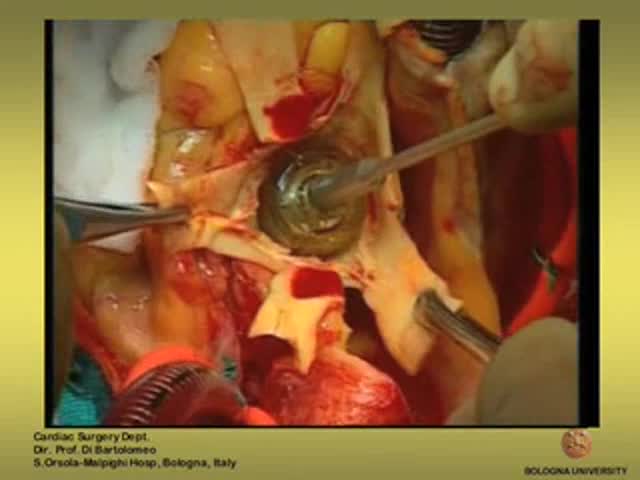
This video shows the main surgical aspects of the Bentall-De Bono procedure with a new biological composite conduit. This is the case of a 76-year-old man with ascending aorta aneurysm and aortic valve cusp calcification. The composite conduit utilized for aortic root and aortic valve replacement is a prefabricated biological valve, called BioValsalva. The tube…