Content from the Journal of the American Neurological Surgeons.
At the 2024 AATS Annual Meeting, CTSNet senior editors set out to interview the most knowledgeable CT surgeons from around the world. Stay tuned for more interviews from the meeting. CTSNet Senior Editor Jill Ley spoke with Dr. Jonathan W. Haft about his presentation on determining brain death in ECMO patients. With ECMO use on…
To begin, a standard median sternotomy was performed and both pleural spaces are widely opened. The anterior diaphragmatic attachments at the pericardium were taken down. The phrenic nerve was identified on the left side. The caudal aspect of the left sided pericardium was taken down to within a few centimeters of the phrenic nerve. Prior…
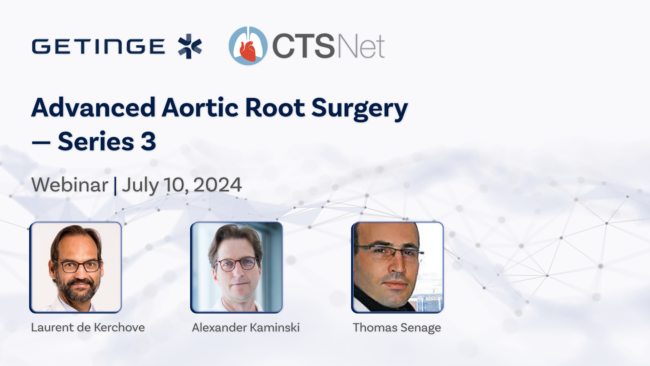
In this continued series of webinars, CTSNet hosted a discussion on, “Advanced Aortic Root Surgery—Series 3: Evolving surgical techniques with Cardioroot in Bio-Bentall and David procedures,” in collaboration with Getinge. The webinar was broadcasted to a live audience on July 10, 2024. The panel featured moderator Laurent De Kerchove (Cliniques Universitaires Saint-Luc), speaker Alexander Kaminski…
Even with the recent progress in the surgical treatment of complex diseases of the aorta, these operations remain challenging for most surgeons (1-4). Nevertheless, complex diseases of the ascending thoracic aorta (ATA), descending thoracic aorta (DTA), and the aortic arch (ARC) are associated with higher morbimortality. One-step surgical correction of these conditions with the use…
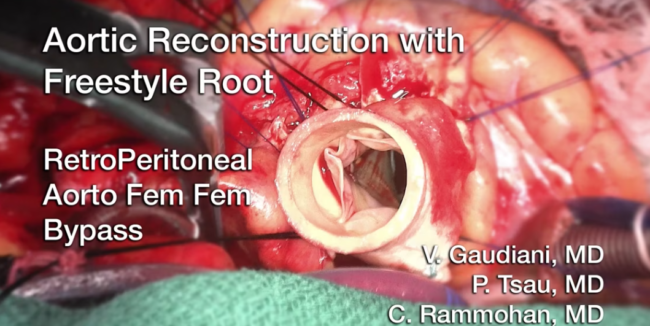
This patient had a severely calcified aorta with severe aortic regurgitation, calcified ascending aorta, and an occluded distal aorta with claudication. The aorta had to be cannulated at the back with an 18 Fr seldinger cannula due to a bank of calcium, and then the root was excised. It was measured on TEE as 17…
This video presents a forty-seven year-old woman who, when she was two years old, had a balloon valvuloplasty, then, as a teen, she had a Ross procedure. This procedure failed, so she had a freestyle biological root replacement. During the next 15 years, this developed severe calcification. The pulmonary valve had received a melody catheter…
Introduction The United States prides itself on its rich ethnic and racial diversity, a trait that is yet to be fully mirrored within the realm of cardiothoracic (CT) surgery (1). Despite the clear benefits of workforce diversity, including enhanced patient outcomes, academic achievements, and career fulfillment, CT surgery lags in accurately representing the nation’s demographic…
The Bentall procedure is a cardiac surgical operation involving composite graft replacement of the aortic valve, aortic root, and ascending aorta, with reimplantation of the coronary arteries into the graft. This technique was first described by Hugh Bentall and Antony De Bono in 1968, using a median sternotomy approach (1). To minimize surgical trauma and…
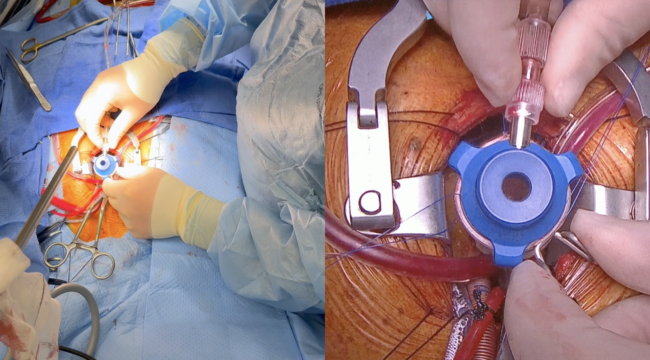
An important goal in modern cardiovascular and thoracic surgery is reducing surgical trauma to achieve faster recovery for patients. More surgeons are comfortable with aortic valve replacement via upper hemi-sternotomy or right mini thoracotomy. Naturally, there is a growing interest in performing proximal aortic surgery via a minimal access incision. This video article describes the…
While complete atrioventricular septal defect covers a wide spectrum of malformations and pathophysiologies, there are several phenotypic features common in all of them. The phenotypic features are the commonality of the atrioventricular junction, the atrioventricular valve leaflets inserted at same level of crux, unwedged and anteriorly displaced aortic valve, an elongated left ventricular outflow tract…
Learn how the unique native design of the Mosaic™ mitral valve and proper orientation help to reduce the risk for LVOT obstruction during this new educational video from Prof. Yanai Ben Gal from Tel Aviv Souraski Medical Center. Review Mosaic mitral valve risks: bit.ly/MosiacISW Disclaimer The information in this video is intended only for healthcare…
Introduction The standard of care for patients with advanced non-small cell lung cancer without mediastinal lymph node invasion is up-front surgical resection, if feasible (1). This can sometimes be difficult to achieve using a minimally invasive method due to tumor size, expected margins, invaded structures, and potential intraoperative injuries. Several authors have shown safety and…
At the 2024 AATS Annual Meeting, CTSNet senior editors set out to interview the most knowledgeable CT surgeons from around the world. Stay tuned for more interviews from the meeting. CTSNet Senior Editor Mara Antonoff spoke with Dr. Marianna Papageorge about her research on the number of diversity, equity, and inclusion (DEI)-focused presentations at major…
This is a three-year-old girl with cyanosis and clubbing. She was born with a double outlet right ventricle and a complete atrioventricular septal defect with a straddling left atrioventricular valve. She underwent an initial main pulmonary artery band but was lost to follow-up. Other associated anomalies include situs ambiguous, left isomerism with polysplenia, and interrupted…
The dogma traditionally proposed to avoid paravalvular leak is that each pair of sutures should be very close to the neighboring suture, with a maximum distance of 1 mm. This dogma was challenged with the use of only nine pairs of sutures without pledget placed equidistant along the aortic annulus, arguing that the force distribution…
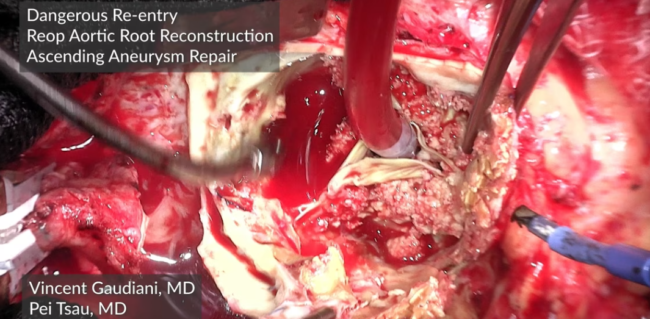
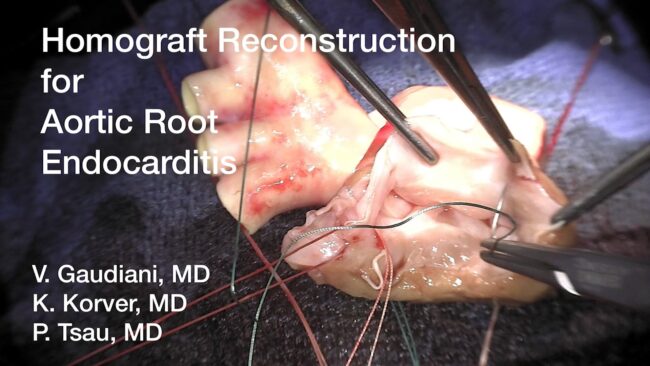
This patient had a severely calcified valve which then became infected with endocarditis with abscess cavities under the left main coronary artery and right coronary artery. To begin the procedure, the patient was placed on bypass and retrograde cardioplegia was given. The aorta was resected, and two large abscess cavities were found disrupting the aortoventricular…