Content from the Journal of the American Neurological Surgeons.
The patient is a sixty-two-year-old man who was in a motor vehicle collision that caused a thoracic spinal fracture and a refractory thoracic duct leak. The patient was initially managed conservatively with NPO, TPN, and octreotide. However, despite optimal medical treatment, the patient was still draining 1 to 3 liters of chylous fluid daily from…
At the time of publication, bedside percutaneous VA ECMO decannulations are performed exclusively with the MANTA closure device in the authors’ cardiovascular ICU. They are able to consistently deploy this device with a single attempt and achieve hemostasis with less blood loss overall than their experience with other devices. It is important to establish which…
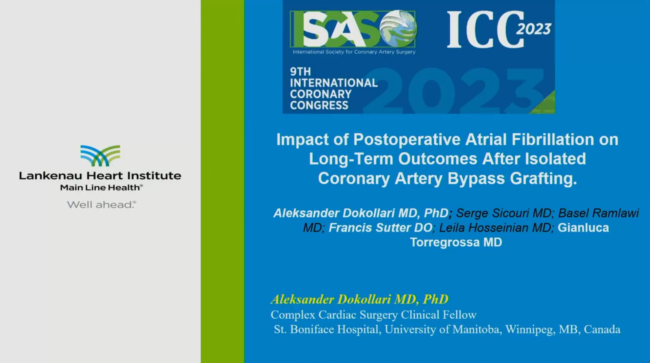
At the 2023 International Coronary Congress, 10 experts presented their abstracts on coronary artery bypass grafting. Subjects included the impact of atrial fibrillation on long-term CABG outcomes, protection of coronary arteries in pericardiectomy, a case study in robotic-assisted CABG, and more. Disclaimer The information and views presented on CTSNet.org represent the views of the authors…
This patient required a double valve replacement, but she had grade V atheroma in the ascending aorta. This meant that the patient was at very high risk of stroke if routine techniques were used. Because of the patient’s high risk of stroke, the left carotid artery was cannulated and proximally clamped. The brain was perfused…
In this video, the authors demonstrate a modified convergent procedure for refractory atrial fibrillation using intraoperative three-dimensional epicardial voltage mapping. The patient is a seventy-four-year-old man who presented with recurrent symptomatic atrial fibrillation despite maximal medical therapy and three prior catheter ablations. 3D voltage maps from the patient’s most recent preoperative catheter ablation are shown…
The patient is a sixty-two-year-old male with notable past medical history of GERD who was diagnosed with T3N1 esophageal adenocarcinoma during an endoscopy for dysphagia. Endoscopic evaluation demonstrated gross changes and luminal narrowing of the distal esophagus. A PET CT scan further showed increased uptake at the distal esophagus and was concerning for a tumor.…
Watch Dr. John Sadeghi discuss his winning video with competition judge Dr. Lana Schumacher, who is the chief of thoracic surgery at Tufts Medical Center and serves as a member of CTSNet’s board of directors. Dr. Sadeghi’s winning submission to the 2023 CTSNet Resident Video Competition, “Open Cervical and Robotic First Rib Resections for Neurogenic…
The role of subsegmentectomies in thoracic surgery is still questionable, and the literature is rare (1). The complete resection of subsegment vascular hilum, coupled with the secure preservation of adjacent hilar segment structures, particularly in anatomically variant cases, could contribute to a significant improvement in recurrence results and postoperative recovery due to greater anatomic precision…
A ten-year-old girl with history of rheumatic fever for eight years presented with worsening dyspnea upon exertion in the prior four to five months with NYHA class III heart failure. Surgeons found that the patient’s anterior mitral valve leaflet was thickened, she had a doming posterior mitral valve leaflet with restricted mobility, and she had…
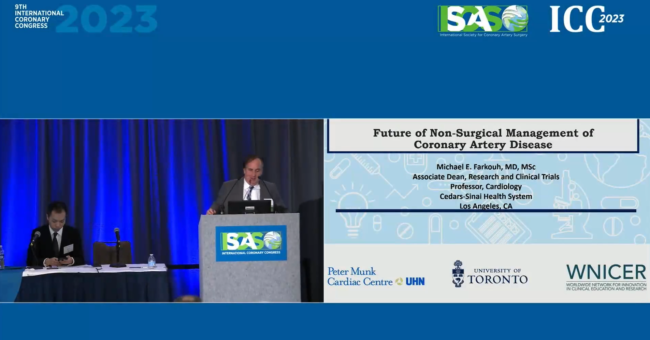
At the 2023 International Coronary Congress, five experts made presentations on hot topics in coronary surgery. Subjects included the future of non-surgical management of coronary disease, the future of coronary surgery research, new coronary guidelines, and more. The session ended with a panel discussion on guideline writing. Disclaimer The information and views presented on CTSNet.org…
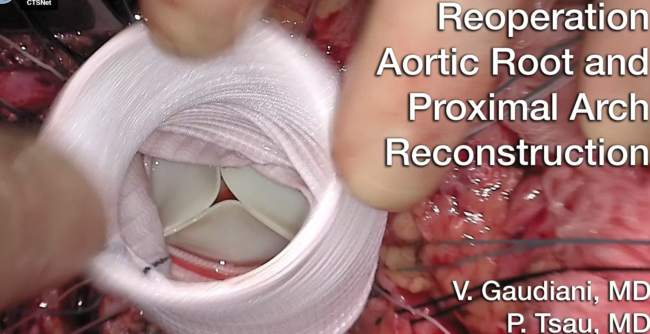
The patient is a sixty-eight-year-old man with a history of chronic aortic dissection 10 years prior to this operation, which was repaired. He had aortic regurgitation and required redo surgery. First, the right femoral vein was cannulated and the innominate artery and aorta were both cannulated separately so that the perfusion could be split. The…
Ebstein’s anomaly is a rare congenital heart malformation that accounts for about 0.5 percent of all congenital heart defects. It is characterized by downward displacement of the septal and inferior leaflets of the tricuspid valve, redundant anterior leaflets with a sail-like morphology, dilation of the true right atrioventricular annulus, tricuspid valve regurgitation, and dilation of…
Endometriosis most commonly involves the pelvis. The most common extrapelvic location of endometriosis is the thorax. Thoracic endometriosis can manifest itself as pneumothorax, hemothorax, hemoptysis, pulmonary nodules, or thoracic pain, but the most common presentation is catamenial pneumothorax. Catamenial pneumothorax symptoms usually begin 24 hours before to 72 hours after the onset of menstruation. A…
In an exclusive interview with the Society of Thoracic Surgeons first woman president, Professor Jennifer Romano, she discusses her plans for her time as president. Prof. Romano emphasizes the importance of having the conversation surrounding gender disparities in CT surgery, her collaborative study with Dr. Anna Olds on fertility and parenting in CT surgery, and…
This video describes the authors’ preferred approach to performing an ascending aorta replacement using a minimally invasive technique. The case involves a fifty-three-year-old male with a past medical history of hypertension and an ascending aorta aneurysm with increased diameter during follow up. A preoperative study showed a normally functioning bicuspid aortic valve and a nondilated…
To simplify allograft implantation, especially in a case like this where the normal aortic root anatomy was disrupted by the infection and when debridement was carried down to the LVOT muscle, the authors of this video set up three points to run three long polypropylene sutures between—the right and left trigones at the base of…