Content from the Journal of the American Neurological Surgeons.
The video begins with an interview featuring thoracic surgeon and CTSNet Editor-in-Chief Joel Dunning and Dr. Leanne Ashrafian, a cardiothoracic surgeon at Guy’s Hospital in London, United Kingdom, interviewing the author of this complex case Dr. Jakraphan Yu, a cardiothoracic surgeon at Vajira Hospital, Bangkok, Thailand. They discuss the intricacies of this case and the…
Congenital diverticulum of the ventricle is a rare cardiac malformation and is usually associated with other congenital abnormalities, including intracardiac, midline thoracic, diaphragmatic, and anterior abdominal wall defects, first described by Cantrell, Haller and Ravitch (1). In this video, the authors describe a single-stage repair of an apical left ventricular diverticulum with ventricular septal defect…
Three dimensional (3D) endoscopic aortic valve replacement combined with extended septal myectomy (the Morrow procedure) via right lateral minithoracotomy offers a safe and effective single-stage surgical solution for the rare and hemodynamically complex coexistence of severe degenerative aortic stenosis (AS) and hypertrophic obstructive cardiomyopathy (HOCM) with critical left ventricular outflow tract (LVOT) obstruction. The coexistence…
The transition toward minimally invasive cardiac surgery is no longer solely about reducing incision size; it is about creating a standardized, versatile, and sustainable concept. The direct-view transaxillary approach represents a significant evolution that is ready for widespread clinical adoption. It provides a simplified surgical setup that enhances the experience for both patients and surgeons.…
This educational video reviews the anatomy of the aorto-mitral junction and demonstrates how the aorto-mitral angle influences mitral valve geometry, surgical exposure, and repair strategy. Using a custom valve model and pathological specimens, the video illustrates the spatial relationship between the aortic valve, mitral valve annulus, and aorto-mitral continuity, highlighting the transition from traditional anatomical…
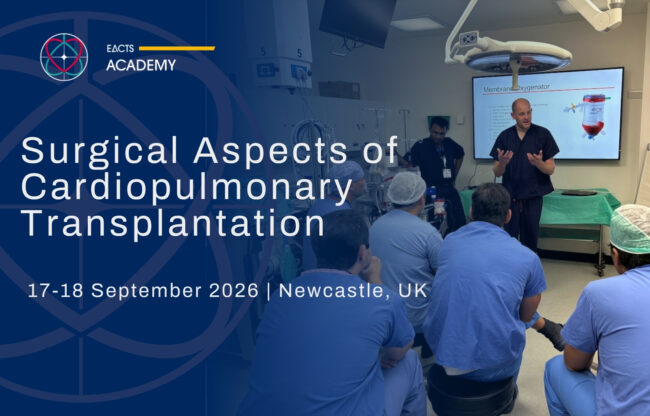
This intensive two-day course features lectures, debates, and practical hands-on sessions in a small group setting. Delegates will have the opportunity to undertake cardiac and lung transplantation in human cadavers under the guidance of a faculty of experienced surgeons and will leave with: • A deeper understanding of patient selection for heart and lung transplantation…
This cardiac session features leading surgeons presenting on robotic valves at the International Society for Minimally Invasive Cardiothoracic Surgery Annual Scientific Meeting 2026. Dr. Johannes Bonatti, Professor of Cardiothoracic Surgery and Director of Robotic Cardiac Surgery at the UPMC Heart and Vascular Institute, University of Pittsburgh, Pennsylvania, USA, opened the session with “Robotic Heart Surgery—How…
This session features leading surgeons discussing mitral valve interventions at the Transcatheter Heart Valves Greece (THVGreece) 2026 conference. Moderators Lampros K. Michalis, Professor of Cardiology, University of Ioannina, Director, 2nd Cardiology Department, University General Hospital of Ioannina, Greece; and Konstantinos Spargias, Director of the Transcatheter Heart Valves Department at Hygeia Hospital in Athens, led an esteemed…
A 69-year-old female smoker (82 pack years) was incidentally diagnosed with a left lung tumor. Imaging revealed an 18×18×10 mm lower-lobe nodule and a 24×30 mm hypermetabolic interbronchial lymph node infiltrating the upper lobe parenchyma. Positron emission tomography-computed tomography (PET-CT) showed intense uptake in both lesions (maximum standardized uptake value [SUVmax] 13.8 and 21.4). Endobronchial…
Ectopic parathyroid adenomas in the anterior mediastinum are rare and present significant diagnostic and surgical challenges. This video shows the case of a 49-year-old male with a history of hypertension who presented with severe hypercalcemia (17.9 mg/dL) and acute kidney injury. Diagnostic evaluation, including 18F-choline positron emission tomography-computed tomography (PET-CT) (1), identified an ectopic parathyroid…
This video completes a day of excellent presentations by leading surgeons exploring advanced minimally invasive techniques including congenital ventricular septal defect (VSD) surgery, endoscopic transcatheter aortic valve replacement (TAVR) explantation, multivessel minimally invasive direct coronary artery bypass (MIDCAB), and more at the International Society for Minimally Invasive Cardiothoracic Surgery Annual Scientific Meeting 2026. To begin,…
This interview highlights safer sternotomies and reducing wound complications. At the 2026 American Association for Thoracic Surgery (AATS) Annual Meeting, thoracic surgeon and CTSNet Editor-in-Chief Joel Dunning spoke with Dr. Klaudiusz Stoklosa, third year cardiac surgeon resident at McGill University, Toronto, Canada, sharing important insights on safer sternotomies. The discussion included the pathology of deep…
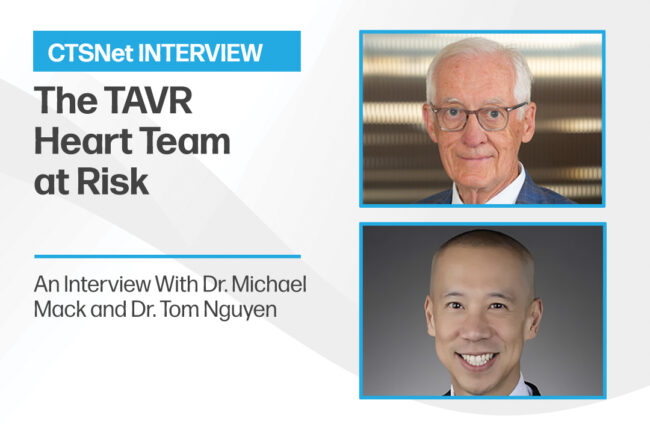
CTSNet Editor-in-Chief Joel Dunning speaks with Drs. Michael Mack and Tom Nguyen about the proposed US Centers for Medicare & Medicaid Services changes to how cardiologists and cardiac surgeons interact during transcatheter aortic valve replacement (TAVR) procedures. Dr. Mack explained the current heart team system, established in 2011 through collaboration with the US Food and…
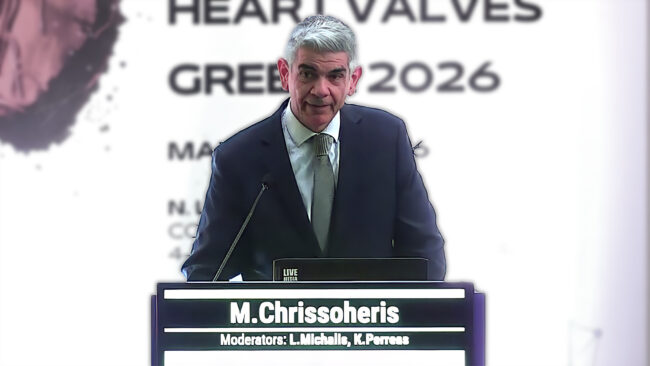
This session features leading surgeons and cardiologists discussing various aspects of assessing and planning mitral valve interventions at the Transcatheter Heart Valves Greece (THVGreece) 2026 conference. Moderators Lampros K. Michalis, Professor of Cardiology, University of Ioannina, Director, 2nd Cardiology Department, University General Hospital of Ioannina, Greece; and Konstantinos Perreas, Cardiac Surgery, Director, 1st Dept of Cardiac…
In this session, cardiothoracic surgery experts gathered to discuss AFib ablation, AF surgery strategies, and the importance of ERAS protocols. These presentations were recorded during the Ancona Minimally Invasive and Trans-Catheter Cardiac Surgery Course on May 29, 2026. Presentations: AF Ablation, LAAM, and ERAS, Part 1 Surgical Training and Strategies for Atrial Functional MR (AFMR),…
This case presents an exceptionally rare and previously unreported combination of intrinsic carotid stenosis and chronic external compression due to a retained ballistic injury. A retained stray bullet injury from 1995 remained untreated for nearly 30 years. In 2025, the patient presented with chest pain. Evaluation revealed 85 percent carotid artery stenosis. The retained bullet…