Content from the Journal of the American Neurological Surgeons.
In this video, the authors present the performance of a trisegmentectomy in the context of an anatomical variation, where the B3 bronchus arose from the lingular bronchus. They described the surgical procedure and shared technical tips to facilitate the successful completion of the operation. This was a 73-year-old patient with three nodules in the…
This video submission is from the 2025 CTSNet Innovation Video Competition. Watch all entries from the competition, including the winning videos. Initial Phases of the Procedure The surgeons began by isolating and preparing the right axillary artery. A purse-string suture was placed using 4-0 polypropylene and a size 17 needle, followed by the cannulation of the…
The authors present the case of a complex thoracoscopic segmentectomy of segments 9 and 10 of the left lower lobe in a 60-year-old male. Preoperative computed tomography (CT) imaging revealed a 1.5 cm lesion involving segments 9 and 10. Pulmonary function tests were within normal limits, and the positron emission tomography (PET) scan showed no…
The surgical operation to remove transcatheter aortic valve replacements (TAVR) and reconstruct the left ventricular outflow tract will become an increasingly important operation to perform well as more TAVRs are implanted. The initial results from performing this operation have been disappointing, with mortality rates exceeding 16 percent. More recent data showed a series with a…
On September 25, 2025, a group of esteemed cardiac surgeons gathered for a live webinar titled “Data-Driven Valve Selection for Younger AVR Patients,” presented by Artivion in collaboration with CTSNet. The panelists, S. Chris Malaisrie, MD, Jordan Bloom, MD, and Marc Gerdisch, MD, provided detailed insights into the latest AVR data and engaged in an…
This video demonstrates a multiportal, robot-assisted left segmentectomy combining the superior segment (S6) with segment S9. A 68-year-old man had a 29 mm left lower lobe mass. His medical history included orthotopic liver transplantation on lifelong immunosuppression, chronic renal insufficiency, and prior contralateral lobectomy. Preoperative function was limited (forced expiratory volume in one second [FEV1]…
Primary cardiac tumors have a very low prevalence. The most common cardiac tumor is myxoma, while the most common left ventricle (LV) mass is thrombus. The most common LV tumors are rhabdomyoma or fibroma (1). Glomus tumor or glomangioma of the left ventricle has been described but is very rare (2). The authors present a…
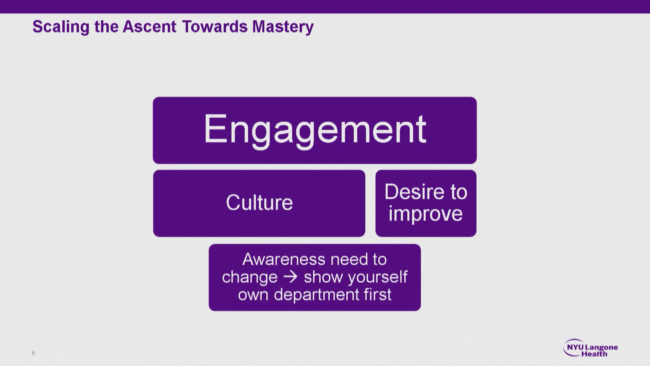
In May 2025, the International Society for Minimally Invasive Cardiothoracic Surgery brought together professionals in the field of cardiothoracic surgery to discuss and share knowledge on minimally invasive techniques. Watch for more ISMICS 2025 videos in the coming weeks. At the International Society for Minimally Invasive Cardiothoracic Surgery Annual Scientific Meeting 2025, Dr. Robert…
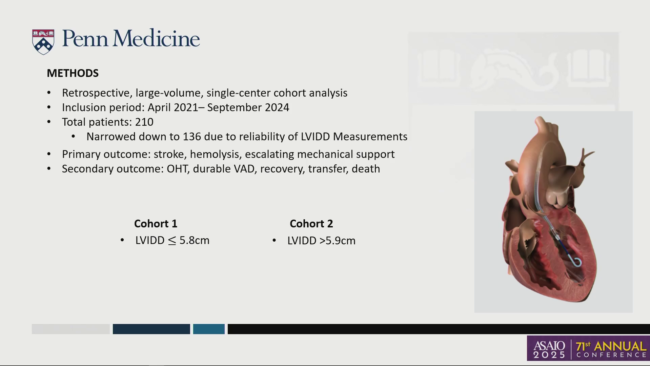
In June 2025, the American Society for Artificial Internal Organs assembled leading cardiothoracic surgeons to share insights and expertise on advanced topics in cardiothoracic surgery Watch for more ASAIO 2025 videos in the coming weeks. At the American Society for Artificial Internal Organs (ASAIO) 2025 Annual Conference, Dr. Andrew M. Acker, a cardiothoracic surgery resident at Penn…
Left atrial appendage closure has become a key point in modern cardiac surgery. On the other hand, as cardiac surgery has become increasingly less invasive, left atrial appendage closure has emerged as a more complex step in these surgeries. Numerous specialized devices have been developed as a solution. In this video, the authors show how…
This video submission is from the 2025 CTSNet Innovation Video Competition. Watch all entries from the competition, including the winning videos. The patient was a 58-year-old female diagnosed with cT3N0M0 adenocarcinoma that appeared to be potentially invading the chest wall on preoperative imaging. She was a former smoker with a history of asthma with poor pulmonary…
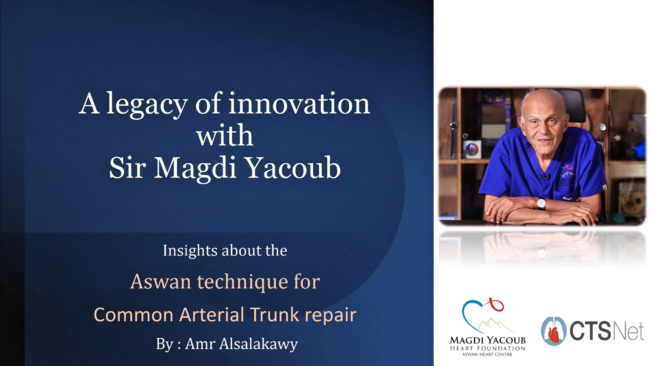
In this engaging interview, Dr. Amr Alsalakawy, a cardiothoracic surgeon at Aswan Heart Center and Research, Magdi Yacoub Foundation, spoke with Dr. Magdi Yacoub, Professor of Cardiothoracic Surgery at the National Heart and Lung Institute at the Imperial College London, and Founder and Director of Research at the Harefield Heart Science Center, Magdi Yacoub Institute,…
Vascular injuries during robotic thoracic surgery are rare but potentially life-threatening. Prompt control of bleeding is essential to avoid hemodynamic instability and the need for conversion to open surgery. This video presents a practical technique for managing vascular injuring using a collagen-based hemostatic patch while preserving the minimally invasive approach. The patch consists of an absorbable…
A 66-year-old 75 KG female presented with New York Heart Association functional classification II/III (NYHA2/3) due to moderate calcific aortic stenosis, estimated to be 60-70 percent. She had lesions in the right coronary artery (RCA) and left anterior descending artery (LAD). A computed tomography (CT) scan of the thorax showed a calcified arch and a…
This case demonstrated the repair of a recurrent left atrioventricular valve regurgitation via a repeat right axillary thoracotomy in a two-year-old girl who had previously undergone repair of a partial atrioventricular (AV) canal 10 months prior. The patient was positioned in a modified left lateral decubitus position, with the right side up and the…
Introduction Endovascular arch repair is a progressive growth technique that has developed over the last 10-15 years, although open surgery remains the gold standard. Clinical Case This case involved a 67-year-old male with coronary disease and severe left ventricle (LV) depression. Computed tomography (CT) showed a penetrating aortic ulcer at zones 2 and…