Content from the Journal of the American Neurological Surgeons.
Patient Details A fifteen-year-old boy with a past medical history of asthma presented with sudden onset chest pain and orthopnea. Imaging workup in the emergency department included a chest X-ray that suggested a mediastinal mass. (A cardiac CT was initially deferred given the patient’s clinical stability.) Advanced cardiac imaging with MRI was chosen for superior…
This video shows step-by-step footage of a mitral valve replacement with a SAPIEN 3 balloon expandable valve. Surgeons used a minithoracotomy approach to treat a calcified mitral annulus. In this case, portions of the anterior leaflet and calcified papillary muscles were resected to create more space for the replacement valve and prevent left ventricular outflow…
February is Heart Health Month in the United States—a time when the country focuses on cardiovascular health and raises awareness of heart disease as the nation’s number one cause of death. But heart health is a major issue worldwide. Nearly 75 percent of the world’s population lacks access to safe, timely, and affordable cardiac surgery…
1. JANS: Major TAVI Studies Have ‘Methodological Issues,’ INTEGRITTY Group Contends The controversy surrounding major TAVR versus SAVR studies has received no shortage of documentation, and this definitive study raised key questions about the integrity of their methodology while not directly discrediting them. Stay tuned for CTSNet’s coverage of this developing discussion. 2. Negative Pressure…
This video illustrates how to achieve rapid hemostasis following the removal of an intra-aortic balloon pump (IABP), using a percutaneous vessel repair device. This is particularity important in patients who are anticoagulated and prone to difficult adequate hemostasis. The procedure and IABP removal can be performed bedside, in the intensive care unit, or in the…
During the 2023 59th Annual STS Meeting, Professor Marc Gerdisch, Chief of Cardiac Surgery at the Franciscan Health Heart Center, was kind enough to sit down with CTSNet Associate Editor Jill Ley to share insight into his contribution to the meeting’s ‘Contemporary Perioperative Management’ program. Dr. Gerdisch Presented on the topic of “Increasing Mobility After…
Watch as Steven Bolling M.D., Joanna Chikwe M.D., and Pieter Kappetein M.D. discuss several cases of mitral valve prolapse and their repair techniques during a Global Grand Rounds session. Disclaimer The information in this video is intended only for healthcare professionals in countries where these Medtronic products and therapies are approved or available for use.…
All cardiac surgeons have found themselves spending several hours in the operating room for hemostasis, in particular after complex interventions such as aortic dissection and aortic arch replacement with deep hypothermia. Very often the surgeon wonders what should be done: Continue with hemostasis? Try to close the sternum? Leave the sternum open? The first step…
The patient is a young woman without comorbidities presenting with a single 15 mm colorectal metastasis located between S9 and S10, requiring a combined segmentectomy for sufficient margin. The patient was first integrated in a midday multidisciplinary outpatient clinic Enhanced Recovery After Surgery (ERAS) program, including ERAS nurse counselling, with a video simulation, physiotherapy education,…
Loretta Erhunmwunsee is a surgeon-scientist at City of Hope Medical Center in Duarte, California. She splits her time between surgically treating patients with thoracic malignancies and researching health inequity. These interests come together in her effort to build evidence that structural inequities lead to thoracic oncologic disparities. Dr. Erhunmwunsee attended Emory University for her undergraduate…
This patient is an eight-week-old, 4.6 kg infant who was diagnosed postnatally with cor triatriatum dexter and a patent foramen ovale. A follow-up was recommended at that time, as she was asymptomatic. She presented at eight weeks of age with intermittent cyanosis. She had no prior surgical or significant medical history. A preoperative chest X-ray…
Only fifty-one cases of isolated anomalous systemic arterial supply to normal lung (ISSNL) have been reported in English literature (1). The anomalous systemic artery usually arises from the descending thoracic aorta, but rarely from the abdominal aorta. In this article and accompanying video, a rare case of an anomalous artery occurring from the right inferior…
The patient featured in the video below is a fourteen-year-old boy who came to emergency room with fever and shortness of breath. He had no history of previous respiratory disorders and no antenatal or postnatal diagnosis of congenital pulmonary airway malformation (CPAM)—a rare presentation in the adolescent population. A chest X-ray was done, revealing a…
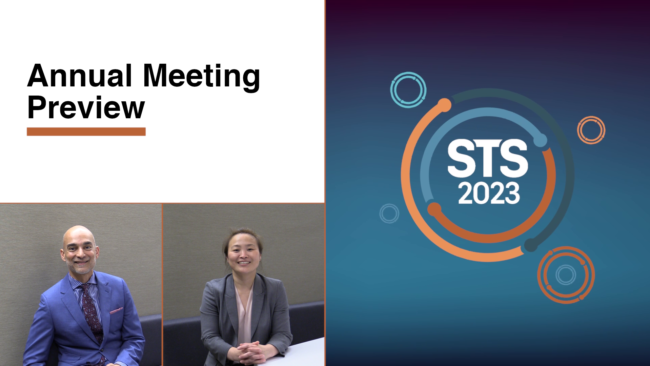
In just one week, the 59th Annual STS Meeting will commence in San Diego, California from January 21–23. In this highly anticipated return to in-person programs and discussions, the STS Workforce on Annual Meeting has been making great preparations to showcase late-breaking abstracts, challenging case presentations, immersive experiences, new scientific studies, and unique surgical techniques.…
The patient featured in this video is a twenty-four-year-old woman with past medical history of intravenous drug abuse, ADHD, anxiety, depression, hepatitis C, PTSD, and morbid obesity, with a BMI of 31. She was admitted in February and April 2022 for recurrent tricuspid valve endocarditis. Blood cultures were positive for S. aureus, and a transthoracic…
Robotic surgery is very rarely considered for trauma cases. In this unique case, the patient came from an outside hospital with a gunshot through the thorax and suffered an isolated midtracheal injury with minor lung lacerations. After thorough assessment, the decision was made to perform a robotic repair with veno-venous ECMO for support. The…