Content from the Journal of the American Neurological Surgeons.
This article is part of CTSNet’s Guest Editor Series, “Right Axillary Thoracotomy for Repair of a Wide Variety of Congenital Heart Defects in Infants and Children—Should This Be the New Standard?” Guest Editor Dr. Sameh Said has curated a robust collection of content that shares the knowledge, techniques, and insights of several distinguished experts from…
This article is part of CTSNet’s Guest Editor Series, “Right Axillary Thoracotomy for Repair of a Wide Variety of Congenital Heart Defects in Infants and Children—Should This Be the New Standard?” Guest Editor Dr. Sameh Said has curated a robust collection of content that shares the knowledge, techniques, and insights of several distinguished experts from…
This article is part of CTSNet’s Guest Editor Series, “Right Axillary Thoracotomy for Repair of a Wide Variety of Congenital Heart Defects in Infants and Children—Should This Be the New Standard?” Guest Editor Dr. Sameh Said has curated a robust collection of content that shares the knowledge, techniques, and insights of several distinguished experts from…
In the newest CTSNet Guest Editor Series, “Right Axillary Thoracotomy for Repair of a Wide Variety of Congenital Heart Defects in Infants and Children—Should This Be the New Standard?” Dr. Sameh Said brought together congenital cardiac surgery experts from around the world to contribute procedure videos on right axillary thoracotomy for repair of congenital heart…
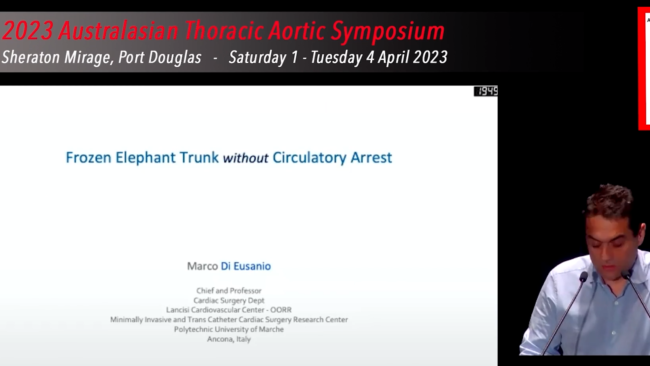
As a part of the 2023 Australian Thoracic Aortic Symposium, Dr. Marco Di Eusanio presented on frozen elephant trunk without circulatory arrest. Dr. Di Eusanio is a cardiothoracic surgeon at Lancisi Cardiovascular Center and Politechnic University of Marche in Ancona, Italy. View Dr. Di Eusanio’s CTSNet profile for more of his articles and videos on…
A ten-month-old, 9.4 kg infant with heterotaxy syndrome presented with cyanosis. The cardiac diagnosis was a double outlet right ventricle with complete atrioventricular septal defect and multilevel right ventricular outflow tract obstruction. Other multiple anomalies included dextrocardia, situs inversus, interrupted inferior vena cava with azygous continuity to a left superior vena cava (SVC), malposed great…
This video demonstrates aortic arch debranching without the usage of cardiopulmonary bypass. In this case, the debranching was performed on a sixty-one-year-old male smoker who was diagnosed with type B aortic dissection three months prior, and presented to the emergency department with chest pain and an enlarging thoracic dissecting aneurysm. Computed tomographic angiography confirmed that…
New techniques and technologies are constantly being developed in surgical treatment for lung cancer. These recent CTSNet videos demonstrate some of the most popular and innovative techniques, including uniportal VATS resection, robotic assisted lobectomy, and surgical management of rare and complex lung cancers. 1. Uniportal VATS Sleeve Resection of the Bronchus IntermediusBy Rihards Mikilps-Mikgelbs, Ints…
This video discusses the management of a complication of device closure for ruptured sinus of Valsalva. The patient was a twenty-seven-year-old man. He was evaluated for a sudden onset of palpitations for three months and diagnosed with a ruptured sinus of Valsalva and right coronary cusp opening into the right ventricular outflow tract by echocardiography.…
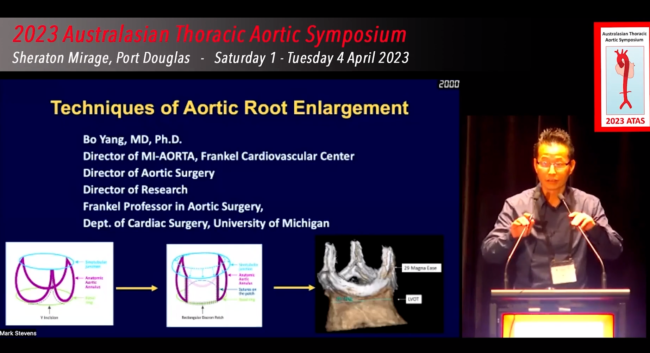
As a part of the 2023 Australian Thoracic Aortic Symposium, Dr. Bo Yang presented on his techniques for aortic root enlargement. Dr. Yang is the director of aortic surgery at the University of Michigan and was the international guest presenter at symposium. For more from Dr. Yang, see also the recent CTSNet webinar he participated…
Cerebral malperfusion is a known complication of type A acute aortic dissection, which is linked to considerable perioperative mortality and morbidity. This article presents a case of Stanford acute type A aortic dissection (ATAAD) successfully managed by early percutaneous fenestration, transluminal angioplasty of the right carotid artery, and emergency central aortic repair of the ATAAD.…
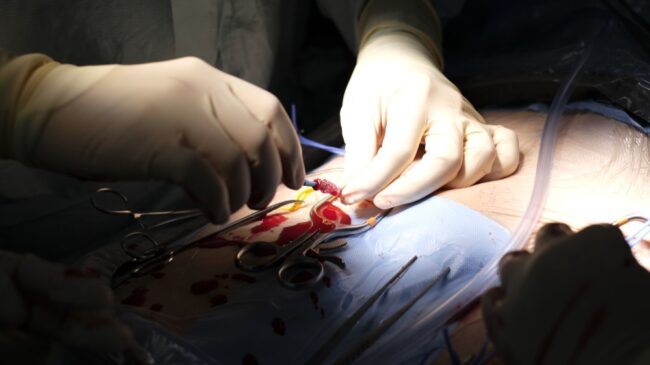
The right axillary artery (AX) has been the authors’ standard cannulation site for elective aortic arch repair, acute aortic dissection repair, or complex redo aortic or cardiac cases (1,2). To begin the procedure, a 4-5 cm transverse skin incision is made approximately 1 cm below the middle and lateral part of the right clavicle (deltopectoral…
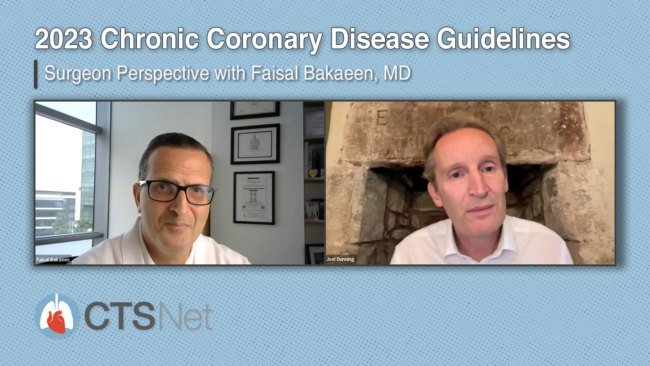
In response to the release of the updated 2023 AHA/ACC/ACCP/ASPC/NLA/PCNA Guideline for the Management of Patients With Chronic Coronary Disease, authors representing the AATS and STS came together to write a rebuttal explaining their perspective on the controversial guidelines. In an interview with CTSNet Editor in Chief Joel Dunning, revascularization specialist and AATS representative Dr.…
The patient is a sixty-seven-year-old woman, nonsmoker, with a history of ocular myasthenia gravis and a strong family history of autoimmune disease. First, a chest CT scan was performed, which demonstrated two nodular opacities in the anterior mediastinum, the largest measuring 5.9 mm. Given the concern for thymoma, the presence of mild to moderate myasthenia…
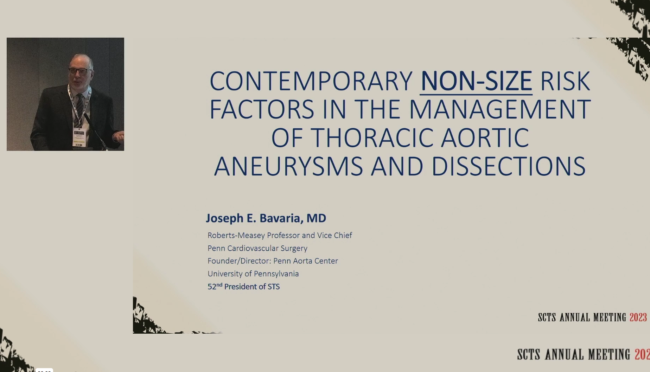
In March 2023, the Society for Cardiothoracic Surgery in Great Britain and Ireland brought together surgeons from around the world to discuss topics in CT surgery. In this talk, Dr. Joe Bavaria discusses risk factors in the management of thoracic aortic aneurysms and dissections that do not have to do with the size of the…
In March 2023, the Society for Cardiothoracic Surgery in Great Britain and Ireland brought together surgeons from around the world to discuss topics in CT surgery. This recording covers the session on innovative mitral valve surgical techniques. Use the time stamps on the video to direct yourself to each surgeon’s discussion. Imaging in Mitral Valve…