Content from the Journal of the American Neurological Surgeons.
This is the seventh session of the 4th International Conference for Sublobar Resections and Evolving Techniques for Lung Cancer, held in January 2023. It includes talks from five experts from the U.S., UK, Denmark, and France discussing target localization and preoperative diagnosis. Target Localization and Preoperative Diagnosis for Sublobar Resesction: Background Can We Get Rid…
As a part of Session 7 of the 4th International Conference for Sublobar Resections and Evolving Techniques for Lung Cancer, Dominique Gossot presented on the transition from maximal access to minimal access and maximal resection to minimal resection in sublobar resection. Disclaimer The information and views presented on CTSNet.org represent the views of the authors…
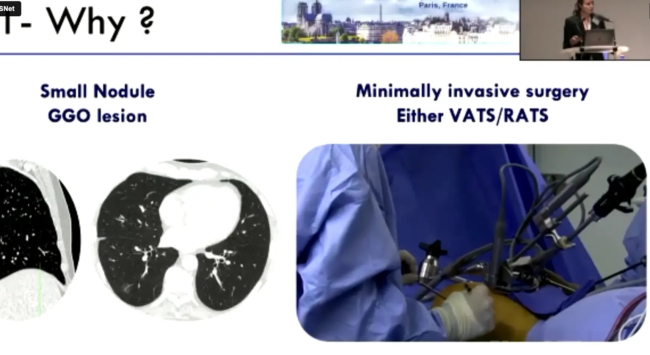
As a part of Session 7 of the 4th International Conference for Sublobar Resections and Evolving Techniques for Lung Cancer, Agathe Seguin-Givelet of Paris, France presented on endobronchial localization for sublobar resection. Disclaimer The information and views presented on CTSNet.org represent the views of the authors and contributors of the material and not of CTSNet. Please…
As a part of Session 7 of the 4th International Conference for Sublobar Resections and Evolving Techniques for Lung Cancer, Rene Petersen of Copenhagen, Denmark presented on percutaneous localization for sublobar resection. Disclaimer The information and views presented on CTSNet.org represent the views of the authors and contributors of the material and not of CTSNet. Please…
As a part of Session 7 of the 4th International Conference for Sublobar Resections and Evolving Techniques for Lung Cancer, Tim Batchelor of London presented on the question of the necessity of preoperative diagnosis. Disclaimer The information and views presented on CTSNet.org represent the views of the authors and contributors of the material and not…
As a part of Session 7 of the 4th International Conference for Sublobar Resections and Evolving Techniques for Lung Cancer, Robert Cerfolio of New York presented on the background of target localization and preoperative diagnosis for sublobar resection. Disclaimer The information and views presented on CTSNet.org represent the views of the authors and contributors of…
This video presents minimally invasive, off-pump mitral valve repair with the NeoChord DS1000 system. This is an innovative device that implants multiple sets of Gortex PTFE neochords onto the prolapsing segment of the posterior mitral valve leaflet. This hybrid operation was performed under TEE guidance and beating heart conditions. The patient in this video is…
During a recent visit to Moi University in Eldoret, Kenya, Dr. Mimi Ceppa met key stakeholders for a potential expansion of a multidisciplinary esophageal and thoracic surgery program in relation to the Academic Model as a Pathway to Healthcare (AMPATH) program. This consortium of North American universities, led by the Indiana University School of Global…
A three-week-old, 2.5 kg neonate who presented with heart failure symptoms and a systolic murmur was found to have anomalous origin of the left main coronary artery from the pulmonary artery. An echocardiogram showed severe left ventricular dysfunction with a dilated left ventricle and moderate to severe mitral valve regurgitation. The decision was made to…
This is the sixth session of the 4th International Conference for Sublobar Resections and Evolving Techniques for Lung Cancer, held in January 2023. It includes talks from three experts from Italy, Canada, and Japan discussing intersegmental plane management. Delineation of the Intersegmental Plane: An Overview by Rossella Potenza Delineation of the Intersegmental Plane by IR…
As a part of Session 6 of the 4th International Conference for Sublobar Resections and Evolving Techniques for Lung Cancer, Masaaki Sato of Tokyo, Japan presented on the challenge of intersegmental plan delineation and division for basilar segmentectomies. Disclaimer The information and views presented on CTSNet.org represent the views of the authors and contributors of…
As a part of Session 6 of the 4th International Conference for Sublobar Resections and Evolving Techniques for Lung Cancer, Wael C. Hanna of Hamilton, Canada presented on delineation of the intersegmental plane using infrared imaging. Disclaimer The information and views presented on CTSNet.org represent the views of the authors and contributors of the material…
As a part of Session 6 of the 4th International Conference for Sublobar Resections and Evolving Techniques for Lung Cancer, Rossella Potenza of Perugia, Italy presented an overview of delineation of the intersegmental plane. Disclaimer The information and views presented on CTSNet.org represent the views of the authors and contributors of the material and not…
The pathophysiology and evidence in terms of long-term management of post-COVID-19 respiratory symptoms and pulmonary sequelae remain poorly understood and data regarding thrombotic lung lesions are still lacking. Patients with post-COVID-19 pulmonary fibrosis may present with dyspnea, dry cough, and oxygen desaturation. Reduced diffusion capacity for carbon monoxide and a restrictive pattern are the most…
Prof. Bo Yang first described a Y-incision rectangular patch aortic annular enlargement technique, and it is one of the posterior aortic annular enlargement techniques that is simpler than giving 3 to 4 valve size enlargements. This group renamed it after Prof. Yang, with his consent, as the Yang procedure. The Patient The patient is a…
The patient is a forty-six-year-old man with a history of a bicuspid aortic valve. He underwent a transcatheter aortic valve replacement (TAVR) two and a half years prior for symptomatic aortic stenosis at an outside hospital. He presented with increasing shortness of breath, fatigue, and lightheadedness. An echocardiogram identified severe prosthetic aortic valve stenosis with…