Content from the Journal of the American Neurological Surgeons.
At the 2025 Endoscopic Cardiac Surgeons Club Annual Meeting, CTSNet Senior Editor Dr. Lorena Montes conducted insightful interviews with leading cardiothoracic surgeons from around the world. Stay tuned for more interviews from the meeting. At the 2025 Endoscopic Cardiac Surgeons (ECS) Club Annual Meeting, CTSNet Senior Editor Dr. Lorena Montes spoke with Dr. Patrick Perier, chairman of…
Branch-first arch replacement is a method for aortic arch repair that allows for continuous brain and organ perfusion. It theoretically has the potential for improved outcomes by reducing or avoiding circulatory arrest and maintaining warmer temperatures. This technique was pioneered by George Matalanis and others in 2005. This presentation focused on the technical aspects of…
In this final series installment, Perfecting TAVR Removal | Skills Sharpening With Vince Gaudiani, cardiac surgeon and CTSNet Senior Editor—Education Vince Gaudiani hosted roundtable discussions on the technical aspects of aortic valve replacement after TAVR. Dr. Gaudiani reviewed the details of the nine videos that are a part of this series and answered questions from the…
This video submission is from the 2025 CTSNet Innovation Video Competition. Watch all entries from the competition, including the winning videos. The authors present a novel technique utilizing an endoloop to assist in the secure and efficient ligation of the left atrial appendage (LAA) using a clip-based approach. This method provides enhanced control and positioning during clip deployment, especially…
This video outlines the surgical technique of beating heart transplantation using the Organ Care System (OCS). It details the preparation of the donor heart, cannulation, and the steps involved in transferring the heart from the OCS to the recipient. Traditionally, donor hearts require two cardioplegic arrests: once during removal from the deceased donor and again…
This video is part of Dr. Vince Gaudiani’s Anomalous Right Coronary Artery Series. View more videos from this series here. This video demonstrates a case involving an anomalous right coronary artery (RCA). The patient, a man who collapsed at an amusement arcade, had an anomalous vessel discovered after resuscitation. He also presented with a large aorta.…
This video submission is from the 2025 CTSNet Innovation Video Competition. Watch all entries from the competition, including the winning videos. Atrial fibrillation (AFib) is the most common sustained arrhythmia encountered in clinical practice, and the left atrial appendage (LAA) is recognized as the predominant source of thromboembolic events in nonvalvular AFib . Therefore, left atrial appendage occlusion (LAAO)…
Introduction Minimally invasive closure of atrial septal defects (ASD) can be safely achieved using a range of techniques. In pediatric patients, femoral cannulation can be difficult due to the small caliber of their vessels. Peripheral cannulation is convenient but carries risks of retrograde dissection, embolization, stroke, and ipsilateral limb ischemia. Central aortic cannulation has…
In this video, the authors present an urgent case of atrial septal defect (ASD) in a young patient. The percutaneous ASD closure device migrated into the main pulmonary artery, creating a life-threatening situation. The surgeons performed emergency surgery to carefully remove the device and reconstruct the pulmonary artery using a Dacron patch, followed by the…
Each month, thoracic surgeon and CTSNet Senior Editor Leanne Ashrafian spotlights unique surgical cases in cardiothoracic surgery through this Case of the Month series. For more videos in this series, click here. In this first episode of the Case of the Month, thoracic surgeon and CTSNet Senior Editor Leanne Ashrafian is joined by CTSNet Editor-in-Chief Joel Dunning to discuss “The Case…
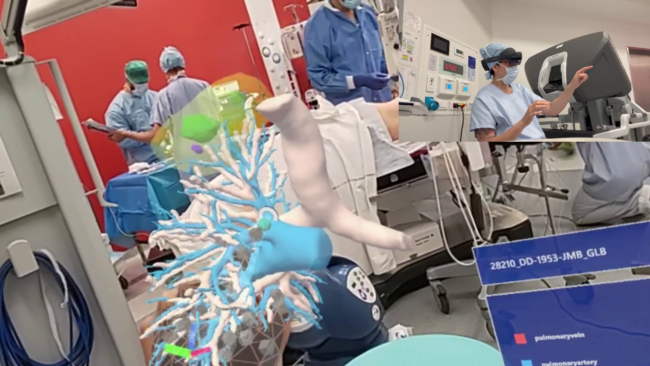
This video submission is from the 2025 CTSNet Innovation Video Competition. Watch all entries from the competition, including the winning videos. The integration of mixed reality (MR) into robotic thoracic surgery represents a transformative step toward enhanced precision, safety, and standardization in complex procedures. By merging 3D planning with MR tools and advanced imaging platforms, surgeons can interact with…
In the attached video, a technique for robotically implanting a partial mitral annuloplasty band is described. It was important to anchor the band to the medial and lateral trigones and to appropriately space the band so that the center mark aligned with the middle of the posterior leaflet. Several techniques may be used to improve…
This video submission is from the 2025 CTSNet Innovation Video Competition. Watch all entries from the competition, including the winning videos. This video shows the different discussions between the surgeon and the proctor that were made possible thanks to teleproctoring in a complex robotic-assisted thoracic surgery (RATS) case. A 66 -year-old patient with a metachronous squamous cell carcinoma originating…
Patient Selection This 42-year-old female patient with seropositive myasthenia gravis was receiving treatment with oral prednisone and pyridostigmine. She presented with persistent generalized weakness. Imaging revealed a 9 cm lobulated mass in the right anterior mediastinum. Magnetic mesonance imaging (MRI) indicated a predominantly cystic lesion with soft tissue nodules, highly suspicious for thymoma, without evidence…
This video submission is from the 2025 CTSNet Innovation Video Competition. Watch all entries from the competition, including the winning videos. Nowadays, despite strong evidence of the benefits of concomitant atrial fibrillation ablation during cardiac surgery, this condition is widely undertreated. One reason for this is that ablation often requires opening the left atrium or extensive dissection around the…
A 30-year-old man underwent a Bentall procedure (mechanical prosthesis) for aortic root aneurysm and bicuspid aortic valve at the age of 20. Subsequently, at the age of 28, he had a spontaneous type B aortic dissection, which was treated medically. He was followed with serial computed tomography angiography (CTA) and was found to have expansion…