Content from the Journal of the American Neurological Surgeons.
Patient Selection Three-field dissection (TFD) for squamous cell carcinoma of the esophagus has been practiced by Japanese surgeons since the early 1980’s. Several reports, exclusively from Japan, showed that approximately one third of patients had previously unsuspected metastases to the cervical nodes. In 1997, we initiated a small pilot trial to evaluate the feasibility of…
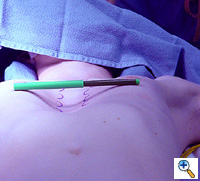
Patient Selection Figure 1. The typical appearance of a pectus excavatum deformity. Pectus excavatum, a relatively commonly occurring congenital chest wall deformity in children, is a depression of the sternum that commonly starts at the angle of Louis, and is deepest at the xiphisternal junction [1] (Figure 1). When severe, pectus excavatum deformity can cause…
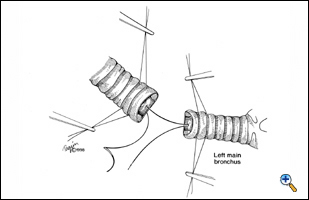
Patient Selection The most common indication for carinal resection is a neoplasm (benign or malignant) involving the carina. The neoplasm may be primarily tracheal, arise from the carina itself, or extend from the lung to involve the carina. All patients must be rigorously screened for metastatic disease and medical contraindications to such extensive surgery. A…
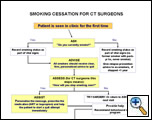
Since a substantial number of patients presenting to a Cardiothoracic Surgery Clinic either smoked in the recent past or continue to do so, it is important to make sure that the patient stops smoking as soon as possible to improve their treatment outcome. The emphasis should be on improvement of treatment outcome and future health…
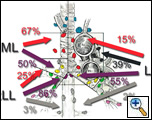
The majority of patients selected for VATS mediastinal nodal dissection are patients undergoing VATS lobectomy procedures for malignancy. Patient Selection The majority of patients selected for VATS mediastinal nodal dissection are patients undergoing VATS lobectomy procedures for malignancy. Nodal drainage patterns have been described and are depicted in Figures 1 & 2 [1]. All ipsilateral…
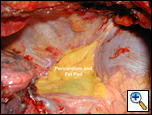
Buttressing suture/staple lines in thoracic surgery has been shown to promote healing and prevent breakdown, especially in situations where the native tissues have been compromised. There are a wide variety of tissue flaps that have been used within the chest ranging from pleura, muscle, to omentum. Patient Selection Figure 1: Buttress of esophageal suture line…
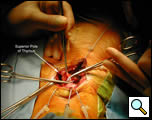
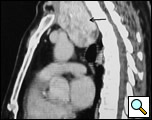
Thymectomy for myasthenia gravis, thymic cysts, thymoma less than two centimeters in size, and mediastinal parathyroid adenoma within the thymus are all indications for a video-assisted extended transcervical thymectomy. Patient Selection Figure 1: CT scan of the chest with arrow pointing out the thymus gland. Thymectomy for myasthenia gravis, thymic cysts, thymoma less than two…
Epiphrenic diverticuli are acquired mucosal outpouchings protruding through the muscular wall of the distal 10 cm of the esophagus. Most are associated with an underlying esophageal motility disorder. Patient Selection Epiphrenic diverticuli are acquired mucosal outpouchings protruding through the muscular wall of the distal 10 cm of the esophagus [1]. Most are associated with an…
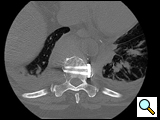
Patient Selection The initial selection is performed by the spine surgeon for typical indications of spine stabilization, resection of tumor, drainage of an abscess, and re-operation for complications of previous spine surgery [1-3]. The transthoracic approach (thoracotomy) affords the spine surgeon excellent visualization and access to the anterior thoracic spine, the vertebral bodies, intervertebral disks,…
Several surgical approaches have been described for the management of adult patients with acquired heart disease and paraductal coarctation of the aorta. Options are a staged procedure using median sternotomy and left thoracotomy, a catheter-based intervention of the coarctation combined with sternotomy, and single-stage simultaneous correction of lesions via sternotomy. Patient Selection Several surgical approaches…
Stainless steel wires are currently used for median sternotomy closure in cardiac and general thoracic surgery; this method is safe, effective, and fast. However, the wires can damage and cut bone during respiratory and chest motion. A novel sternal reinforcement device has been designed to prevent wires cutting into the bone. Stainless steel wires are…
Unilateral diaphragmatic agenesis is a rare diagnosis typically made early in infancy and generally associated with other genetic anomalies. We present an unusual case of adult onset progressive shortness of breath and peripartum hepatic herniation into the chest, which on intraoperative exploration revealed diaphragmatic agenesis. IntroductionUnilateral diaphragmatic agenesis is a rare diagnosis typically made early…
Introduction Intrathoracic goiters are encountered less often today than they were in previous decades. Nonetheless, they are still considered a diagnostic possibility in all anterosuperior mediastinal masses, particularly in Eastern Europe and Asia. Creswell and Wells [1] in 1992 reported that intrathoracic thyroid masses accounted for 5.8% of all mediastinal masses. For an intrathoracic thyroid,…
Patient Selection Currently, only patients with preexisting, paroxysmal atrial fibrillation undergoing OPCAB have been offered an adjuvant off-pump Maze procedure. Patients with previous thromboembolism or warfarin complication, as well as those with palpitations or antiarrythmic drug intolerance are offered this therapy when undergoing concomitant OPCAB. Patients with long standing atrial fibrillation are currently not candidates…
ABSTRACT Ten-year old child presented with recurrent hemoptysis and a bout of massive hemoptysis. Chest radiography and computerized tomography revealed a soft tissue mass in the right lower lobe. Emergency right lower lobectomy revealed echinococcal cyst as the cause of the exsanguinating bleed. PRESENTATION In the evening of July 1, 2005 a ten-year old child…
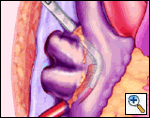
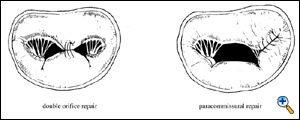
Patient Selection The edge-to-edge technique is a method to treat mitral valve regurgitation by suturing the edges of the leaflets at the site of regurgitation. Although the method is technically simple, its application should follow a few rules to ensure effective and durable results, and to avoid complications. The most critical issue is to avoid…