Content from the Journal of the American Neurological Surgeons.
“If I have seen further, it is by standing on the shoulders of giants.” –– Isaac Newton, 1675 Disclaimer The information and views presented on CTSNet.org represent the views of the authors and contributors of the material and not of CTSNet. Please review our full disclaimer page here.
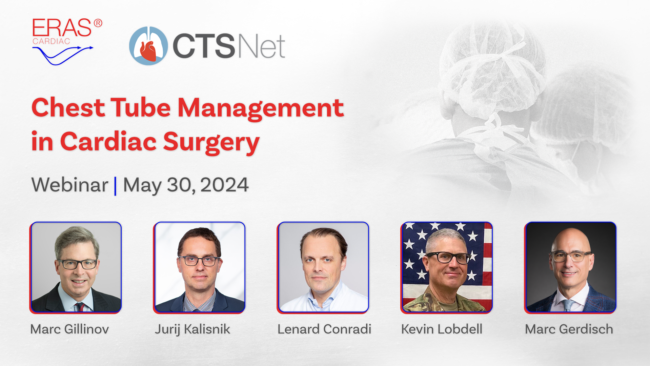
ERAS Cardiac Society once more conducted a joint webinar with CTSNet on May 30, 2024, bringing about presentations, discussion, and questions on, “Chest Tube Management in Cardiac Surgery.” The session included presentations from Dr. Marc Gillinov, Dr. Jurij Kalisnik, and Dr. Lenard Conradi, with Dr. Kevin Lobdell and Dr. Marc Gerdisch serving as the webinar’s…
This video presents a robotic diaphragm plication procedure using the Versius robotic surgical system. The patient is a fifty-eight-year-old man with a history of mitral valve regurgitation who underwent mitral valve repair surgery in June 2022. Following surgery, he experienced progressive dyspnea on exertion and imaging revealed an elevated left hemidiaphragm. Evaluation included a transthoracic…
This video shows the case of a patient in Ghana who underwent a redo sternotomy and then a Bentall’s operation for a dilated aortic root with severe regurgitation. The patient was thought to have only aortic regurgitation four years prior, when only a transthoracic echocardiogram was available to surgeons. Upon opening the chest in this…
A seven-month-old, 8.5 kg infant was followed clinically for a large ventricular septal defect (VSD) until an echocardiographic evaluation raised concerns regarding aortic valve (AV) regurgitation secondary to a new prolapse of the aortic cusps into the large defect. The combination of a large subaortic VSD, AV cusp (especially the right and/or non-coronary cusps) prolapse,…
The Patient The patient is a seventy-two-year-old male with stage 3 chronic kidney disease, a BMI of 35, and prior RCA stent placement who presented with symptomatic severe aortic stenosis and a CT angiogram demonstrating aneurysmal dilation of the aortic root and ascending aorta. The CTA highlighted the 4.5 cm sinus of Valsalva, 4.5 cm…
At the 2023 International Coronary Congress, four surgeons presented their biggest mistakes in CABG surgery and how they went about fixing them. They emphasized the importance of surgeons sharing their mistakes so others can learn from them. After the presentations, the participants engage in a discussion with audience members on each case. Disclaimer The information…
This video demonstrates the construction of a felt Dacron plug, which was used to close the ventriculotomy in the left ventricle following explantation of a Heart Mate 3 LVAD device. The plug was constructed with material which is readily available in most operating theatres. The method for creating this plug was simple and thus should…
This young patient had his aortic dissection missed on multiple occasions. First, he experienced classic symptoms described in this video. He then underwent a CT angiogram and 3D reconstruction that missed the large dissection cavity. Finally, he was identified as having this large abnormality but was unable to undergo the complex surgery in his home…
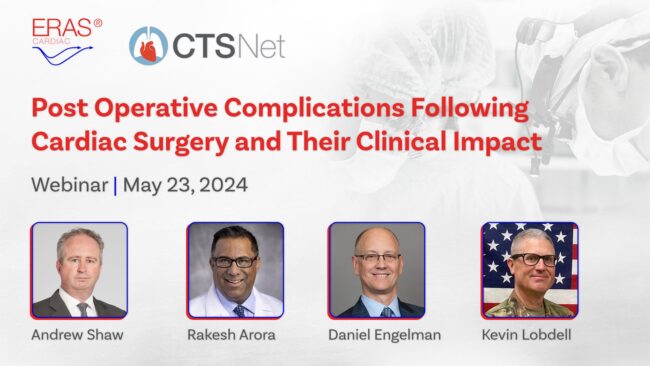
ERAS Cardiac Society conducted a joint webinar with CTSNet on May 23, 2024, bringing about pivotal insights and questions on the topic, “Post Operative Complications Following Cardiac Surgery and Their Clinical Impact.” The session included presentations from Dr. Andrew D. Shaw and Dr. Rakesh C. Arora, with Dr. Daniel Engelman and Dr. Kevin Lobdell serving…
In this case, a four-month-old infant presented with cardiogenic shock. He had previously undergone repair of coarctation of the aorta through left thoracotomy at one month old. An aortogram revealed mild anatomical narrowing at the repair site with no gradient across the anastomoses. Aortic root injection revealed that the left anterior descending artery and circumflex…
The authors have been using left innominate vein cannulation for SVC drainage in mitral valve surgery instead of direct cannulation of the SVC or right atrium for more than 20 years. Advantages include improved access to the left atrium with no need for special pericardial retraction stitches for visualization of the entire mitral valve, and…
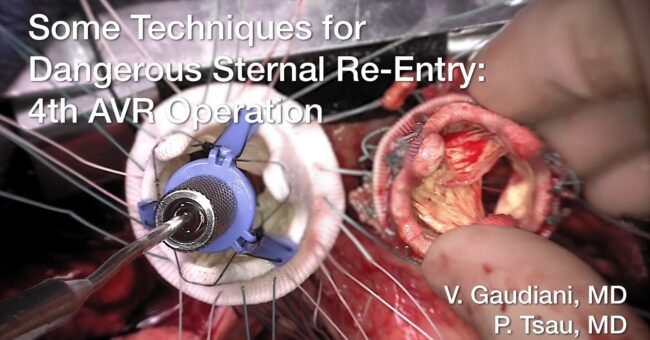
This video details how to enter the sternum when patients have undergone previous sternotomy. This patient was having his fourth sternal reentry and the CT scan showed the aorta was right next to the back of the sternum. First, the femoral vessels were cannulated. Most importantly, the carotid artery was accessed and a 14 Fr…
In this video, the authors present their technique with modifications to the peroral endoscopic myotomy for Zenker’s diverticulum (Z-POEM). They believe this leads to increased effectiveness, safety, and durability of results. The patient is a sixty-nine-year-old man with a significantly symptomatic Zenker’s diverticulum as shown on a preoperative barium swallow. The patient had limited mouth…
An aberrant right subclavian artery is the most common embryological abnormality of the aortic arch and is known clinically as arteria lusoria. In the case of this patient, there was complete absence of the brachiocephalic trunk and the right subclavian was seen branching distal or to the left of the left subclavian artery. To supply…
In an interview with legendary cardiothoracic surgeon Professor J. Donald Hill, CTSNet Allied Health Editor Jill Ley and Prof. Hill discuss his impact as a surgeon, mentor, and leader in the field. They talk about some of Prof. Hill’s own mentors in his early career, his most impactful accomplishments, and his ongoing interest in developing…