Content from the Journal of the American Neurological Surgeons.
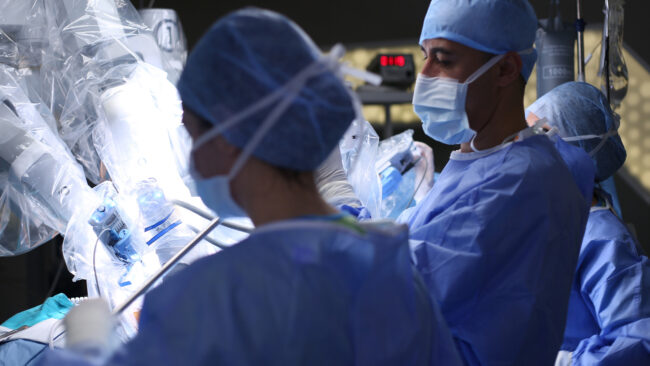
This is the winning thoracic video from the 2025 CTSNet Instructional Video Competition. Watch all entries from the competition, including the cardiac and congenital first place winners. Click here to watch Dr. Edward Kim’s interview with CTSNet Editor-in-Chief Joel Dunning. This video showcases a complex, robot-assisted intrapericardial pneumonectomy with bronchoplasty and thymic flap reinforcement in a…
The authors present the case of a 40-year-old male with no prior medical history who reported progressive dysphagia to solids over several months. Imaging with CT and MRI revealed a submucosal esophageal lesion consistent with leiomyoma. The patient underwent a right-sided robot-assisted thoracoscopic surgery (RATS) for tumor resection. Intraoperative methylene blue test showed no mucosal…
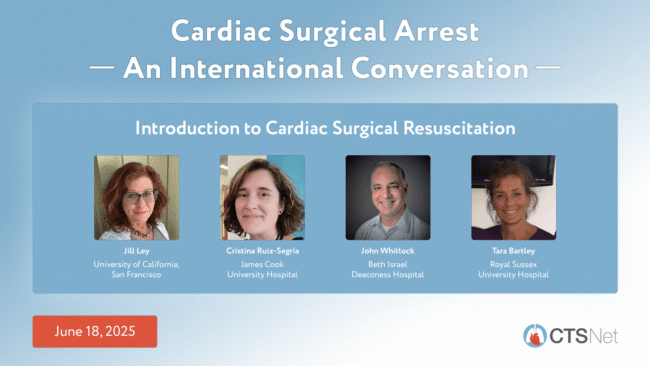
This ongoing discussion of cardiac surgical resuscitation (CSR/CALS) management is a five-part series led by CTSNet Senior Editor—Clinical Care Providers Jill Ley, Nurse Educator at Essentials of Cardiac Surgical Resuscitation, featuring a panel of international experts including Tara Bartley, Corporate Lead for Advanced Practice, University Hospitals Sussex; Cristina Ruiz Segria, Surgical Care Practitioner, James Cook…
This is the winning cardiac video from the 2025 CTSNet Instructional Video Competition. Watch all entries from the competition, including the thoracic and congenital first place winners. Click here to watch Dr. Anthony Zaki’s interview with CTSNet Editor-in-Chief Joel Dunning. Postcardiotomy cardiogenic shock presents a complex clinical challenge that demands prevention, timely recognition, and early consideration…
Robert Chesley Lowery Jr. was born on October 7, 1949. He was the first in his family to pursue higher education, earning a Bachelor of Science in Zoology from California State University at Los Angeles in 1972. He went on to earn a Doctor of Medicine from the University of San Francisco in 1976. While…
This video is part of the Pulmonary Arterial Reconstruction Series. Click here to explore more videos in this series. This case demonstrated a repeat sternotomy for unifocalization of a residual major aortopulmonary collateral artery (MAPCA) and relief of right ventricular outflow tract obstruction by reconstruction of the right pulmonary artery and conduit rereplacement. A…
This video showcases a totally endoscopic mitral valve replacement (TE-MVR) using a transcatheter device in a patient with a history of mitral commissurotomy. The procedure was performed using a minimally invasive, port-access approach, ensuring precision and reducing surgical trauma. The patient, who had previously undergone mitral commissurotomy, presented with severe mitral valve dysfunction, necessitating valve…
The patient, a 60-year-old male, had previously undergone aortic root replacement due to aortic insufficiency and a bicuspid valve. He suffered from increasing exertional dyspnea. Echocardiography revealed recurrent severe aortic insufficiency, secondary moderate-to-severe mitral insufficiency with marked leaflet tenting, and severe tricuspid insufficiency (pulmonary artery pressure: 70 mmHg). His medical history included heart failure with…
In March 2025, the Society for Cardiothoracic Surgery in Great Britain and Ireland held its annual meeting, bringing together professionals in the field of cardiothoracic surgery to discuss the latest advancements in technologies and techniques. Watch for more SCTS 2025 videos in the coming weeks. At the Society for Cardiothoracic Surgery in Great Britain…
The patient was a 61-year-old male with no significant medical or surgical history who presented with symptomatic diaphragm paralysis. A fluoroscopic study demonstrated left hemidiaphragm elevation with paradoxical motion, consistent with diaphragmatic paralysis. Similarly, computed tomography (CT) of the chest revealed chronic elevation of the left hemidiaphragm with compressive atelectasis. Preoperative clearance included pulmonary function…
This video is part of CTSNet’s 2024 Resident Video Competition. Watch all entries into the competition, including the winning videos. The authors present the case of a 67-year-old patient who was referred to their institution with a one week history of fever and malaise. The patient had a past medical history of aortic valve replacement with…
A 43-year-old female patient was referred to the hospital for evaluation with complaints of chronic cough that worsened while eating. Her medical history was uneventful other than a few episodes of right-side pneumonia during childhood. Computed tomography (CT) imaging raised the suspicion of a tracheoesophageal fistula (TEF)10 cm proximal to the bifurcation of the trachea.…
This video is part of CTSNet’s 2024 Resident Video Competition. Watch all entries into the competition, including the winning videos. Catamenial pneumothorax (CP) can be defined as a recurrent spontaneous pneumothorax occurring within 24-72 hours of menses. CP is a common manifestation of thoracic endometriosis and is most commonly seen in women between the ages of…
A 35-year-old physically active female patient presented with exertional dyspnea and was referred from the otolaryngology department with a diagnosis of intrathoracic multinodular goiter. The CT scan illustrated a diffuse multinodular goiter with marked intrathoracic extension of the right thyroid lobe, forming a mass measuring approximately 89 x 63 x 62 mm. The goiter produced…
This video is part of CTSNet’s 2024 Resident Video Competition. Watch all entries into the competition, including the winning videos. A 29-year-old male presented with nausea, vomiting, and abdominal pain. He had a recent history of a traumatic motorcycle accident one month prior. In the emergency room, he was found to have concerns for a left-sided…
A 64-year-old male presented with complaints of severe dyspnea on minimal exertion, lower extremity edema, and weakness. The patient had a history of long-term atrial fibrillation (AF). Echocardiography revealed reduced left ventricular ejection fraction, moderate to severe aortic valve stenosis with a mean gradient of 31 mmHg, and an aortic valve area (AVA) of 0.9…