Content from the Journal of the American Neurological Surgeons.
The complexity of cardiac surgery precludes its application via minimally invasive approaches compared to other surgical specialties. Despite these complexities, minimally invasive cardiac surgery (MICS) has been applied in procedures such as coronary artery bypass grafting (CABG), valve repairs and replacement (1), and, more recently, for congenital heart defects (CHD) (2). This case provides insight into…
Materials and Methods A 56-year-old male with a history of systemic hypertension presented with dyspnea on exertion, classified as New York Heart Association (NYHA) Class III for one month. C linical examination revealed an apex beat located at the fifth left interspace outside the midclavicular line, along with slightly reduced air entry in the left hemithorax. …
This short video demonstrates how to correct sternum asymmetry in the Nuss procedure using a Gigli saw. It is often very difficult to correct asymmetry, even with costal compression sutures and the Park Pectus System, but Professor Hyung Park previously demonstrated this technique, in which the sternum was divided just before it started to angulate,…
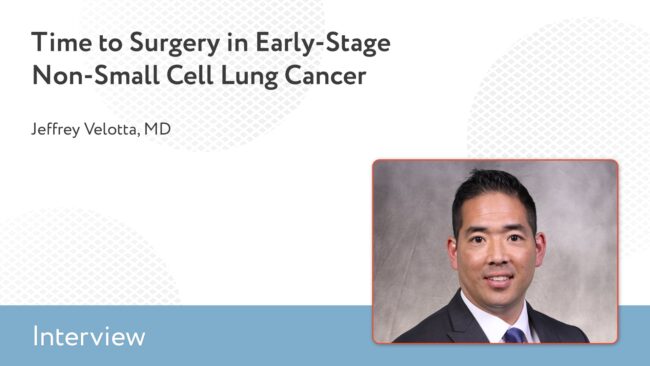
CTSNet Editor-in-Chief Dr. Joel Dunning recently had the opportunity to speak with Dr. Jeffrey Velotta, thoracic surgeon at Kaiser Permanente Oakland Medical Center, regarding his paper, Time to Surgery in Early-Stage Non-Small Cell Lung Cancer: Defining the Optimal Diagnosis-to-Resection Interval to Reduce Mortality. Their discussion covered the key takeaway messages from the study and the…
Enlarging Axillary Incision The axillary incision was enlarged in two ways. First, a horizontal conversion to a posterolateral approach was performed based on previous pen markings. Additionally, a vertical downward enlargement was made to reach the selected chest drain location. Use of Right Atrial Appendage The right atrial appendage was utilized by placing a…
In this video, viewers will learn how to construct an autologous pericardial mitral valve for infants and small children when repair is not possible. The technique offers a durable solution by utilizing the patient’s own living tissue, thereby avoiding the risks of degeneration and calcification associated with chemically treated or prosthetic valves. While some long-term…
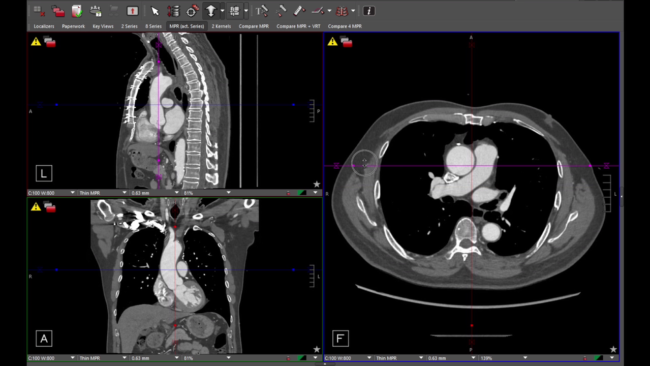
This video submission is from the 2025 CTSNet Instructional Video Competition. Watch all entries from the competition, including the winning videos. This video aims to provide the basics of obtaining accurate aortic dimensions. Aortic surveillance is critical for the early detection and lifelong monitoring of aortic disease, enabling appropriately timed treatments that can prevent life-threatening complications.…
Redo tricuspid valve replacement (TVR) is a technically demanding and high-risk surgical procedure, especially in patients with prior cardiac operations and multiple comorbidities. This case report outlines the use of an annular-preserving explantation technique utilizing electrocautery to safely remove a degenerated bioprosthetic tricuspid valve. The report emphasizes surgical planning, intraoperative management, and the patient’s postoperative…
This video submission is from the 2025 CTSNet Instructional Video Competition. Watch all entries from the competition, including the winning videos. In this video, the authors examined surgical techniques related to the mitral valve. They demonstrated how to assess the mitral valve, how to place annular sutures, how to implant Gore-Tex neochord, and how to…
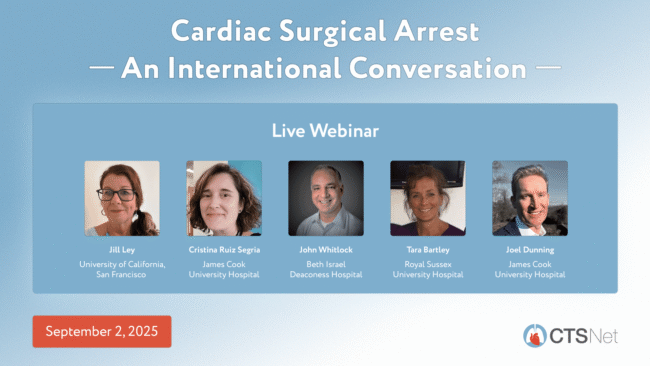
In the final installment of the CTSNet video series, Cardiac Surgical Arrest—An International Conversation, Nurse Educator Jill Ley, founder of Essentials of Cardiac Surgical Resuscitation, was joined in a webinar panel discussion by clinical care providers from the United Kingdom and the Unites States. The discussion focused on exploring the optimal management of cardiac surgical…
Currently in its 32nd year, the Birmingham Review Course is the longest-running course in the cardiothoracic specialty. The 2025 course promises an immersive learning experience featuring didactic lectures and interactive seminars on cardiac and thoracic topics, along with opportunities to engage with an international faculty. The 2025 Birmingham Review Course will take place from September…
In June 2025, the American Society for Artificial Internal Organs assembled leading cardiothoracic surgeons to share insights and expertise on advanced topics in cardiothoracic surgery. Watch for more ASAIO 2025 videos in the coming weeks. At the American Society for Artificial Internal Organs (ASAIO) 2025 Annual Conference, Dr. Clauden Louis, cardiothoracic surgeon at the Cardiothoracic Surgery BayCare…
This video presents the case of a 79-year-old male with an unpredictable adhesive process in the pericardium, which was discovered during an elective totally endoscopic mitral valve replacement with tricuspid valve repair. The patient was diagnosed with severe multiple comorbidities, including stage four chronic kidney disease (CKD G-4) and chronic obstructive pulmonary disease (COPD), along…
This video submission is from the 2025 CTSNet Instructional Video Competition. Watch all entries from the competition, including the winning videos. Aortic valve repair and valve-sparing aortic root replacement are excellent approaches to treating aortic root aneurysm and severe aortic regurgitation when valve repair is feasible (1, 2). Congenitally abnormal supra-commissural coronary ostia are rare conditions;…
The strategies and approaches to cardiopulmonary bypass (CPB) access have evolved as surgeons gain experience in minimally invasive cardiac surgery (MICS) procedures. Femoral artery cannulation is convenient but carries risks of retrograde dissection, embolization, stroke, and ipsilateral limb ischemia. In contrast, central aortic cannulation has the advantage of antegrade flow. An incision was made 1…
This video submission is from the 2025 CTSNet Instructional Video Competition. Watch all entries from the competition, including the winning videos. This video illustrates the approach for closing an atrial septal defect (ASD) via a right lateral thoracotomy. A transesophageal echocardiogram (TEE) revealed a large atrial septal defect approximately 3 cm in diameter lacking an aortic…