Content from the Journal of the American Neurological Surgeons.
Ivor Lewis esophagectomy is occasionally required in patients who have previously undergone gastric surgery. A technique is described to salvage a gastric conduit by preserving the left gastric pedicle during esophagectomy. Background Gastric reconstruction of the esophagus following esophagectomy typically requires division of the left gastric pedicle to attain sufficient length for an esophagogastric anastomosis1.…
A unique approach to surgical repair of descending thoracic aortic saccular aneurysm due to penetrating atherosclerotic ulcer is described in a very high-risk patient with severe peripheral and cerebrovascular occlusive disease, coronary artery disease, chronic renal failue and COPD. This video is available in the CTSNet China Resource Center for CTSNet users who are unable…
A 42-year-old man with chronic obstructive pulmonary disease (COPD) presented to the emergency department (ED) complaining of worsening shortness of breath and respiratory distress. His home oxygen requirement was 2 liters by nasal canula, and he has had multiple prior hospital admissions for respiratory failure. Patient Presentation A 42-year-old man with chronic obstructive pulmonary disease…
Introduction Pericardial cysts are an uncommon benign congenital anomaly in the middle mediastinum. They represent 6% of mediastinal masses, and 33% of mediastinal cysts. Other cysts in the mediastinum are bronchogenic – 34%, enteric – 12%, thymic and others – 21%[1]. In the middle mediastinum 61% of presenting masses are cysts[1]. Pericardial and bronchogenic cysts…
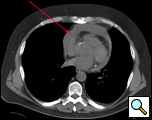
Hemodynamically stable patients with an undiagnosed pericardial effusion are well suited for a thoracoscopic window. When pericardial, pleural, or pulmonary pathology co-exist and require diagnosis or therapy, a thoracoscopic approach is ideal. Patient Selection Figure 1. CT scan showing pericardial effusion. Hemodynamically stable patients with an undiagnosed pericardial effusion are well suited for a thoracoscopic…
On May 30, 2010 the field of cardiovascular surgery, physicians and friends mourned the loss of a mentor, colleague and friend. Kit Arom died in Bangkok on this day after a long battle with pancreatic carcinoma. Born Kitipan Visudharom, Kit came to the United States to do his internship at the University of Kentucky and…
Repair of generalized mitral prolapse associated with Barlow’s valves has been difficult with resectional techniques. This video, presented at the 2004 STS meeting, illustrates a simple non-resectional method of using multiple Gore-Tex artificial chords to repair generalized prolapse associated with Barlow’s Syndrome. Two chords are positioned in both papillary muscles initially, and after ring placement,…
For purposes of this survey, readers were asked to assume that they were consulted on a hospitalized middle aged patient who has been diagnosed with stage IV non-small cell lung cancer. The patient has shortness of breath in the absence of an important pleural effusion. There is no endobronchial obstruction and there is no…
The latest survey on CTSNet content in the Thoracic Portal provides important information as to what users find effective and what new content they would like to see. Clinical practice is most influenced by Experts’ Techniques and by clinical videos. Clinical knowledge is most influenced by current literature. New features that users would most…
This survey was posted during October 2006. There were 117 responses to this survey, with the majority of surgeons living in North America and Europe. Just over half of physicians use PET routinely for evaluating N2 disease. One third of physicians use PET only when mediastinal or hilar lymph nodes are abnormal on CT.…
The survey on management of giant paraesophageal hernia produced more concensus than most prior surveys. The respondents were asked to consider the case of an elderly female who was diagnosed with a large (>50% of stomach in the chest) type III (esophagogastric junction has migrated into the chest) paraesophageal hernia. The patient had early…
Management of Achalasia Home » Thoracic » Survey Results Respondents were asked to assume for purposes of this survey that the patient is a 40 yo male with a 12 month history of symptoms compatible with achalasia. There is no evidence that he has Chagas’ disease. The diagnosis has been confirmed with endoscopy, contrast esophagram,…
Prophylaxis and Management of Arrhythmias After Thoracic Surgery Home » Thoracic » Survey Results This survey was designed to help inform readers about current practices in prophylaxis for and management of supraventricular arrhythmias after major thoracic surgery. Participants were asked to respond to questions regarding perioperative management of thoracic surgery patients. They were asked to…
The survey for the Thoracic Portal addressed an important topic in the management of non-small cell lung cancer. Patients with NSCLC are at increased risk for perioperative deep venous thrombosis. The results of this survey will help inform the practicing surgeon about how other surgeons manage this challenging clinical situation. The questions related to…
Management of Perioperative Anticoagulation Readers were asked to respond to questions regarding a clinical scenario in which a patient for major lung resection had coronary stents placed prior to surgery. The results were interesting, demonstrating a fair amount of variability in the management of this situation and a surprisingly liberal attitude towards the use of…
Management of Malignant Pleural Effusion READER COMMENTS View/Add Comments Home » Thoracic » Survey Results This survey was based on the scenario that participants were asked to consult on a hospitalized middle-aged patient who has been diagnosed with stage IV non-small cell lung cancer with a symptomatic uniloculated unilateral malignant pleural effusion (MPE). Most of…