Content from the Journal of the American Neurological Surgeons.
This video submission is from the 2025 CTSNet Instructional Video Competition. Watch all entries from the competition, including the winning videos. This case involves a 62-year-old male patient who underwent valve-sparing aortic root replacement (the David procedure) in combination with two-vessel coronary artery bypass grafting. Preoperative transthoracic echocardiography revealed a dilated aortic root with preserved left…
A 45-year-old female with a body surface area (BSA) of 1.68 m² (weight: 64 kg, height: 154 cm) presented with a one-year history of progressively worsening dyspnea, classified as New York Heart Association (NYHA) Class III. She also reported symptoms of chest heaviness and presyncope. At the time of admission, the patient was hemodynamically stable,…
This interview features the thoracic winner of the 2025 CTSNet Instructional Video Competition. Watch the winning videos and all other competition entries. CTSNet Editor-in-Chief Joel Dunning spoke with Dr. Edward Kim, a cardiothoracic surgery resident at Tufts Medical Center in Boston, about his winning video, “Robot-Assisted Intrapericardial Pneumonectomy With Bronchoplasty and Thymic Flap Post Neoadjuvant Chemo/IO.” They discussed the…
This interview features the cardiac winner of the 2025 CTSNet Instructional Video Competition. Watch the winning videos and all other competition entries. CTSNet Editor-in-Chief Joel Dunning spoke with Dr. Anthony Zaki, a cardiac surgeon at the Cleveland Clinic, about his winning video, “Direct Aortic Impella 5.5 in Post-Cardiotomy Shock.” They discussed the specifics of the surgery, highlighting the advantages of…
This case involves a 72-year-old man with a past medical history of end-stage lung disease due to chronic obstructive pulmonary disease who was on 2-3 liters nasal cannula at home. He was admitted to an outside hospital with acute-on-chronic respiratory failure with worsening exercise intolerance. Despite being on maximum noninvasive oxygen support (high flow oxygen…
In this fascinating interview, CTSNet Editor-in-Chief Joel Dunning speaks with Dr. Joseph Zacharias, a consultant cardiothoracic surgeon at the Lancashire Cardiac Center in Blackpool, England, discussing lifetime management of heart valve disease. They delve into Dr. Zacharias’s recent paper titled “Lifetime Management of Heart Valve Disease—Treat It Early and Treat It Right, First Time,” and…
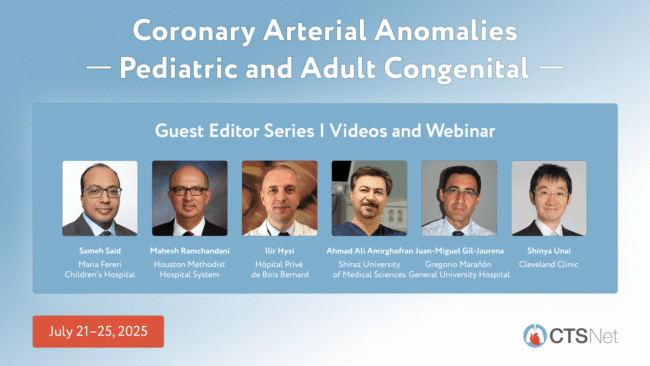
In the final installment of the CTSNet Guest Editor Series, Coronary Arterial Anomalies—Pediatric and Adult Congenital, congenital surgeon and CTSNet Senior Editor Professor Sameh Said was joined by pediatric and adult cardiac surgeons from around the world for a panel discussion on coronary arterial anomalies and different surgical techniques used to manage them. Dr. Said…
Currently in its 32nd year, the Birmingham Review Course is the longest-running course in the cardiothoracic specialty. The 2025 course promises an immersive learning experience featuring didactic lectures and interactive seminars on cardiac and thoracic topics, along with opportunities to engage with an international faculty. The 2025 Birmingham Review Course will take place from September…
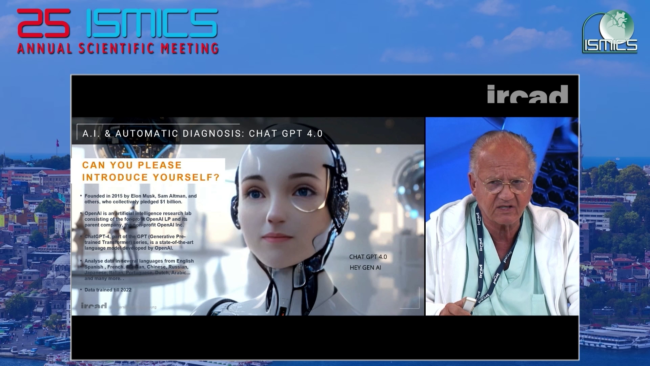
In May 2025, the International Society for Minimally Invasive Cardiothoracic Surgery brought together professionals in the field of cardiothoracic surgery to discuss and share knowledge on minimally invasive techniques. Watch for more ISMICS 2025 videos in the coming weeks. At the International Society for Minimally Invasive Cardiothoracic Surgery Annual Scientific Meeting 2025, Dr. Jacques…
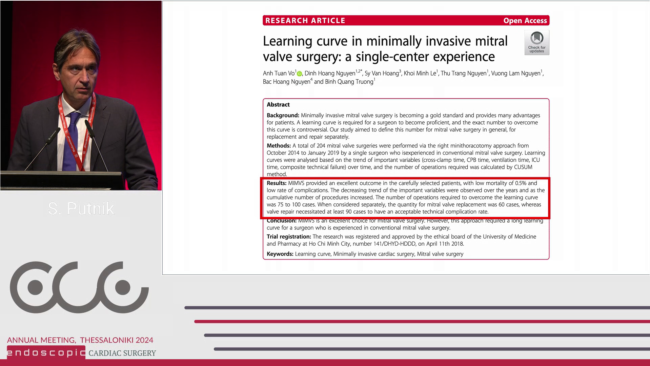
The Endoscopic Cardiac Surgeons Club is dedicated to raising global awareness of the benefits of endoscopic cardiac surgery among patients, surgeons, and industry partners. Stay tuned for more ECSC videos in the coming weeks. At the Endoscopic Cardiac Surgeons Club Meeting 2024, Dr. Svetozar Putnik, Director of Cardiac Surgery at the University Clinical Center of Serbia,…
This case describes a robotic left atrial appendage occlusion (LAAO) performed at a specialized institution that receives patients who are poor candidates for percutaneous left atrial appendage (LAA) devices. These include individuals with contraindications to oral anticoagulation (OAC) therapy commonly due to active gastrointestinal bleeding or patients with failed previous device attempts. The robotic LAAO…
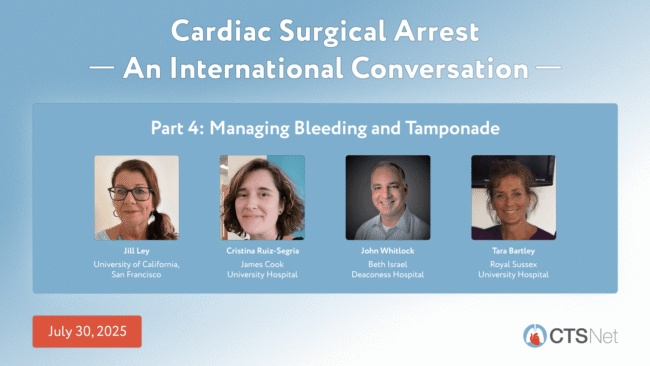
This ongoing discussion of cardiac surgical resuscitation (CSR/CALS) management is a five-part series led by Jill Ley, Nurse Educator at Essentials of Cardiac Surgical Resuscitation. The series features a panel of international experts including Tara Bartley, Corporate Lead for Advanced Practice, University Hospitals Sussex; Cristina Ruiz-Segria, Surgical Care Practitioner, Jame Cook University Hosptial; and John…
Typical carcinoids are low-grade tumors that can be localized in the large airways, often growing on the bronchial bifurcations. Their main treatment method is surgical resection. Guidelines and previous experience in the treatment of such tumors show that complete tumor resection allows for excellent survival rates (1, 2). With the development of minimally invasive surgical…
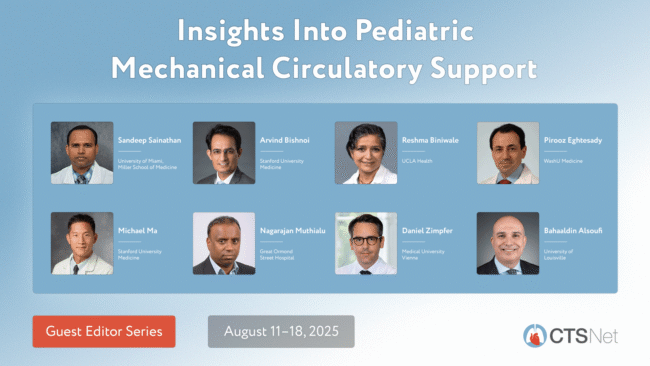
In this CTSNet Guest Editor Series, Insights Into Pediatric Mechanical Circulatory Support, congenital and pediatric surgeon Sandeep Sainathan invited accomplished pediatric surgeons from around the world to contribute clinical videos on the surgical aspects of pediatric mechanical circulatory support as a bridge to cardiac transplantation or recovery of cardiac function. The clinical videos featured in this six-part…
This video submission is from the 2025 CTSNet Instructional Video Competition. Watch all entries from the competition, including the winning videos. The authors present the first robotic lung resection following neoadjuvant therapy at their institution. This case involved a female patient who presented with a partial clinical response to right upper lobe adenocarcinoma. Intraoperatively, there was…
This video submission is from the 2025 CTSNet Instructional Video Competition. Watch all entries from the competition, including the winning videos. This video presents the surgical management of an aorto-left ventricular tunnel (ALVT) in an 11-month-old infant, a rare congenital anomaly characterized by an abnormal extracardiac communication between the ascending aorta and the left ventricular cavity.…